Douglas Aircraft Company
SBD Dauntless
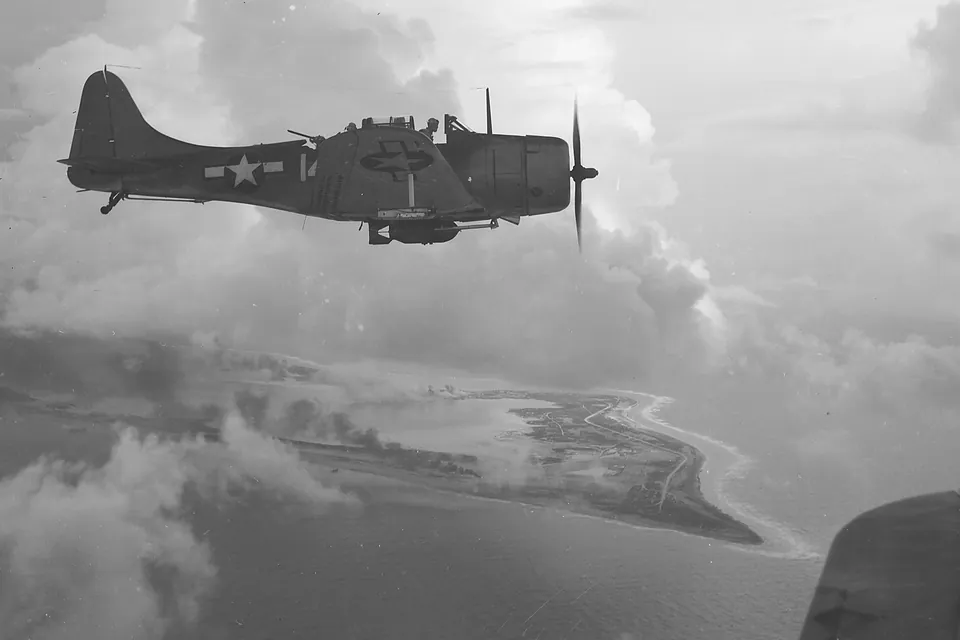
The SBD Dauntless was a two-seat, carrier-capable scout/dive bomber produced by Douglas Aircraft Company for the United States Navy and Marine Corps from 1940-1944. It served as the U.S. sea-service's principal carrier dive bomber during the critical 1942 campaign cycle, delivering decisive attacks at Coral Sea and Midway with 1,000-lb bombs. The aircraft later transitioned to sustained land-based operations at Guadalcanal, demonstrating adaptability from carrier strike doctrine to persistent interdiction and close-support roles.
Quick Facts
- Role
- Dive Bomber
- Manufacturer
- Douglas Aircraft Company
- Nation
- United States
- Era
- World War II
- Produced
- 5,936
5,936
Built
2
Crew
1940-1944
Service Period
Scout/Dive Bomber
Primary Role
41 ft 6 1/8 in
Wingspan
31 ft 8 3/4 in
Length
323.9 sq ft
Wing Area
12 aircraft/day
Peak Production
9,031 lb
Combat Weight
310 gallons
Fuel Capacity
Aircraft Description
The Douglas SBD Dauntless was the most important American dive bomber of the early Pacific War. At the Battle of Midway, Dauntless dive bombers sank four Japanese fleet carriers in minutes, turning the tide of the Pacific War. Despite being called "Slow But Deadly" by its crews, the SBD had an outstanding combat record and sank more Japanese shipping than any other aircraft.
Engines & Armament
Powerplant
Single Wright R-1820 radial engine, with variants ranging from early R-1820 series to R-1820-66 producing 1,350 hp in the SBD-6
Armament
Forward-firing fixed guns and rear flexible defensive guns, with centerline bomb crutch capable of carrying 1,000-lb bombs for dive-bombing missions
Design Features
Specifications
- Crew
- 2
- Length
- 10.09 m
- Wingspan
- 12.66 m
- Height
- 4.14 m
- Wing Area
- 30.2 m²
- Max Speed
- 410 km/h
Variants & Models
| Variant | Engines | Max Speed | Range | Ceiling | Armament | Built |
|---|---|---|---|---|---|---|
| SBD-1 | Wright R-1820 series (early) | — | — | — | Forward fixed guns + rear flexible guns; bomb crutch centerline | 57 |
| SBD-2 | Wright R-1820 series (early) | — | — | — | Same concept as SBD-1 | 87 |
| SBD-3 | Wright R-1820 series | — | — | — | Armament weight listed in handbook load breakdowns; fixed and flexible gun controls | 584 |
| SBD-4 | Wright R-1820 series | — | — | — | Same concept as earlier variants | 780 |
| SBD-5 | Wright R-1820-60 class | — | — | — | Same concept with improvements | 2,965 |
| SBD-6 | Wright R-1820-66, 1,350 hp | — | — | — | Same concept; late display example notes twin-gun shield | 450 |
SBD-1
- Engines
- Wright R-1820 series (early)
- Built
- 57
- Armament
- Forward fixed guns + rear flexible guns; bomb crutch centerline
More details
ID Features: Large cowling-top carburetor intake scoop, early propeller hub style
Notes: Early production for Marines; lacks later protective improvements. Many airframes retrofitted later, obscuring pure SBD-1 features. BuNos 1596-1631.
SBD-2
- Engines
- Wright R-1820 series (early)
- Built
- 87
- Armament
- Same concept as SBD-1
More details
ID Features: Smaller cowling-top carburetor intake scoop than SBD-1, early propeller hub style
Notes: Increased fuel capacity vs earliest; still lacking later armor/self-sealing baselines. Field mods and depot upgrades sometimes blur SBD-2 vs early SBD-3 identification.
SBD-3
- Engines
- Wright R-1820 series
- Built
- 584
- Armament
- Armament weight listed in handbook load breakdowns; fixed and flexible gun controls
More details
ID Features: Small cowling-top carburetor intake scoop, early propeller hub style
Notes: Adds key survivability improvements (armor/self-sealing) and standardizes heavier defensive fit. 1942 pilot handbook provides reliable baseline data. 310 gal total fuel capacity, empty weight 5,669.5 lb, combat gross weight up to 9,031 lb.
SBD-4
- Engines
- Wright R-1820 series
- Built
- 780
- Armament
- Same concept as earlier variants
More details
ID Features: Small cowling-top carburetor intake scoop, later propeller hub style
Notes: Electrical-system and equipment improvements; some specialized conversions noted. Externally subtle differences - many cues are internal/electrical rather than silhouette-level. Improved radionavigation reported.
SBD-5
- Engines
- Wright R-1820-60 class
- Built
- 2,965
- Armament
- Same concept with improvements
More details
ID Features: No cowling-top carburetor intake scoop, later propeller hub style
Notes: Engine and ammunition/operational improvements; bulk of wartime production. Often easiest to spot by cowling-intake/hub details. Produced primarily at Douglas Tulsa operation.
SBD-6
- Engines
- Wright R-1820-66, 1,350 hp
- Built
- 450
- Armament
- Same concept; late display example notes twin-gun shield
More details
ID Features: No cowling-top carburetor intake scoop, later propeller hub style, may have underwing Yagi radar antenna
Notes: Final production; more powerful engine; some late-war electronics fits documented. NASM BuNo 54605 is reference airframe for late configuration. Radar fits may vary by role.
Production & Service
- Number Built
- 5,936
- First Service
- 1940
- Last Built
- 1944
- Retired
- 1959
- Status
- Retired
Development & Operational Timeline
First Major Production Orders
First major production orders placed for SBD-1/SBD-2 family variants.
Entry into Service
SBD Dauntless enters service with initial deliveries flowing to Marine units and beginning Navy integration.
Coral Sea Campaign Begins
Strike operations in the Coral Sea campaign period begin in earnest with ship-based air attacks documented in Yorktown air-ops reporting.
Main Coral Sea Carrier Battle
Main Coral Sea carrier battle with dive-bomber performance and bomb-hit claims recorded in detail in Lexington and Yorktown action reports.
Battle of Midway
Midway battle period with squadron and ship action reports enumerating SBD strike compositions, including VB-3's 17 SBDs and VMSB-241 operations from Midway itself.
Guadalcanal Land-Based Operations Begin
Marine SBD squadrons arrive to operate from Henderson Field-area facilities, with VMSB-232 arriving with 12 SBD-3 aircraft, marking the early phase of sustained land-based use.
Late Production Example Acceptance
NASM SBD-6 BuNo 54605 accepted by U.S. Navy, representing late production configuration.
Production Ends
Final SBD leaves the assembly line, ending production during summer 1944 after 5,936 total aircraft produced.
Combat History
Coral Sea Campaign
May 7-8, 1942SBD squadrons from USS Lexington and USS Yorktown conducted massed, high-angle attacks with 1,000-lb-class bombs during the main Coral Sea carrier battle. VB-2's attack timing and claimed bomb hits were documented in action reports.
First major carrier battle engagement for SBDs, with detailed action reports providing tactical doctrine insights
Battle of Midway - Carrier Operations
June 4-6, 1942Multiple SBD squadrons participated in the decisive Midway battle, including VB-3's 17 SBDs from Yorktown armed with 1,000-lb bombs, and Enterprise squadrons VB-6 and VS-6. Strike compositions, approach altitudes, and attack runs were documented in squadron action reports.
17
Dispatched
Pivotal engagement demonstrating SBD effectiveness in carrier strike operations
Battle of Midway - Land-Based Operations
June 4-5, 1942Marine squadron VMSB-241 operated SBDs from Midway Atoll itself, dividing into detachments for defensive operations against the Japanese attack force.
Demonstrated SBD capability in land-based defensive operations from forward bases
Guadalcanal Campaign
August 1942 onwardMarine SBD squadrons became cornerstone of land-based offensive air operations, transitioning from carrier strike doctrine to persistent interdiction and close-support routines under austere field conditions. VMSB-232 arrived with 12 SBD-3 aircraft.
12
Dispatched
Demonstrated SBD adaptability from carrier operations to sustained land-based combat under forward deployment conditions
Where to See One
SBD-2P
S/N: Serial 2173
Variant: SBD-2P
Document appendix set available for aircraft-history documentation providing restoration/provenance support. Training accident recovery from Lake Michigan.
SBD-2
S/N: BuNo 2106
Variant: SBD-2
Official photo description ties this BuNo to Midway-period Marine use and later recovery narrative.
SBD-6 Dauntless
S/N: BuNo 54605
Variant: SBD-6
National Air and Space Museum
Washington, DC
Smithsonian Institution
Sixth SBD-6 produced, accepted by U.S. Navy on March 30, 1944. Reference airframe for late variant configuration with museum-grade provenance.