The Boeing Company
B-29 Superfortress
 Steve CarmichaelLast updated April 3, 2026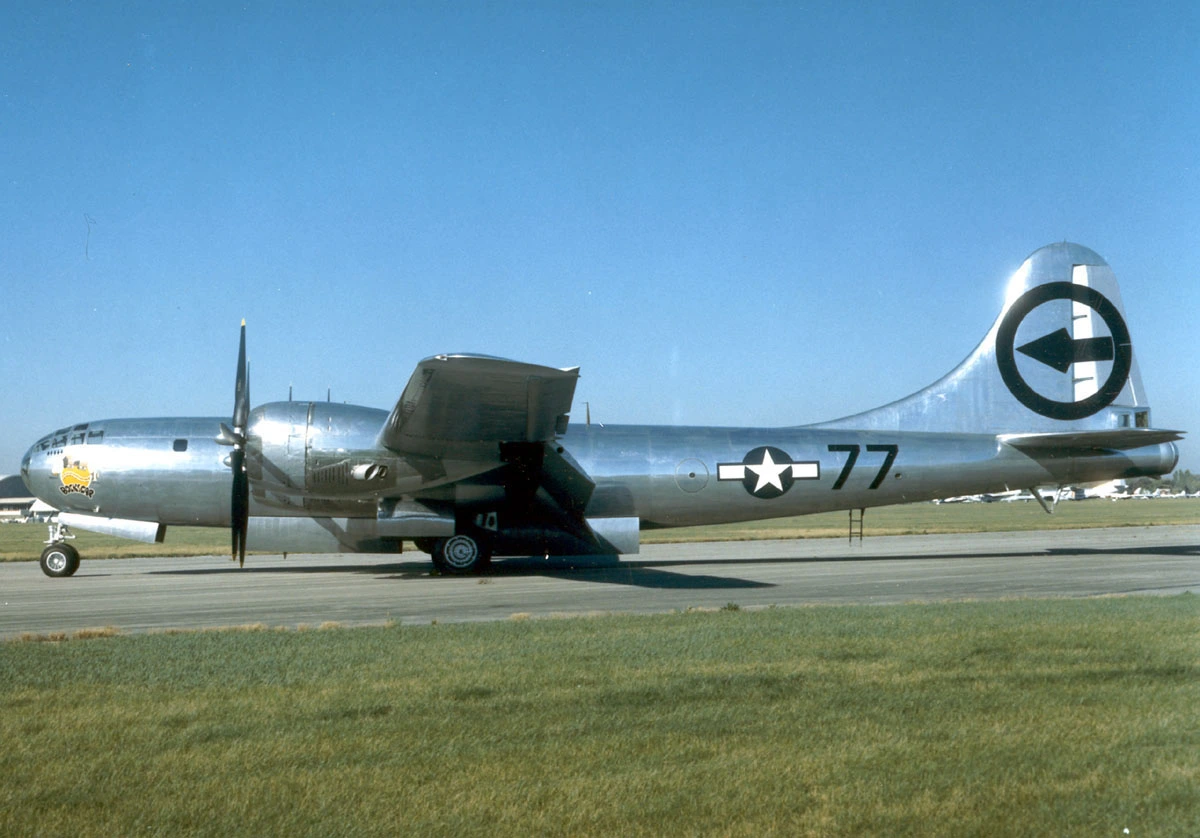
The Boeing B-29 Superfortress was the most advanced and expensive weapons system of World War II — a "very heavy bomber" that combined pressurized crew compartments, centralized remote-controlled gun turrets, and four massive Wright R-3350 engines to deliver unprecedented range and payload at high altitude. Production was distributed across four factories: Boeing in Wichita and Renton, Bell in Marietta, and Martin in Omaha, with approximately 3,970 aircraft built. The B-29 began combat from India/China in June 1944, shifted to the Marianas for the sustained strategic bombing of Japan, executed the devastating low-altitude Tokyo firebombing raids of March 1945, and delivered the atomic bombs on Hiroshima (August 6) and Nagasaki (August 9) that brought the war to an end.
B-29 Superfortress at a Glance
- Role
- Very Heavy Bomber
- Manufacturer
- The Boeing Company
- Nation
- United States
- Era
- World War II
By the Numbers
3,970
Built
~3,970
Built
4
Factories
10
Crew
20,000 lbs
Bomb Load
357 mph
Max Speed
2
Airworthy Today
Aircraft Description
The Boeing B-29 Superfortress was the most technologically advanced bomber of World War II, introducing pressurized crew compartments, centralized remote-controlled gun turrets, and high-altitude performance that no other bomber could match. Ordered into mass production before its first flight — an extraordinary wartime gamble — the B-29 carried the air war to Japan through high-altitude precision bombing, low-altitude incendiary raids that devastated Japanese cities, and ultimately delivered the atomic bombs on Hiroshima and Nagasaki that ended the war.
Paint Schemes and Markings
The B-29 Superfortress was primarily delivered in unpainted natural aluminum — a deliberate weight-saving measure critical for the extreme range required for operations against Japan from the Mariana Islands.
- Bare Silver Aluminum Overall (1944–45): The overwhelming majority of B-29s flew unpainted in natural aluminum finish. Weight savings were critical for the 1,500-mile missions from Tinian, Guam, and Saipan to Japan. Minimal markings: national insignia, tail numbers, and bomb group identification. This is the standard and most common B-29 scheme.
- Black Undersides (Night Operations): B-29s of the 313th and 315th Bombardment Wings conducting night incendiary raids over Japanese cities had their lower surfaces painted flat black to reduce visibility from searchlights. The contrast of black undersides against the silver upper fuselage is a distinctive modeling subject.
- Silverplate Atomic Bomb Carriers: "Enola Gay" (44-86292) and "Bockscar" (44-27297) wore standard unpainted natural metal with minimal markings. These aircraft were distinguished by the removal of defensive gun turrets (except tail) to save weight for the atomic missions. Circle-R tail markings of the 509th Composite Group.
- Bomb Group Identification: 20th Air Force bomb groups used geometric symbols on the vertical stabilizer for identification — circles, squares, triangles, and diamonds with letter codes. The 73rd, 313th, 314th, and 315th Bombardment Wings each had distinctive marking systems. Individual aircraft carried letter-number codes on the fuselage.
- Nose Art: B-29 nose art was less prolific than B-17 art but included notable examples. Mission tallies (small bomb silhouettes) tracked raids over Japan. Some aircraft carried distinctive names and artwork, though the pressurized nose section limited the available painting surface compared to earlier bombers.
Design Features
Key engineering and design choices that defined the B-29 Superfortress's capabilities.
Pressurized Crew Compartments
The B-29 was the first production bomber with pressurized crew compartments, allowing crews to operate at altitudes above 25,000 feet without oxygen masks or heated suits. Three pressurized sections — the forward crew compartment, the aft gunner's compartment, and the tail gunner's station — were connected by a crawlway tunnel over the bomb bays.
Central Fire Control System
Instead of manually-aimed guns, the B-29 used a revolutionary General Electric centralized fire-control system. Five remote sighting stations controlled four powered turrets via an analog computer, allowing any gunner to control any turret — or multiple turrets simultaneously. This system demanded sophisticated electromechanical reliability in combat conditions.
Wright R-3350 Engines
The four Wright R-3350 Duplex Cyclone engines, each producing 2,200 hp with dual turbo-superchargers, gave the B-29 its high-altitude performance. However, the engines suffered chronic overheating during development, caused the fatal crash of the second prototype in February 1943, and remained a maintenance challenge throughout the war. Engine fires were a constant hazard.
Four-Factory Production
B-29 production was distributed among Boeing Wichita (1,595), Boeing Renton (998), Bell Atlanta/Marietta (652), and Martin Omaha (515) — approximately 3,760 factory acceptances through the wartime period. The 'Battle of Kansas' in early 1944 saw a massive modification surge at four Kansas bases to ready aircraft for combat deployment.
Silverplate Atomic Modifications
Fifteen B-29s were specially modified under the 'Silverplate' program for the 509th Composite Group to carry atomic weapons. Modifications included removal of armor and most turret armament (the tail turret was retained), bomb bay modifications for the oversized weapons, and fuel injection engines. Enola Gay (44-86292) dropped the Hiroshima bomb; Bockscar (44-27297) dropped the Nagasaki bomb.
Engines & Armament
Powerplant and weapons configuration for the B-29 Superfortress's primary production variant.
Powerplant
4x Wright R-3350-23 "Duplex Cyclone" 18-cylinder twin-row radial engines with dual turbo-superchargers, 2,200 hp each
Armament
8x .50 caliber M2 Browning machine guns in four remote-controlled turrets + 2x .50 cal and 1x 20mm cannon in tail position; up to 20,000 lbs of bombs
Specifications
Key dimensions and performance figures for the B-29 Superfortress's primary production variant.
- Crew
- 10
- Length
- 30.18 m(99.0 ft)
- Wingspan
- 43.05 m(141.2 ft)
- Height
- 8.46 m(27.8 ft)
- Wing Area
- 161.3 m²(1736 ft²)
- Max Speed
- 574 km/h(357 mph)
Variants & Models
Each B-29 Superfortress variant introduced changes to the airframe, engine, or armament. Visual ID features help modelers and spotters distinguish between versions.
XB-29
3
Built
- Powerplant
- 4x Wright R-3350, 2,200 hp
Visual ID
Prototype: non-standard turret installations; test instrumentation; early propeller/cowl variations
Three prototypes. First flight September 21, 1942. Second prototype lost to engine fire crash on February 18, 1943 — a major program setback highlighting the R-3350's chronic overheating problems.
B-29
- Powerplant
- 4x Wright R-3350-23, 2,200 hp
- Max Speed
- 574 km/h(357 mph)
- Range
- 5,955 km(3,700 mi)
- Ceiling
- 10,241 m(33,599 ft)
Visual ID
Full defensive turret blisters (upper and lower); natural-metal finish common; large unit tail markings
Baseline production model. Pressurized crew compartments and centralized fire control as defining features. Museum specs: max 357 mph, cruise 220 mph, range 3,700 mi, ceiling 33,600 ft.
B-29A
- Powerplant
- 4x Wright R-3350-23, 2,200 hp
- Max Speed
- 587 km/h(365 mph)
- Range
- 9,382 km(5,830 mi)
Visual ID
Production engineering differences (wing center section); difficult to distinguish visually from B-29 without serial/block data
Structurally centered production engineering revisions. Enola Gay is identified as B-29-45-MO, accepted from Martin Omaha — block/plant suffixes are baked into the designation system.
B-29B
- Powerplant
- 4x Wright R-3350, 2,200 hp
Visual ID
Missing upper/lower turret blisters; prominent APQ-7 "Eagle" radar antenna beneath wings/fuselage
Late-war variant with reduced defensive armament and radar specialization. Associated with the 315th Bomb Wing's precision night raids from Guam.
Silverplate
15
Built
- Powerplant
- 4x Wright R-3350 (fuel injection)
Visual ID
Absence of dorsal/ventral turret blisters; "cleaner" upper fuselage profile; bomb bay modified for atomic weapons
Fifteen specially modified B-29s for the 509th Composite Group. Enola Gay (44-86292) — Hiroshima, August 6, 1945. Bockscar (44-27297) — Nagasaki, August 9, 1945.
F-13
- Powerplant
- 4x Wright R-3350, 2,200 hp
Visual ID
Camera ports or modified panels in aft fuselage/rear compartment area; reduced weapons load
Reconnaissance conversion carrying camera suite including K-17B, K-22, and K-18 cameras. Later redesignated RB-29.
KB-29P (Tanker)
208
Built
- Powerplant
- 4x Wright R-3350, 2,200 hp
Visual ID
Refueling boom installation at rear; boom operator position fairings
Postwar aerial refueling tanker conversion (1948–1951). 40 KB-29M tankers and 40 B-29MR receivers were also produced. The Air Force activated its first KB-29M squadrons on June 30, 1948.
Development & Operational Timeline
Key milestones in the B-29 Superfortress's journey from design through operational service.
Very Heavy Bomber Requirement
The U.S. Army issues a requirement for a "very heavy bomber" with unprecedented range, altitude, and payload. Boeing begins development of what will become the B-29 — the most complex and expensive weapons system of the war.
XB-29 Prototype First Flight
The first XB-29 prototype makes its maiden flight from Boeing Field, Seattle. The aircraft has been ordered into mass production before this flight — an extraordinary wartime gamble reflecting the urgency for a very-long-range bomber.
Second Prototype Lost to Engine Fire
The second XB-29 prototype crashes near Boeing Field after an engine fire during a test flight, killing the crew and Boeing test pilot Edmund T. Allen. The R-3350 engine's chronic overheating and fire problems become a major friction point delaying combat deployment.
Twentieth Air Force Established
The AAF establishes the Twentieth Air Force to manage B-29 operations as a strategic weapon directly from Washington, reducing the risk of dispersing the bombers into competing theater priorities. The "Battle of Kansas" modification surge at four Kansas bases readies aircraft for deployment.
First Combat Mission (Bangkok)
B-29s fly their first combat mission against Bangkok from bases in India. The first raid on Japan follows ten days later when 68 aircraft bomb the Yawata steel mills from Chinese staging bases — the first raid on the Japanese home islands since the Doolittle Raid.
Shift to Marianas Bases
B-29 operations shift to newly captured airfields in the Mariana Islands (Saipan, Tinian, Guam), bringing the Japanese home islands within regular striking range. The first Marianas raid is a 14-plane "shake down" strike against Truk on October 28; the first mission against Japan follows on November 24.
Tokyo Firebombing — Incendiary Campaign Begins
The XXI Bomber Command launches its "first incendiary attack" against Tokyo — a planned low-altitude night offensive with 334 B-29s dropping incendiary bombs from 5,000–9,000 feet. The raid destroys 16 square miles of the city and kills an estimated 80,000–100,000 people. This mission marks the doctrinal shift from high-altitude precision bombing to area incendiary attacks.
Operation Starvation — Aerial Mining Campaign
The 313th Bomb Wing conducts Operation Starvation, dropping naval mines in Japanese harbors and shipping lanes. The five-phase campaign devastates Japanese maritime transport. Admiral Nimitz commends the operation: "The Navy is gratified... outstanding... very effective mining operations."
Atomic Bomb Dropped on Hiroshima
The Silverplate B-29 "Enola Gay" (44-86292), piloted by Colonel Paul Tibbets of the 509th Composite Group, drops the first atomic bomb ("Little Boy") on Hiroshima at 0815 hours. Three days later, "Bockscar" drops "Fat Man" on Nagasaki. Japan surrenders on August 15.
Production Ends
B-29 production concludes with approximately 3,970 aircraft built across four factories. The airframe continues in service in postwar roles including reconnaissance, weather, rescue, and aerial refueling.
Final Squadron Retirement
The last B-29 in U.S. Air Force squadron use is retired. Between 1948 and 1951, 208 B-29s had been converted to KB-29 aerial refueling tankers, extending the type's useful service life well beyond the war.
Combat History
Major engagements and missions that defined the B-29 Superfortress's combat record.
First Raid on Japan — Yawata
June 15, 194468 B-29s take off from Chinese staging bases near Chengdu to bomb the Imperial Iron and Steel Works at Yawata, Japan — the first bombing of the Japanese home islands since the Doolittle Raid of April 1942. The mission highlights the severe logistical burden of supplying Chinese staging fields and the distance limitations of operating from the Asian mainland.
68
Dispatched
Symbolically important as the first strategic bombing of Japan since 1942. Operationally demonstrated the limitations of the India-China basing concept (Operation Matterhorn), contributing to the decisive shift to Marianas-based operations later in 1944.
Tokyo Firebombing (Operation Meetinghouse)
March 9–10, 1945XXI Bomber Command launches 334 B-29s in a planned low-altitude night incendiary attack against Tokyo, dropping incendiary bombs from 5,000–9,000 feet. The mission plan explicitly specified ensuring "the minimum requirement of 60 tons of incendiaries per square mile." An estimated 16 square miles of the city were destroyed.
334
Dispatched
14
Aircraft Lost
The most destructive single air raid in history. Marked the formal doctrinal shift from high-altitude precision bombing to low-altitude area incendiary attacks against Japanese urban areas. Field Order No. 43 directed the 73rd, 313th, and 314th Bombardment Wings in the command's "first incendiary attack."
Atomic Bombing of Hiroshima and Nagasaki
August 6 and 9, 1945Silverplate B-29 "Enola Gay" drops the "Little Boy" uranium bomb on Hiroshima on August 6, 1945 at 0815 hours. Three days later, "Bockscar" drops the "Fat Man" plutonium bomb on Nagasaki. Japan announces surrender on August 15.
The defining missions of the B-29 program and among the most consequential military actions in history. The Silverplate modifications that made atomic delivery possible represent the most significant special-purpose configuration of any WWII aircraft.
Production & Service
From first flight to retirement — the B-29 Superfortress's operational lifespan at a glance.
- Number Built
- 3,970
- First Service
- 1944
- Last Built
- 1946
- Retired
- 1960
- Status
- Retired
Where to See One
Surviving B-29 Superfortress aircraft you can visit today. Airworthy aircraft may appear at air shows.
Doc
S/N: 44-69972
Variant: B-29
Doc's Friends Hangar
Wichita, Kansas
1788 S Airport Road, Wichita, KS 67209
Doc's Friends
Visit website →One of only two airworthy B-29s worldwide. Boeing Wichita-manufactured. Extensive multi-year restoration to flying condition. Based at Eisenhower National Airport.
FIFI
S/N: 44-62070
Variant: B-29A
One of only two airworthy B-29s worldwide. Grounded 2006 for engine refit; returned to flight 2010 after all four engines replaced. Home base Dallas, tours nationally.
Bockscar
S/N: 44-27297
Variant: B-29 (Silverplate)
National Museum of the United States Air Force
Dayton, Ohio
1100 Spaatz Street, Wright-Patterson AFB, Dayton, OH 45433
United States Air Force
Visit website →Dropped the "Fat Man" atomic bomb on Nagasaki, August 9, 1945. One of 15 Silverplate aircraft assigned to the 509th Composite Group.
Enola Gay
S/N: 44-86292
Variant: B-29-45-MO (Silverplate)
Smithsonian National Air and Space Museum – Steven F. Udvar-Hazy Center
Chantilly, Virginia
14390 Air and Space Museum Parkway, Chantilly, VA 20151
Smithsonian Institution
Visit website →Dropped the first atomic bomb on Hiroshima, August 6, 1945. Restoration began 1984, took nearly two decades and approximately 300,000 work-hours. Named by pilot Col. Paul Tibbets after his mother.
Museum of Flight B-29
S/N: 44-69729
Variant: B-29
Museum of Flight
Seattle, Washington
9404 E Marginal Way S, Seattle, WA 98108
Museum of Flight (on loan from National Museum of USAF)
Visit website →Museum page provides serial and specifications. On loan from the National Museum of the United States Air Force.
Model Kits Available
Scale model kits of the B-29 Superfortress from leading manufacturers.
Browse all aircraft kits →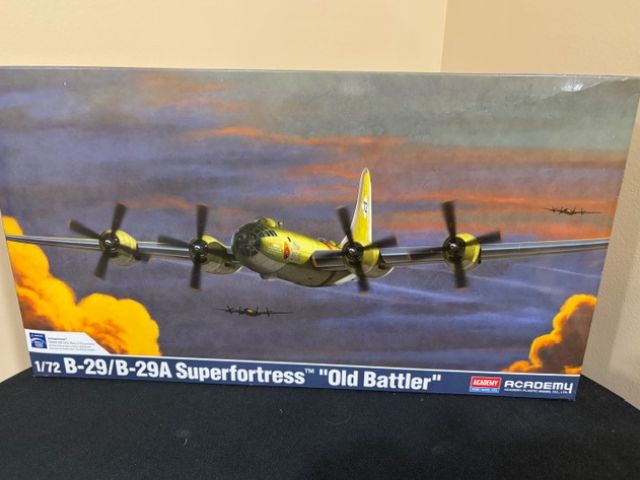
Written by
Steve Carmichael
I am a ww2 model enthusiast getting back into building scaled models after many years away. This site allows me to work on my web development skills while sharing what I am learning.