Piper Aircraft, Inc.
L-4 Grasshopper
 Steve CarmichaelLast updated April 3, 2026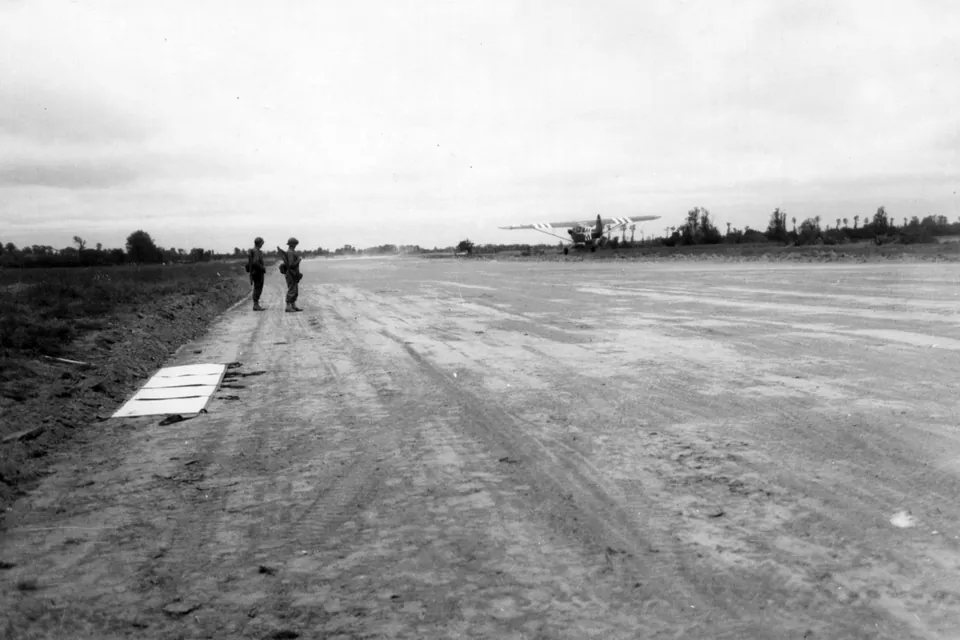
The Piper L-4 Grasshopper — the military version of the iconic Piper J-3 Cub — was virtually identical to its civilian counterpart except for a plexiglass greenhouse canopy for improved observation visibility. With 5,413 built for US forces, it flew everywhere the Army went — North Africa, Italy, France, the Pacific. The most famous surviving example, "Rosie the Rocketeer" (s/n 43-30426), is at the American Heritage Museum and carries a documented score of six German tanks destroyed by Major Charles "Bazooka Charlie" Carpenter.
L-4 Grasshopper at a Glance
- Role
- Reconnaissance Aircraft
- Manufacturer
- Piper Aircraft, Inc.
- Nation
- United States
- Era
- World War II
By the Numbers
5,413
Built
5,413
Built (L-4)
2
Crew
65 hp Continental
Engine
85 mph (137 km/h)
Top Speed
"Rosie" — 6 kills
Tank Ace
38 mph (61 km/h)
Stall Speed
Aircraft Description
The Piper L-4 Grasshopper was the military version of the famous Piper Cub, one of the most produced aircraft in history. Used for artillery spotting, liaison, and reconnaissance, these tiny unarmed aircraft flew low and slow over the battlefields of Europe and the Pacific. With over 20,000 built, the L-4 was an essential tool for ground commanders who used it as their eyes in the sky.
From Piper Cub to Military Observer
The L-4 Grasshopper was born from one of the most successful light aircraft ever designed — the Piper J-3 Cub. In the summer of 1941, the US Army evaluated civilian light aircraft during the massive Louisiana Maneuvers, and the Cub's ability to operate from roads, farm fields, and pastures proved the concept of organic aviation for artillery spotting. The Army's requirement was simple: take the J-3, add a plexiglass greenhouse canopy for improved upward and rearward visibility, install a military radio, and paint it Olive Drab. The result was an observation platform that would change the way artillery was employed on the battlefield.
Artillery's Eyes in the Sky
The L-4's primary mission was artillery observation — flying at 500–1,000 feet over the front lines while an observer in the rear seat radioed grid corrections to battery positions miles behind the lines. This was unglamorous but devastating work. With an L-4 overhead, field artillery could engage targets accurately at ranges far beyond what ground observers could see. The mere presence of an L-4 could suppress enemy movement across an entire sector — troops and vehicles would freeze or scatter when they heard the distinctive put-put of the small Continental engine, knowing that 105mm and 155mm shells would follow within minutes.
The casualty rate among L-4 pilots was significant. They flew in direct view of enemy forces who shot at them with everything available — rifles, machine guns, 20mm flak, and even occasional fighter attacks. The L-4's only defense was its tiny size, slow speed, and the pilot's ability to duck behind trees and hedgerows. Some pilots developed extraordinary evasive skills, using the L-4's 38 mph stall speed to turn inside pursuing fighters.
"Rosie the Rocketeer" — Bazooka Charlie
The defining story of the L-4 is Major Charles "Bazooka Charlie" Carpenter and his L-4H "Rosie the Rocketeer." Carpenter, assigned to the 4th Armored Division under General Patton's Third Army, decided that merely observing German armor wasn't enough — he wanted to fight it. He mounted six M1A1 bazooka launchers on the wing struts of his L-4H (serial 43-30426), three per wing, with firing wires running back to switches in the cockpit.
On September 20, 1944, during the Battle of Arracourt in northeastern France, Carpenter flew three attack sorties against a German Panther tank counterattack. Diving on the tanks at low level and firing his bazookas, he broke up the attack and was officially credited with destroying two tanks and several armored cars. By the end of the war, Carpenter was credited with six tanks destroyed — making him a "tank ace" in a 65-horsepower fabric-covered airplane. Stars and Stripes, the Associated Press, and Liberty magazine all covered his exploits.
His aircraft was found in a barn in Austria in 2017. It was restored to flying condition by the Collings Foundation, with original bullet holes visible, and is now displayed at the American Heritage Museum in Hudson, Massachusetts. It is the most historically documented surviving tank-killing aircraft of World War II.
Normandy to the Bulge
L-4s flew artillery observation missions over the Normandy beachheads beginning on D-Day itself, operating from hedgerow-bordered fields just behind the front lines. In the bocage country of Normandy, where the thick hedgerows limited ground observation to a few hundred yards, the L-4's aerial perspective was often the only way to see what was happening beyond the next field. During the breakout from Normandy and the race across France, L-4s kept pace with the advancing armor columns, setting up in farmer's fields and being ready to fly within hours.
During the Battle of the Bulge in December 1944, L-4s provided critical artillery spotting in marginal weather. When the skies finally cleared after Christmas, L-4 observers helped coordinate the devastating air and artillery strikes that shattered the German offensive.
Paint Schemes and Markings
The diminutive L-4 Grasshopper — a militarized Piper J-3 Cub — wore simple markings befitting its unglamorous but vital role as an artillery observation aircraft.
- Overall Olive Drab (1942–1945): Dark Olive Drab (ANA 613) on all fabric-covered surfaces. Unlike most USAAF combat types, the L-4 did not use Neutral Gray undersides — it was OD overall. Fabric surfaces took OD dope while the metal cowling received OD enamel. Chromate green primer often visible where the OD paint wore thin.
- D-Day Invasion Stripes (June 1944): Standard five-stripe black and white pattern on wings and rear fuselage. The stripes were important for the L-4 since its profile could be confused with the German Fieseler Fi 156 Storch.
- "Rosie the Rocketeer" Scheme: OD overall with nose art of a woman in the Rosie the Riveter pose on the port fuselage. Six bazooka launchers on forward wing struts. 4th Armored Division markings. USAAF serial 43-30426. The most compelling L-4 scheme for modelers.
- Unit Markings: Typically limited to serial number on vertical tail and small unit insignia. Some L-4s carried colored propeller spinners or cowl markings for specific artillery battalions. Mission tallies using small shell silhouettes occasionally appeared on the fuselage.
Design Features
Key engineering and design choices that defined the L-4 Grasshopper's capabilities.
Plexiglass Greenhouse Canopy
The military L-4 differed from the civilian J-3 Cub primarily in its large plexiglass panels in the roof and aft fuselage, providing upward and rearward visibility essential for artillery observation. A pilot and observer could scan the terrain below and behind the aircraft without the blind spots created by the J-3's fabric-covered cabin structure. This simple modification transformed a recreational airplane into a practical military observation platform.
Tandem Seating for Observer/Pilot Team
Standard missions carried a pilot in the front seat and an artillery observer in the rear with a 25-lb SCR-610 radio for communicating fire corrections to battery positions. The combined weight frequently exceeded the aircraft's published limits, but the L-4's generous structural margins absorbed the overload routinely. The observer called corrections while the pilot maneuvered to maintain sight of the target — a two-man team performing a task that modern armies accomplish with drones and satellites.
Road and Field Operations
The L-4's light weight — under 1,000 lbs empty — and wide-tire main landing gear enabled operations from roads, farm fields, pastures, and shell-cratered ground inaccessible to any other military aircraft. In Normandy, L-4s operated from hedgerow-bordered fields mere hundreds of yards behind the front lines. This proximity to the fighting made the L-4 the most tactically responsive aircraft in the Army's inventory — an artillery observer could be airborne and over the target within minutes of a request.
Near-Silent Low-Altitude Flight Profile
At cruise speeds of 75 mph just above treetop height, the L-4's small 65 hp engine and slow-turning propeller created minimal noise signature. The aircraft could approach an observation position before ground forces heard it coming — a critical advantage when the enemy response to an L-4 sighting was to immediately take cover or cease movement, knowing that artillery fire would follow within minutes.
Interservice and Allied Universality
The NE-1 and NE-2 were identical Navy variants used for ship-spotting and utility work. Allied forces including Britain and France operated similar liaison types. The L-4 and its contemporaries — the Aeronca L-3 Defender and Stinson L-5 Sentinel — were collectively called 'Grasshoppers' and established the doctrine of organic aviation that evolved into today's Army helicopter fleet.
Engines & Armament
Powerplant and weapons configuration for the L-4 Grasshopper's primary production variant.
Powerplant
1x Continental O-170-3 (also designated O-200), four-cylinder horizontally opposed air-cooled engine, 65 hp. Top speed 85 mph (137 km/h); cruise 75 mph (121 km/h); stall 38 mph (61 km/h). The deliberately modest power made slow, low-altitude observation practical and extended fuel endurance to approximately three hours.
Armament
Standard configuration: completely unarmed. Field modifications: some pilots mounted M1A1 bazooka launchers on wing struts, typically in pairs. Major Charles Carpenter's "Rosie the Rocketeer" mounted six M1A1 bazookas (three per wing), wire-fired from cockpit switches. This was unofficial but command-approved — the L-4 was never officially cleared as an attack platform.
Specifications
Key dimensions and performance figures for the L-4 Grasshopper's primary production variant.
- Crew
- 2
- Length
- 6.83 m(22.4 ft)
- Wingspan
- 10.74 m(35.2 ft)
- Height
- 2.03 m(6.7 ft)
- Wing Area
- 16.58 m²(178 ft²)
- Max Speed
- 137 km/h(85 mph)
Variants & Models
Each L-4 Grasshopper variant introduced changes to the airframe, engine, or armament. Visual ID features help modelers and spotters distinguish between versions.
O-59
- Powerplant
- 1x Continental O-170-3, 65 hp
- Max Speed
- 137 km/h(85 mph)
- Range
- 350 km(217 mi)
- Ceiling
- 3,660 m(12,008 ft)
Visual ID
Initial 1941 Army designation before liaison category created
Original Army designation from 1941 Army maneuvers evaluation. Redesignated L-4 in April 1942 when the Liaison category was established.
L-4Grasshopper
- Powerplant
- 1x Continental O-170-3, 65 hp
- Max Speed
- 137 km/h(85 mph)
- Range
- 350 km(217 mi)
- Ceiling
- 3,660 m(12,008 ft)
Visual ID
Initial L designation; standard military Cub
Basic military J-3 Cub with greenhouse canopy and military radio. Redesignated from O-59 in April 1942.
L-4A
948
Built
- Powerplant
- 1x Continental O-170-3, 65 hp
- Max Speed
- 137 km/h(85 mph)
- Range
- 350 km(217 mi)
- Ceiling
- 3,660 m(12,008 ft)
Visual ID
Modified radio equipment
Modified radio equipment. 948 built.
L-4B
980
Built
- Powerplant
- 1x Continental O-170-3, 65 hp
- Max Speed
- 137 km/h(85 mph)
- Range
- 350 km(217 mi)
- Ceiling
- 3,660 m(12,008 ft)
Visual ID
Additional equipment changes
Additional equipment changes. 980 built.
L-4H
1,801
Built
- Powerplant
- 1x Continental O-170-3, 65 hp
- Max Speed
- 137 km/h(85 mph)
- Range
- 350 km(217 mi)
- Ceiling
- 3,660 m(12,008 ft)
Visual ID
Most-produced variant; definitive wartime model
The most-produced L-4 variant and the definitive wartime model. 1,801 built. Major Carpenter's "Rosie the Rocketeer" was an L-4H (s/n 43-30426).
L-4J
1,680
Built
- Powerplant
- 1x Continental O-170-3, 65 hp
- Max Speed
- 137 km/h(85 mph)
- Range
- 350 km(217 mi)
- Ceiling
- 3,660 m(12,008 ft)
Visual ID
Final variant
Final production L-4 variant. 1,680 built.
NE-1 / NE-2
250
Built
- Powerplant
- 1x Continental O-170-3, 65 hp
- Max Speed
- 137 km/h(85 mph)
- Range
- 350 km(217 mi)
- Ceiling
- 3,660 m(12,008 ft)
Visual ID
US Navy variant; identical airframe
US Navy designation for the military Cub. 250 built for the Navy. Used for ship-spotting, utility transport, and training.
TG-8Training Glider
- Powerplant
- None (glider)
Visual ID
Engineless training glider conversion
Training glider variant with engine removed. Used to introduce students to glider handling before they flew larger assault gliders like the Waco CG-4A.
Development & Operational Timeline
Key milestones in the L-4 Grasshopper's journey from design through operational service.
Taylor E-2 Cub Origins
C. Gilbert Taylor designs the Taylor E-2 Cub, the ancestor of the Piper J-3 Cub and all subsequent military L-4 variants. The E-2 establishes the basic concept: a simple, lightweight, affordable airplane for everyman.
Piper J-3 Cub Established
The Piper J-3 Cub becomes the definitive version of the Cub lineage under William T. Piper's leadership. With its yellow paint, simple construction, and affordable price, the J-3 becomes the most popular training aircraft in America.
Army Evaluates Civilian Cubs in Maneuvers
The US Army evaluates civilian light aircraft including Piper Cubs, Aeronca Defenders, and Stinson Voyagers in the Louisiana Maneuvers, the largest peacetime military exercise in American history. The Cubs' ability to operate from roads and fields proves the concept of organic aviation for artillery spotting.
Army Orders O-59 Liaison Aircraft
Based on the maneuver results, the Army orders militarized Cubs designated O-59. A plexiglass greenhouse canopy for improved visibility and military radio equipment are the primary modifications from the civilian J-3.
Redesignated L-4 Grasshopper
The Army creates the Liaison (L) category and redesignates the O-59 as the L-4. The "Grasshopper" nickname encompasses all Army liaison aircraft — L-3 (Aeronca), L-4 (Piper), and L-5 (Stinson).
North Africa
L-4s deploy to North Africa with US Army artillery units for Operation Torch and the subsequent Tunisian campaign. Artillery spotting from the air dramatically improves the accuracy and responsiveness of field artillery fire.
Sicily and Italy
L-4s accompany Army forces into Sicily and up the Italian peninsula. The mountainous Italian terrain makes aerial observation especially valuable for directing artillery fire into valleys and behind ridgelines.
Normandy
L-4s fly artillery observation missions over the Normandy beachheads beginning on D-Day itself. Operating from hedgerow-bordered fields just behind the front lines, L-4 pilots direct fire for divisional artillery batteries supporting the breakout.
"Rosie the Rocketeer" Operations
Major Charles "Bazooka Charlie" Carpenter of the 4th Armored Division mounts six M1A1 bazookas on his L-4H "Rosie the Rocketeer" and uses them to attack German armor during the advance across France. Officially credited with destroying six tanks — making him a tank ace in a 65 hp fabric airplane.
Pacific Operations
L-4s operate in the Philippines and on Okinawa, where the jungle terrain and mountainous ground make conventional artillery spotting especially difficult. Liaison pilots fly in conditions that ground larger aircraft.
Battle of the Bulge
L-4s provide critical artillery spotting during the Battle of the Bulge, flying in marginal weather to direct fire against German formations advancing through the Ardennes. When the weather clears, L-4 observers help coordinate the devastating air and artillery strikes that halt the German offensive.
Combat History
Major engagements and missions that defined the L-4 Grasshopper's combat record.
Artillery Spotting Role (All Theaters)
1942–1945L-4s directed the majority of US Army field artillery fire throughout the war. Flying at 500–1,000 ft in front of advancing units, observer pilots radioed grid corrections to batteries miles behind the lines. The presence of an L-4 overhead could suppress enemy movement across an entire sector — troops and vehicles would freeze or scatter when they heard the distinctive sound of the small engine, knowing that artillery fire would follow within minutes.
The L-4's contribution to the ground war was profound and largely unrecognized. Artillery was the single greatest killer on the WWII battlefield, and the L-4 made that artillery dramatically more accurate and responsive. The casualty rate among L-4 pilots was significant — they flew in direct view of enemy forces who shot at them with everything available.
"Rosie the Rocketeer" — Major Charles Carpenter
September–November 1944Major Charles "Bazooka Charlie" Carpenter, assigned to the 4th Armored Division (Patton's Third Army), mounted six M1A1 bazookas on the wing struts of his L-4H (s/n 43-30426) named "Rosie the Rocketeer." On September 20, 1944, during the Battle of Arracourt, Carpenter flew three sorties against a German Panther tank counterattack, breaking up the attack and being officially credited with destroying two tanks and several armored cars. By the end of the war he was credited with six tanks destroyed.
The defining story of the L-4 for this site's history-meets-modeling mission. Carpenter became a "tank ace" in a 65-hp fabric-covered Cub — one of the most extraordinary individual combat records of the war. Stars and Stripes, AP, and Liberty magazine all covered his exploits. His aircraft, found in Austria in 2017, was restored to flying condition in 2020 and is displayed at the American Heritage Museum in Hudson, MA, complete with original bullet holes.
Pacific Operations
1944–1945L-4s operated in the Philippines and on Okinawa, where the mountainous, jungle-covered terrain made conventional ground-level artillery observation extremely difficult. Liaison pilots flew in conditions — low clouds, rain, poor visibility — that grounded larger aircraft, maintaining artillery observation when it was most desperately needed.
Proved the L-4's versatility across theaters and terrain types. The Pacific L-4 operations were less documented than the European campaigns but equally vital to the ground forces they supported.
Assault on Fort Koenigsmacker
November 1944Three L-4 pilots supporting the 90th Infantry Division spotted and directed artillery fire against a heavily fortified German position on the Moselle River at Fort Koenigsmacker. Flying in fog-obscured terrain where ground observers were blinded, the L-4s provided the only means of adjusting fire onto the fortifications, enabling the infantry assault that would otherwise have been impossible.
3
Dispatched
Demonstrated the L-4's irreplaceable value in conditions where no other observation method was available. Without the aerial observers, the heavily fortified position could not have been accurately engaged by artillery.
Production & Service
From first flight to retirement — the L-4 Grasshopper's operational lifespan at a glance.
- Number Built
- 5,413
- First Service
- 1938
- Last Built
- 1947
- Status
- Retired
Where to See One
Surviving L-4 Grasshopper aircraft you can visit today. Airworthy aircraft may appear at air shows.
"Rosie the Rocketeer" (43-30426)
S/N: 43-30426
Variant: L-4H
American Heritage Museum / Collings Foundation
Hudson, Massachusetts
Collings Foundation
Visit website →The actual aircraft flown by Major Charles "Bazooka Charlie" Carpenter. Found in Austria in 2017, restored to flying condition in 2020. Airworthy; flies at the museum's annual October WWII Reenactment event. Original bullet holes visible. Nose art repainted by Carpenter's granddaughter. The most historically documented surviving L-4.
L-4 (Army Aviation Museum)
Variant: L-4
US Army Aviation Museum
Fort Novosel (formerly Fort Rucker), Alabama
US Army Aviation Museum
Visit website →L-4 at the primary Army aviation museum. Multiple liaison aircraft examples in the collection.
L-4 (EAA Museum)
Variant: L-4
L-4 at the EAA Aviation Museum. "Rosie the Rocketeer" appeared at AirVenture 2023.
L-4 (NASM Udvar-Hazy)
Variant: L-4
Steven F. Udvar-Hazy Center, National Air and Space Museum
Chantilly, Virginia
Smithsonian Institution
Visit website →L-4 on display at the Udvar-Hazy Center.
L-4 (Smithsonian American History)
Variant: L-4
Smithsonian National Museum of American History
Washington, D.C.
Smithsonian Institution
Visit website →L-4 on display at the Smithsonian National Museum of American History.
L-4 (USAF Museum)
Variant: L-4
L-4 on display at the National Museum of the US Air Force.
L-4J (Pima)
Variant: L-4J
L-4J on display at the Pima Air and Space Museum.
Written by
Steve Carmichael
I am a ww2 model enthusiast getting back into building scaled models after many years away. This site allows me to work on my web development skills while sharing what I am learning.