Consolidated Aircraft
PBY Catalina
 Steve CarmichaelLast updated April 3, 2026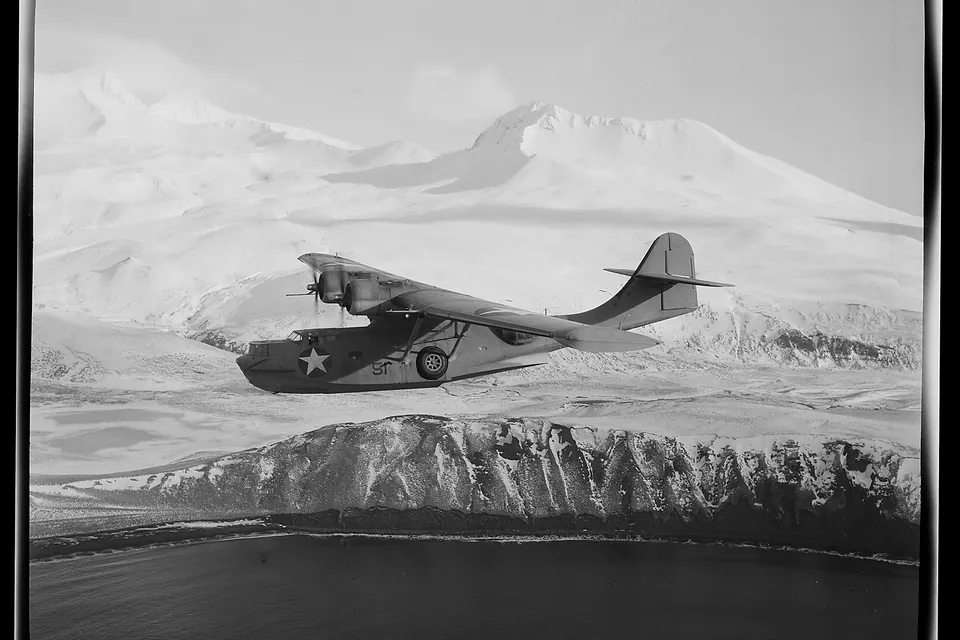
The Consolidated PBY Catalina was the most widely used maritime patrol aircraft of World War II, with over 3,300 built. Famous for the 24-hour patrol endurance that made it indispensable for ocean surveillance, air-sea rescue, and night torpedo attack, the Catalina served with virtually every Allied nation. PBYs spotted the Japanese fleet before the Battle of Midway — arguably the most consequential patrol of the Pacific War.
PBY Catalina at a Glance
- Role
- Seaplane
- Manufacturer
- Consolidated Aircraft
- Nation
- United States
- Era
- World War II
By the Numbers
3,305
Built
~3,305
Built
7–10
Crew
24+ hours
Patrol Endurance
~2,520 mi
Range
~8
Airworthy Today
28+ nations
Operators
Aircraft Description
The Consolidated PBY Catalina was the most widely used maritime patrol aircraft of World War II. It served with every branch of the US military and with numerous Allied nations. Catalinas located the Japanese fleet before the Battle of Midway, rescued countless downed airmen, and conducted nighttime torpedo attacks as "Black Cats." Its endurance of over 24 hours made it indispensable for ocean patrol.
Origins and Development
In October 1933, the US Navy issued a requirement for a new long-range patrol flying boat to replace the aging Martin P3M and Consolidated P2Y. Consolidated Aircraft's chief designer, Isaac M. "Mac" Laddon, proposed a revolutionary monoplane design featuring a parasol wing mounted above the fuselage on a streamlined pylon, retractable wingtip floats that became the wingtips in flight, and two engines mounted on the wing leading edge — a clean, efficient configuration that would define the Catalina's extraordinary range.
The XP3Y-1 prototype first flew on March 28, 1935, at San Diego. It demonstrated range and endurance figures that far exceeded any existing patrol aircraft, and the Navy ordered the type into production as the PBY-1. Through successive variants — PBY-1 through PBY-4 — the design was refined with more powerful engines, improved defensive armament, and the distinctive waist blisters that gave observers panoramic views of the ocean below.
The PBY-5 and PBY-5A: Wartime Workhorses
The PBY-5, with its R-1830-92 engines producing 1,200 hp each, was the definitive wartime flying boat variant. But the most important development was the PBY-5A amphibian, which added retractable tricycle landing gear to the flying boat hull. This amphibious capability — the ability to operate from both water and land — proved invaluable in the Pacific, where Catalinas might need to land at an advanced island base with either a harbor or a rough airstrip but rarely both.
Midway: The Patrol That Changed the War
On June 3, 1942, PBYs from VP-44 spotted the Japanese invasion force approximately 700 miles from Midway Island during a routine long-range patrol. The contact report, radioed back to Pearl Harbor, confirmed the intelligence from codebreaking and allowed Admiral Nimitz to position USS Enterprise, USS Hornet, and USS Yorktown for the carrier ambush that would sink four Japanese fleet carriers the following day. It is no exaggeration to say that the PBY patrol that found the Japanese fleet was one of the most consequential single missions of the entire Pacific War.
The "Black Cats"
Perhaps the most dramatic chapter in the Catalina's story was the "Black Cat" night operations. Beginning in late 1942, PBYs painted overall flat black — with subdued markings and exhaust flame dampeners — flew nocturnal harassment, interdiction, and torpedo attack missions from forward bases in the Solomons, New Guinea, and Philippines. Using radar to find targets and attacking at night when Japanese fighters could not intercept, the Black Cat squadrons sank or damaged numerous enemy vessels. The missions were extraordinarily dangerous — solo PBYs flying low over darkened waters, attacking warships that outgunned them enormously — and the crews who flew them remain among the unsung heroes of the Pacific air war.
Air-Sea Rescue: The "Dumbo" Missions
The PBY's ability to land on open water made it the primary air-sea rescue platform of the Pacific War. In missions codenamed "Dumbo," Catalina crews flew into combat zones to recover downed fighter and bomber pilots from life rafts, often within sight of enemy-held islands and under fire. The amphibious PBY-5A was particularly suited to this role — it could land on the water, taxi to survivors, haul them aboard through the waist blisters, and then either take off from the water or taxi to a nearby beach. Catalina crews saved hundreds of lives throughout the Pacific campaign.
Global Service
The Catalina served with virtually every Allied nation during the war. The Royal Air Force operated Catalinas from bases in Northern Ireland, Scotland, Iceland, and Gibraltar for anti-submarine patrol in the Atlantic — an RAF Catalina crewed by a US Navy pilot located the German battleship Bismarck on May 26, 1941. The Royal Australian Air Force, Royal Canadian Air Force, Royal New Zealand Air Force, and Soviet Naval Aviation all operated the type. Canadian-built versions were designated Canso, and the type saw postwar service with dozens of nations into the 1960s.
Paint Schemes and Markings
The PBY Catalina wore a remarkable range of schemes reflecting its diverse roles — from standard patrol camouflage to the all-black "Black Cat" night operations finish that made it one of the most feared aircraft in the Pacific.
- Blue-Gray over Light Gray (pre-war through 1942): Blue-Gray upper surfaces over Light Gray undersides. The standard scheme at the time of the Pearl Harbor attack and during the Battle of Midway, where PBY-5s provided critical reconnaissance.
- Tri-Color Scheme (1943–1944): Non-Specular Sea Blue (ANA 607) uppers, Intermediate Blue (ANA 608) sides, Insignia White (ANA 601) undersides and hull bottom. Hull boot-topping (waterline area) often painted in a darker shade.
- Overall Sea Blue (1944 onward): Non-Specular Sea Blue (ANA 607) overall. Patrol aircraft generally retained non-specular rather than gloss finish. Some late-war PBY-6A models received Glossy Sea Blue (ANA 623).
- RAF Coastal Command: Temperate Sea Scheme — Extra Dark Sea Grey and Dark Slate Grey uppers over Sky Type S undersides. RAF Catalinas based in Northern Ireland, Scotland, Iceland, and Gibraltar carried this scheme.
- "Black Cat" Night Operations: Overall flat/non-specular black on all surfaces. Used by USN patrol squadrons for nocturnal harassment, interdiction, and rescue missions. Exhaust flame dampeners fitted. Minimal external markings. One of the most dramatic schemes available to modelers.
- USAAF Olive Drab / Neutral Gray (OA-10): ANA 613 Olive Drab upper, ANA 603 Neutral Gray lower. USAAF rescue aircraft wore Army rather than Navy schemes.
Design Features
Key engineering and design choices that defined the PBY Catalina's capabilities.
Parasol Wing Configuration
The PBY's wing was mounted above the fuselage on a streamlined pylon, creating a parasol arrangement that reduced aerodynamic interference drag and kept the engines well clear of ocean spray during water operations. This distinctive high-wing design also provided exceptional downward visibility for the crew during long maritime patrols — a critical advantage when searching for submarines, ships, or downed aircrew across vast stretches of open ocean.
Retractable Wingtip Floats
The Catalina's most distinctive visual feature was its retractable wingtip floats, which folded upward to become the wingtips in flight. Electrically actuated, the floats reduced drag by approximately 5% when retracted — a meaningful improvement on an aircraft designed for 24-hour patrols. When lowered for water operations, they prevented the wingtips from dipping into the sea during taxi, takeoff, and landing.
Waist Blister Observation Positions
The PBY's aft fuselage featured distinctive transparent blisters on each side that served as both gunner positions and observation stations. These teardrop-shaped blisters gave the waist gunners and observers an exceptionally wide field of view over the ocean surface — essential for spotting submarine periscopes, life rafts, or enemy surface vessels. The blisters became one of the Catalina's most recognizable visual features.
Amphibious Hull with Retractable Undercarriage
The PBY-5A variant added retractable tricycle-type landing gear to the flying boat hull, creating a true amphibian capable of operating from both water and land. This versatility proved invaluable in the Pacific, where Catalinas needed to operate from advanced island bases that might have either a harbor or an airstrip but rarely both. The amphibious capability also enabled air-sea rescue operations where the aircraft could land on water to recover survivors, then fly to a land base.
Long-Range Fuel Capacity and Crew Endurance
Designed for patrols exceeding 24 hours, the Catalina carried up to 1,750 gallons of fuel and accommodated a crew of 7–10 with rest bunks, a small galley, and a navigator's station. This endurance was not merely a technical achievement — it was operationally transformative. PBY crews could search sectors of ocean hundreds of miles from base for an entire day, filling coverage gaps that shorter-range aircraft simply could not reach.
Engines & Armament
Powerplant and weapons configuration for the PBY Catalina's primary production variant.
Powerplant
2x Pratt & Whitney R-1830-92 Twin Wasp, 14-cylinder twin-row air-cooled radial, 1,200 hp each. Earlier models used the R-1830-58 at 825 hp and R-1830-64. The twin-engine parasol wing arrangement provided the range and endurance that defined the type — over 2,500 miles and 24+ hours on patrol.
Armament
Three .30 cal machine guns in bow turret and two waist blister positions, plus one .50 cal in a ventral tunnel gun. Bomb bay and underwing hardpoints: up to 4,000 lbs of bombs, depth charges, or two Mark 13 torpedoes. Some PBY-5As carried ASV radar under the wings for anti-submarine patrol.
Specifications
Key dimensions and performance figures for the PBY Catalina's primary production variant.
- Crew
- 10
- Length
- 19.47 m(63.9 ft)
- Wingspan
- 32 m(105.0 ft)
- Height
- 6.43 m(21.1 ft)
- Wing Area
- 130 m²(1399 ft²)
- Max Speed
- 315 km/h(196 mph)
Variants & Models
Each PBY Catalina variant introduced changes to the airframe, engine, or armament. Visual ID features help modelers and spotters distinguish between versions.
PBY-1
60
Built
- Powerplant
- 2x P&W R-1830-58, 825 hp each
- Max Speed
- 289 km/h(180 mph)
- Range
- 4,030 km(2,504 mi)
- Ceiling
- 5,590 m(18,340 ft)
Visual ID
Early production; small rudder; non-retractable floats on some
Initial production variant delivered from October 1936. Served with VP-11F as the first operational Catalina squadron.
PBY-2
50
Built
- Powerplant
- 2x P&W R-1830-64, 900 hp each
- Max Speed
- 293 km/h(182 mph)
- Range
- 4,030 km(2,504 mi)
- Ceiling
- 5,590 m(18,340 ft)
Visual ID
Minor improvements over PBY-1
Second production batch with minor structural and equipment improvements. Delivered 1937.
PBY-3
66
Built
- Powerplant
- 2x P&W R-1830-66, 1,000 hp each
- Max Speed
- 306 km/h(190 mph)
- Range
- 4,070 km(2,529 mi)
- Ceiling
- 6,310 m(20,702 ft)
Visual ID
More powerful engines
Uprated engines. Delivered 1938. Some still in service at time of Pearl Harbor.
PBY-4
33
Built
- Powerplant
- 2x P&W R-1830-72, 1,050 hp each
- Max Speed
- 311 km/h(193 mph)
- Range
- 4,070 km(2,529 mi)
- Ceiling
- 6,310 m(20,702 ft)
Visual ID
Transparent waist blisters introduced
Introduced the distinctive waist blister observation/gun positions that became the Catalina's signature feature. First variant with .50 cal tunnel gun.
PBY-5
683
Built
- Powerplant
- 2x P&W R-1830-82, 1,200 hp each
- Max Speed
- 315 km/h(196 mph)
- Range
- 4,030 km(2,504 mi)
- Ceiling
- 5,520 m(18,110 ft)
Visual ID
Pure flying boat; no landing gear; definitive wartime flying boat variant
The definitive wartime flying boat variant. Pure flying boat with no landing gear. The only pure flying boat PBY-5 known to survive is at the National Naval Aviation Museum, Pensacola — important distinction for modelers as most surviving Catalinas are PBY-5A amphibians.
PBY-5A
803
Built
- Powerplant
- 2x P&W R-1830-92, 1,200 hp each
- Max Speed
- 288 km/h(179 mph)
- Range
- 4,030 km(2,504 mi)
- Ceiling
- 4,480 m(14,698 ft)
Visual ID
Retractable tricycle landing gear; amphibian hull — wheels visible when deployed
The amphibious variant with retractable tricycle-type landing gear. Lower top speed and ceiling than the pure flying boat PBY-5 due to the weight and drag of the gear. Most surviving and most modeled Catalina variant. 803 built by Consolidated plus additional production by other manufacturers.
PBY-6A
175
Built
- Powerplant
- 2x P&W R-1830-92, 1,200 hp each
- Max Speed
- 288 km/h(179 mph)
- Range
- 4,030 km(2,504 mi)
- Ceiling
- 4,480 m(14,698 ft)
Visual ID
Taller vertical tail; improved electrical system; amphibian
Final production variant. Improved PBY-5A with taller vertical stabilizer for better directional stability and updated electrical systems. 175 built.
OA-10Canso
- Powerplant
- 2x P&W R-1830-92, 1,200 hp each
- Max Speed
- 288 km/h(179 mph)
- Range
- 4,030 km(2,504 mi)
- Ceiling
- 4,480 m(14,698 ft)
Visual ID
USAAF designation; same airframe as PBY-5A
USAAF designation for the amphibious rescue variant. Used primarily for air-sea rescue operations. Also known as Canso when built in Canada by Boeing Canada and Canadian Vickers.
Development & Operational Timeline
Key milestones in the PBY Catalina's journey from design through operational service.
Navy Issues Patrol Bomber Requirement
The US Navy issues a requirement for a new long-range patrol flying boat to replace the Martin P3M and Consolidated P2Y. Consolidated Aircraft submits a monoplane design that will become the PBY.
XP3Y-1 Prototype First Flight
The XP3Y-1 prototype, later redesignated XPBY-1, makes its maiden flight at San Diego. The parasol-wing flying boat with retractable wingtip floats demonstrates the design innovations that will make the Catalina uniquely suited for long-range patrol.
First PBY-1 Delivered to VP-11F
The first production PBY-1 is delivered to Patrol Squadron VP-11F, beginning the Catalina's long operational career with the US Navy.
Pearl Harbor — PBYs on Morning Patrol
PBY Catalinas are conducting routine morning patrol from Pearl Harbor when the Japanese attack begins. Some PBYs are destroyed on the water at Ford Island; others already airborne attempt to locate the Japanese carrier force.
Atlantic Anti-Submarine Patrol
PBYs operating from Iceland, Newfoundland, UK, and Gibraltar bases locate and attack U-boats in the Battle of the Atlantic. MAD (Magnetic Anomaly Detection) equipped variants prove effective against submerged submarines.
PBYs Sight Japanese Fleet Before Midway
PBYs from VP-44 spot the Japanese invasion force approximately 700 miles from Midway Island. This contact report allows Admiral Nimitz to position his carriers for the ambush that will decide the battle. Arguably the most consequential single patrol of the Pacific War.
"Black Cat" Night Operations Begin
Night-equipped PBYs begin radar-guided night torpedo and bombing attacks against Japanese shipping from Henderson Field and later from island bases throughout the Solomons. Operating at night with flat black paint, the "Black Cats" sink or damage numerous vessels with near-zero Japanese fighter interception.
Air-Sea Rescue "Dumbo" Missions
PBYs fly into combat zones to recover downed aircrew in hazardous "Dumbo" rescue missions. Catalinas save hundreds of lives throughout the Pacific War, landing on open ocean to pluck aircrew from life rafts, often under enemy fire.
V-J Day
With Japan's surrender, the PBY Catalina concludes one of the longest and most varied combat careers of any WWII aircraft type, having served in every theater with virtually every Allied nation.
Combat History
Major engagements and missions that defined the PBY Catalina's combat record.
Atlantic Anti-Submarine Warfare
1941–1945PBYs operating from bases in Iceland, Newfoundland, Northern Ireland, and Gibraltar conducted sustained anti-submarine patrol across the Atlantic, locating and attacking German U-boats. MAD (Magnetic Anomaly Detection) equipped variants proved especially effective against submerged submarines that radar could not detect.
The PBY's enormous endurance — over 24 hours on patrol — was uniquely valuable for covering the vast expanses of the North Atlantic. Catalinas helped close the "Mid-Atlantic Gap" where U-boats had operated beyond the range of shorter-range patrol aircraft, contributing to the eventual Allied victory in the Battle of the Atlantic.
Midway Fleet Sighting
June 3, 1942PBYs from VP-44 spotted the Japanese invasion force approximately 700 miles from Midway Island during routine long-range patrol. The contact report — radioed back to Pearl Harbor — allowed Admiral Nimitz to position USS Enterprise, USS Hornet, and USS Yorktown for the ambush that would sink four Japanese carriers the following day.
Arguably the most consequential single patrol of the Pacific War. Without the PBY sighting, Nimitz could not have positioned his carriers with the precision needed to achieve the decisive victory at Midway. The Catalina's 24-hour endurance made this long-range detection possible — no other aircraft type could have covered the distances required.
"Black Cat" Night Operations
1942–1944Night-equipped PBYs flying from Henderson Field and later from island bases throughout the Solomons conducted radar-guided night torpedo and bombing attacks against Japanese shipping. Painted overall flat black with subdued markings, the "Black Cats" of VP-12 and other squadrons sank or damaged numerous vessels while operating with near-zero risk of Japanese fighter interception at night.
The "Black Cat" operations demonstrated the Catalina's versatility beyond its designed patrol role. Flying low over darkened waters with radar guidance, PBY crews conducted some of the most dangerous and psychologically demanding missions of the war — solo night torpedo attacks against enemy warships.
Air-Sea Rescue "Dumbo" Missions
1943–1945PBYs flew into active combat zones to recover downed aircrew in hazardous rescue missions codenamed "Dumbo." Catalina crews landed on open ocean swells to pick up fighter and bomber pilots from life rafts, often within sight of enemy-held islands and under fire. Remarkable rescues included recovery of numerous fighter and bomber crews throughout the Pacific campaign.
The "Dumbo" missions represented the Catalina at its most heroic. PBY crews routinely risked their aircraft and lives to save downed aircrew, often landing in rough seas near Japanese-held territory. The amphibious PBY-5A proved particularly valuable, as it could land on water, recover survivors, and then taxi to a beach or take off from the water surface.
Production & Service
From first flight to retirement — the PBY Catalina's operational lifespan at a glance.
- Number Built
- 3,305
- First Service
- 1936
- Last Built
- 1945
- Retired
- 1957
- Status
- Retired
Where to See One
Surviving PBY Catalina aircraft you can visit today. Airworthy aircraft may appear at air shows.
"Miss Pick Up" G-PBYA
S/N: G-PBYA
Variant: Canso A
Plane Sailing Air Displays
Duxford, United Kingdom
Plane Sailing Air Displays
The sole airworthy Catalina in Europe. Regular UK and European airshow appearances. Based at IWM Duxford.
Canso A N222FT
S/N: N222FT
Variant: Canso A
Private
USA
Private owner
One of approximately five US-registered airworthy Catalina/Canso examples.
PBY-5A N2172N
S/N: N2172N
Variant: PBY-5A
Private
USA
Private owner
Privately operated airworthy PBY-5A.
Canso A (ACAM)
Variant: Canso A
Atlantic Canada Aviation Museum
Halifax, Nova Scotia, Canada
Atlantic Canada Aviation Museum
Canadian-built Canso A on display at the Atlantic Canada Aviation Museum in Halifax.
OA-10A (USAF Museum)
Variant: OA-10A
USAAF rescue variant (OA-10) on display at the National Museum of the US Air Force.
PBB-2B "Frigate Bird II"
Variant: PBB-2B
Relocated in 2024 to HARS facility at Albion Park, New South Wales.
PBY-5 BuNo 08317
S/N: 08317
Variant: PBY-5
The only surviving pure flying boat PBY-5 in existence. On loan from Smithsonian NASM. The most historically significant surviving Catalina — important distinction from the amphibious PBY-5A.
PBY-5A (Air Zoo)
Variant: PBY-5A
PBY-5A on display at the Kalamazoo Air Zoo.
PBY-5A (Fantasy of Flight)
Variant: PBY-5A
PBY-5A in the Kermit Weeks collection at Fantasy of Flight.
PBY-5A (NASM Udvar-Hazy)
Variant: PBY-5A
Steven F. Udvar-Hazy Center, National Air and Space Museum
Chantilly, Virginia
Smithsonian Institution
Visit website →PBY-5A amphibian on display at the Udvar-Hazy Center.
PBY-5A (NMWWIIA)
Variant: PBY-5A
National Museum of World War II Aviation
Colorado Springs, Colorado
National Museum of World War II Aviation
Visit website →PBY-5A on display at the National Museum of World War II Aviation.
PBY-5A (Pima)
Variant: PBY-5A
PBY-5A on display at the Pima Air and Space Museum in Tucson.
Model Kits Available
Scale model kits of the PBY Catalina from leading manufacturers.
Browse all aircraft kits →Written by
Steve Carmichael
I am a ww2 model enthusiast getting back into building scaled models after many years away. This site allows me to work on my web development skills while sharing what I am learning.