Grumman Aircraft Engineering Corporation
TBF Avenger
 Steve CarmichaelLast updated April 3, 2026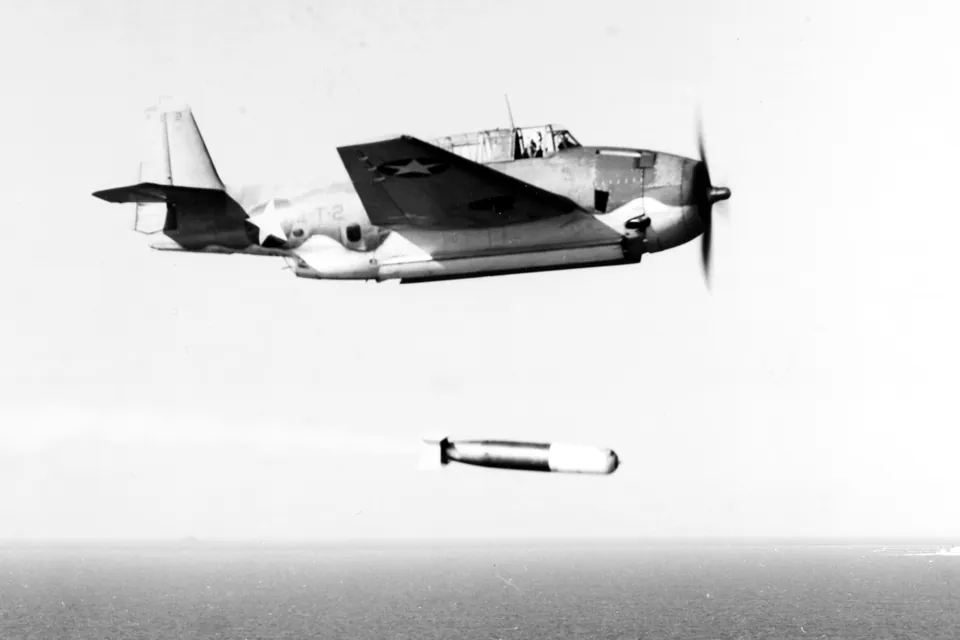
The Grumman TBF Avenger was the US Navy's primary torpedo bomber from 1942 to the end of the war, with 9,839 built — 2,290 by Grumman (TBF) and 7,546 by General Motors' Eastern Aircraft Division (TBM). Its catastrophic debut at Midway, where five of six were shot down, belied a combat career that would see Avengers contribute to sinking the super-battleships Yamato and Musashi. Future President George H.W. Bush flew TBM Avengers in the Pacific.
TBF Avenger at a Glance
- Role
- Torpedo Bomber
- Manufacturer
- Grumman Aircraft Engineering Corporation
- Nation
- United States
- Era
- World War II
By the Numbers
9,839
Built
~9,839
Built
3
Crew
Mark 13
Torpedo
7,546
GM-Built (TBM)
~40
Survive Today
2–3x .50 cal + 1x .30 cal
Guns
Aircraft Description
The Grumman TBF Avenger was the US Navy's standard torpedo bomber from 1942 through the end of the war. It debuted at the Battle of Midway, where five of six Avengers were shot down, but it went on to become one of the most effective naval aircraft of the conflict. Future President George H.W. Bush flew Avengers in the Pacific. Nearly 10,000 were produced.
Origins and Development
In April 1940, the US Navy issued a requirement for a new torpedo bomber to replace the Douglas TBD Devastator, which was already becoming obsolescent. Grumman's design, the XTBF-1, competed against Vought's TBU Sea Wolf and won the contract largely on the strength of its enclosed weapons bay, power-operated dorsal turret, and the company's reputation for building rugged naval aircraft.
The XTBF-1 first flew on August 1, 1941, just four months before Pearl Harbor. It was a massive aircraft for a single-engine design — its 16.5-foot wingspan folded for carrier storage, and it carried a crew of three in separate compartments. The internal bomb bay could hold a full-size Mark 13 torpedo or 2,000 lbs of bombs, and the electrically powered dorsal turret gave it meaningful defensive armament that its predecessor utterly lacked.
The Midway Catastrophe
The Avenger's combat debut at the Battle of Midway on June 4, 1942, was one of the worst first engagements in aviation history. Six TBF-1 Avengers from VT-8's land-based detachment launched from Midway Island against the Japanese carrier strike force without fighter escort. Five of the six were shot down by Japanese Zeros and anti-aircraft fire; the surviving aircraft, flown by Ensign Albert Earnest, staggered back to Midway with one crewman dead, another wounded, and the aircraft riddled with hits. None of the torpedoes struck their targets.
The disaster, occurring alongside the near-total destruction of the carrier-based TBD torpedo squadrons, seemed to condemn the new aircraft. But the Navy recognized that the losses stemmed from tactical failures — no fighter escort, uncoordinated attacks, and unreliable Mark 13 torpedoes — rather than fundamental design problems. The Avenger was sound; the tactics had to change.
Proving Ground: Guadalcanal
Within months of Midway, TBF Avengers redeemed themselves at Guadalcanal. Operating from the contested Henderson Field under constant threat of Japanese bombardment, Marine and Navy Avenger squadrons conducted sustained torpedo and bombing attacks against the "Tokyo Express" — the Japanese destroyer runs that attempted to reinforce and supply their forces on the island. The Avenger demonstrated the toughness that would become its hallmark, absorbing significant damage from anti-aircraft fire and returning to its rough coral airstrip.
Grumman to General Motors
In 1943, a remarkable industrial transition occurred. Grumman, needing its Bethpage, New York factory floor for the urgent production of F6F Hellcats, transferred the entire Avenger production line to General Motors' Eastern Aircraft Division. GM plants in Trenton, New Jersey, and Tarrytown, New York, would ultimately produce 7,546 TBM Avengers — more than three times Grumman's own output of 2,290 TBFs. The TBF/TBM designation distinction (F for Grumman, M for GM) matters to modelers selecting markings, as late-war aircraft were overwhelmingly TBMs.
The Super-Battleship Killers
The Avenger's finest hours came in the battles that ended the era of the battleship. On October 24, 1944, during the Battle of Leyte Gulf, carrier-based TBM Avengers participated in the multi-wave strikes that sank the Japanese super-battleship Musashi in the Sibuyan Sea. Then on April 7, 1945, Avengers were central to the 386-aircraft strike that sank the Yamato — the largest battleship ever built — during its suicide sortie toward Okinawa. The torpedo hits delivered by Avengers were among the decisive blows that capsized both vessels.
The Atlantic Hunter-Killers
While the Pacific campaign gets the headlines, Avengers played an equally vital role in the Atlantic. Flying from small escort carriers (CVEs), composite squadrons (VC-) paired TBM Avengers with FM-2 Wildcats to hunt German U-boats. The Avenger's long range, radar capability, and ability to carry depth charges and torpedoes made it ideally suited for anti-submarine warfare. These hunter-killer teams helped close the "Mid-Atlantic Gap" and contributed significantly to the Allied victory in the Battle of the Atlantic.
George H.W. Bush
The most famous Avenger pilot was future President George H.W. Bush, who flew TBM Avengers with VT-51 from the carrier USS San Jacinto. On September 2, 1944, Bush's Avenger was hit by anti-aircraft fire during a strike on the Japanese-held island of Chichijima. Bush completed his bomb run, then bailed out over the ocean. He was rescued by the submarine USS Finback after spending hours in a life raft. His two crewmen, Lt. (j.g.) William "Ted" White and Radioman 2nd Class John Delaney, were killed — their fate uncertain to this day.
Paint Schemes and Markings
The TBF/TBM Avenger transitioned through all three standard Navy color schemes during its wartime service, and wore a distinctive gray-and-white scheme for Atlantic anti-submarine operations.
- Blue-Gray over Light Gray (1942–early 1943): Blue-Gray upper surfaces over Light Gray undersides. The scheme worn by the six TBF-1s of VT-8's detachment at the Battle of Midway (June 1942), five of which were lost — the type's combat debut. Pre-war insignia with red center dot removed after June 1942.
- Tri-Color Scheme (1943–1944): Non-Specular Sea Blue (ANA 607) upper surfaces, Intermediate Blue (ANA 608) lower fuselage sides, Insignia White (ANA 601) undersides. Counter-shading applied under wing roots. Appeared at frontline units from summer 1943.
- Overall Glossy Sea Blue (October 1944 onward): Glossy Sea Blue (ANA 623) on all surfaces. Applied to late-war TBM-3 models.
- Atlantic Hunter-Killer Scheme: Dark Gull Gray (ANA 621) upper surfaces over Insignia White (ANA 601) undersides. Used on Avengers operating from escort carriers (CVE) in Atlantic anti-submarine warfare. Composite squadrons (VC-) paired Avengers with FM-2 Wildcats. Some carried ASB radar pods under the starboard wing.
- Markings: Large white side numbers for tactical identification within the air group. Geometric symbols (arrows, bars, circles) on the tail for carrier and air group identification.
Design Features
Key engineering and design choices that defined the TBF Avenger's capabilities.
Internal Weapons Bay
The Avenger's most distinctive feature was its large internal bomb bay, capable of carrying a full-size Mark 13 aerial torpedo, a single 2,000-lb bomb, or four 500-lb bombs. The bomb bay doors were electrically operated and could be opened in seconds during an attack run. This internal carriage reduced drag compared to external ordnance, improving speed and range on long over-water missions.
Power-Operated Dorsal Turret
The Grumman-designed electrically powered dorsal turret mounted a single .50 caliber machine gun and provided the radioman/gunner with 360-degree traverse and significant elevation range. It was one of the first turrets on a single-engine naval aircraft and gave the Avenger meaningful defensive firepower against attacking fighters — a capability that single-seat torpedo planes like the TBD Devastator completely lacked.
Three-Man Crew Arrangement
The Avenger carried a pilot, a turret gunner/radioman, and a bombardier/ventral gunner. The pilot sat in an enclosed cockpit above and ahead of the wing, while the two crewmen occupied a separate compartment aft of the bomb bay. This physical separation meant the crew could not easily communicate face-to-face, relying on intercom, but it allowed each crew member to focus on their specialized role during the chaos of a torpedo attack.
Sto-Wing Folding System
Grumman's patented Sto-Wing hydraulic wing-folding system pivoted each wing panel rearward to lie flat alongside the fuselage, dramatically reducing the aircraft's footprint on crowded carrier hangar decks. The system was reliable enough to be operated by a single crew member and became a standard feature across Grumman naval designs, enabling carriers to embark far more aircraft than would otherwise be possible.
Rugged Self-Sealing Fuel Tanks
The Avenger incorporated self-sealing fuel tanks with multiple layers of rubber and fabric that would swell to plug bullet holes when contacted by aviation fuel. Combined with substantial cockpit and engine armor, the Avenger could absorb significant damage and still fly home — a stark contrast to the TBD Devastator it replaced, which had virtually no protection and was devastated at Midway.
Engines & Armament
Powerplant and weapons configuration for the TBF Avenger's primary production variant.
Powerplant
1x Wright R-2600-8 Twin Cyclone, 14-cylinder twin-row air-cooled radial, 1,700 hp. The TBM-3 introduced the more powerful R-2600-20 rated at 1,900 hp, improving performance at combat weight. The engine drove a three-blade Hamilton Standard propeller.
Armament
TBF-1: One .30 cal forward-fixed machine gun, one .50 cal in power-operated Grumman dorsal turret, one .30 cal ventral stinger gun. TBF-1C: Added two .50 cal wing guns replacing the cowl gun. Internal bomb bay: one Mark 13 torpedo, or one 2,000 lb bomb, or four 500 lb bombs. TBM-3: Added underwing hardpoints for eight 5-inch HVAR rockets or drop tanks.
Specifications
Key dimensions and performance figures for the TBF Avenger's primary production variant.
- Crew
- 3
- Length
- 12.195 m(40.0 ft)
- Wingspan
- 16.51 m(54.2 ft)
- Height
- 5 m(16.4 ft)
- Wing Area
- 46 m²(495 ft²)
- Max Speed
- 447 km/h(278 mph)
Variants & Models
Each TBF Avenger variant introduced changes to the airframe, engine, or armament. Visual ID features help modelers and spotters distinguish between versions.
TBF-1
2,290
Built
- Powerplant
- 1x Wright R-2600-8, 1,700 hp
- Max Speed
- 436 km/h(271 mph)
- Range
- 1,778 km(1,105 mi)
- Ceiling
- 6,949 m(22,799 ft)
Visual ID
Early production; greenhouse canopy; single forward-firing .30 cal
Initial Grumman-built production variant. Debuted at the Battle of Midway on June 4, 1942. Grumman built 2,290 TBF-1 and TBF-1C combined before transitioning production to GM.
TBF-1C
- Powerplant
- 1x Wright R-2600-8, 1,700 hp
- Max Speed
- 436 km/h(271 mph)
- Range
- 1,778 km(1,105 mi)
- Ceiling
- 6,949 m(22,799 ft)
Visual ID
Wing guns added; cowl gun deleted
Added two .50 cal wing guns and deleted the cowl-mounted .30 cal. Improved offensive armament for strafing runs. Production numbers included in TBF-1 total.
TBM-1
- Powerplant
- 1x Wright R-2600-8, 1,700 hp
- Max Speed
- 436 km/h(271 mph)
- Range
- 1,778 km(1,105 mi)
- Ceiling
- 6,949 m(22,799 ft)
Visual ID
Identical to TBF-1 but General Motors-built; "TBM" designation indicates GM Eastern Aircraft Division manufacture
General Motors Eastern Aircraft Division-built equivalent of TBF-1. The TBF/TBM designation distinction is important for modelers selecting markings — TBM indicates GM manufacture.
TBM-1C
2,882
Built
- Powerplant
- 1x Wright R-2600-8, 1,700 hp
- Max Speed
- 436 km/h(271 mph)
- Range
- 1,778 km(1,105 mi)
- Ceiling
- 6,949 m(22,799 ft)
Visual ID
GM-built; wing guns like TBF-1C
GM-built equivalent of TBF-1C. 2,882 produced. The most common early variant in service from late 1943.
TBM-3
4,657
Built
- Powerplant
- 1x Wright R-2600-20, 1,900 hp
- Max Speed
- 444 km/h(276 mph)
- Range
- 1,625 km(1,010 mi)
- Ceiling
- 9,174 m(30,098 ft)
Visual ID
Strengthened wing with underwing hardpoints for rockets or drop tanks; more powerful R-2600-20 engine
Definitive wartime variant with R-2600-20 engine and underwing hardpoints for eight 5-inch HVAR rockets. 4,657 built. The most numerous single Avenger variant.
TBM-3E
- Powerplant
- 1x Wright R-2600-20, 1,900 hp
- Max Speed
- 444 km/h(276 mph)
Visual ID
APS-4 radar pod under starboard wing; search/attack variant
Equipped with AN/APS-4 search radar for anti-submarine and anti-shipping operations. Most surviving airworthy Avengers are TBM-3E models.
TBM-3W
- Powerplant
- 1x Wright R-2600-20, 1,900 hp
Visual ID
Large APS-20 search radar radome under fuselage; all offensive armament removed
Airborne early warning variant with AN/APS-20 search radar in a large ventral radome. Operated as the "hunter" in hunter-killer ASW teams paired with TBM-3S strike aircraft. Precursor to modern AEW aircraft.
Development & Operational Timeline
Key milestones in the TBF Avenger's journey from design through operational service.
Navy Issues Torpedo Bomber Requirement
The US Navy issues a requirement for a new torpedo bomber to replace the obsolescent TBD Devastator. Grumman submits its design proposal, competing against Vought's TBU Sea Wolf.
XTBF-1 Prototype First Flight
The XTBF-1 prototype makes its maiden flight at Bethpage, Long Island. The new torpedo bomber demonstrates the enclosed weapons bay, dorsal turret, and three-man crew configuration that would define the type.
Production Deliveries Begin
First production TBF-1 Avengers begin delivery to the US Navy. VT-8 at NAS Norfolk begins working up on the new type.
Combat Debut at Midway
Six TBF-1 Avengers of VT-8's land-based detachment attack the Japanese fleet at Midway. Five are shot down and the sixth is heavily damaged — a catastrophic debut. Despite the losses, the Avenger demonstrates the potential of its torpedo delivery capability.
Guadalcanal Operations
TBF Avengers operating from Henderson Field on Guadalcanal conduct sustained torpedo and bombing operations against Japanese shipping, proving the type's reliability and effectiveness in combat conditions.
GM Eastern Aircraft Division Begins TBM Production
General Motors' Eastern Aircraft Division begins production of the TBM-1, with Grumman transferring production tooling to free its Bethpage plant for F6F Hellcat production. GM would ultimately produce 7,546 Avengers.
Grumman Phases Out TBF Production
Grumman ends TBF production after 2,290 aircraft to focus entirely on the F6F Hellcat, which has become the Navy's priority fighter. All subsequent Avenger production transfers to GM.
Sinking of Musashi
Avengers participate in the coordinated multi-wave carrier strikes that sink the Japanese super-battleship Musashi in the Sibuyan Sea during the Battle of Leyte Gulf. TBM torpedo hits contribute to the 19 torpedo and 17 bomb hits that sink the 72,800-ton warship.
Sinking of Yamato
In Operation Ten-Go, 386 carrier aircraft including TBM Avengers attack the Japanese super-battleship Yamato. Avenger torpedo hits are credited as among the decisive blows that sink the world's largest battleship. The Yamato sinking marks the definitive end of the battleship era.
V-J Day and End of Combat Operations
With Japan's surrender, Avenger combat operations cease. The TBM has served as the backbone of US Navy torpedo and bombing operations throughout the Pacific campaign. Postwar, the type transitions to anti-submarine warfare roles.
Combat History
Major engagements and missions that defined the TBF Avenger's combat record.
Battle of Midway
June 4, 1942Six TBF-1 Avengers of VT-8's land-based detachment launched from Midway Island against the Japanese carrier strike force. Five of the six were shot down; the surviving aircraft, flown by Ensign Albert Earnest, was heavily damaged with one crewman killed and another wounded. None of the torpedoes scored hits.
6
Dispatched
5
Aircraft Lost
The most disastrous single-mission debut of any major WWII aircraft type. However, the loss revealed critical tactical lessons: the need for fighter escort during torpedo runs, improved torpedoes, and coordinated timing with dive bombers. These lessons were absorbed and the Avenger went on to become the war's most effective torpedo bomber.
Guadalcanal Campaign
1942–1943TBF Avengers operating from Henderson Field on Guadalcanal conducted sustained torpedo and bombing operations against Japanese naval forces and shipping attempting to reinforce and resupply the island. Avengers attacked the "Tokyo Express" destroyer runs and participated in the naval battles around Guadalcanal.
After the Midway disaster, Guadalcanal was where the Avenger proved itself. Operating from a rough, contested airfield under constant threat of Japanese bombardment, the TBF demonstrated the ruggedness and combat effectiveness that would characterize its service for the remainder of the war.
Atlantic Anti-Submarine Warfare
1943–1945TBF and TBM Avengers flying from escort carriers (CVEs) conducted extensive anti-submarine patrols in the Atlantic, hunting German U-boats using radar, sonobuoys, and depth charges. Composite squadrons (VC-) paired Avengers with FM-2 Wildcats. TBM-3W variants with APS-20 radar evolved into the postwar primary ASW platform.
The Avenger's long range, internal weapons bay, and ability to carry depth charges and torpedoes made it ideally suited for the hunter-killer anti-submarine role. CVE-based Avenger squadrons helped close the "Mid-Atlantic Gap" that U-boats had exploited, contributing significantly to the Allied victory in the Battle of the Atlantic.
Sinking of Musashi
October 24, 1944During the Battle of Leyte Gulf, carrier-based TBM Avengers participated in multiple waves of coordinated strikes against the Japanese super-battleship Musashi in the Sibuyan Sea. Over the course of the day, Avengers contributed torpedo hits that — combined with dive bomber attacks — resulted in 19 torpedo and 17 bomb hits sinking the 72,800-ton vessel.
Demonstrated the absolute dominance of carrier aviation over surface warships. The Avenger's ability to deliver Mark 13 torpedoes accurately against the most heavily defended warship afloat validated the torpedo bomber concept that had seemed so costly at Midway just two years earlier.
Sinking of Yamato
April 7, 1945In Operation Ten-Go, approximately 386 carrier aircraft — including large numbers of TBM Avengers — attacked the Japanese super-battleship Yamato, the world's largest battleship, during its suicide sortie toward Okinawa. Avenger torpedo hits were among the decisive blows in the two-hour engagement that sank the 72,800-ton warship along with the cruiser Yahagi and four destroyers.
386
Dispatched
10
Aircraft Lost
The sinking of Yamato by carrier aircraft — including TBM Avengers delivering the torpedoes that capsized her — was the ultimate vindication of naval aviation over the battleship. It was the largest warship ever sunk by air attack and proved that no surface vessel, however heavily armed and armored, could survive a concentrated carrier strike.
Production & Service
From first flight to retirement — the TBF Avenger's operational lifespan at a glance.
- Number Built
- 9,839
- First Service
- 1942
- Retired
- 1960
- Status
- Retired
Where to See One
Surviving TBF Avenger aircraft you can visit today. Airworthy aircraft may appear at air shows.
TBM-3 BuNo 24185 "Doris Mae"
S/N: 24185
Variant: TBM-3
CAF Capital Wing
Culpeper, Virginia
Commemorative Air Force
Restored to airworthy condition in 2024. Operated by the CAF Capital Wing.
TBM-3 BuNo 53785
S/N: 53785
Variant: TBM-3
Airworthy TBM-3 at the Palm Springs Air Museum.
TBM-3E BuNo 53454
S/N: 53454
Variant: TBM-3E
Airworthy TBM-3E wearing VC-1 composite squadron markings.
TBM-3E BuNo 53503
S/N: 53503
Variant: TBM-3E
Airworthy TBM-3E. Living History flights available through the CAF Rocky Mountain Wing.
TBM-3E BuNo 53575
S/N: 53575
Variant: TBM-3E
Airworthy TBM-3E at the Erickson Aircraft Collection.
TBM-3E BuNo 53638
S/N: 53638
Variant: TBM-3E
Airworthy TBM-3E at the Mid-Atlantic Air Museum in Reading, PA.
TBM-3E BuNo 53858
S/N: 53858
Variant: TBM-3E
Canadian Warplane Heritage Museum
Hamilton, Ontario, Canada
Canadian Warplane Heritage Museum
Visit website →Under restoration to airworthy condition at the Canadian Warplane Heritage Museum.
TBM-3E BuNo 91188
S/N: 91188
Variant: TBM-3E
Under restoration to airworthy condition at the Valiant Air Command Warbird Museum.
TBF-1C BuNo 24085
S/N: 24085
Variant: TBF-1C
Steven F. Udvar-Hazy Center, National Air and Space Museum
Chantilly, Virginia
Smithsonian Institution
Visit website →TBF-1C on display at the Udvar-Hazy Center. On loan from NASM.
TBM-1 BuNo 24803
S/N: 24803
Variant: TBM-1
TBM-1 on loan from NNAM. Displayed aboard the aircraft carrier USS Intrepid (CV-11).
TBM-3 BuNo 53229 (Bush Library)
S/N: 53229
Variant: TBM-3
George Bush Presidential Library and Museum
College Station, Texas
George Bush Presidential Library and Museum
Visit website →Aircraft type flown by President George H.W. Bush during his Navy service in the Pacific. Displayed at the Bush Presidential Library.
TBM-3 BuNo 53403
S/N: 53403
Variant: TBM-3
National Museum of the Pacific War
Fredericksburg, Texas
National Museum of the Pacific War
Visit website →TBM-3 on loan from NNAM. Displayed at the National Museum of the Pacific War.
TBM-3 BuNo 53593
S/N: 53593
Variant: TBM-3
TBM-3 on static display at the premier naval aviation collection in the United States.
TBM-3 BuNo 53804
S/N: 53804
Variant: TBM-3
TBM-3 displayed aboard the aircraft carrier USS Lexington (CV-16).
TBM-3 BuNo 69374
S/N: 69374
Variant: TBM-3
TBM-3 on display at the National WWII Museum in New Orleans.
TBM-3 BuNo 69375
S/N: 69375
Variant: TBM-3
TBM-3 displayed aboard the aircraft carrier USS Hornet (CV-12).
TBM-3 BuNo 85957
S/N: 85957
Variant: TBM-3
TBM-3 displayed aboard the aircraft carrier USS Midway (CV-41).
TBM-3E BuNo 85890
S/N: 85890
Variant: TBM-3E
National Museum of the Marine Corps
Triangle, Virginia
National Museum of the Marine Corps
Visit website →TBM-3E on display at the National Museum of the Marine Corps.
TBM-3E BuNo 91586
S/N: 91586
Variant: TBM-3E
TBM-3E on static display at the Cradle of Aviation Museum on Long Island.
Model Kits Available
Scale model kits of the TBF Avenger from leading manufacturers.
Browse all aircraft kits →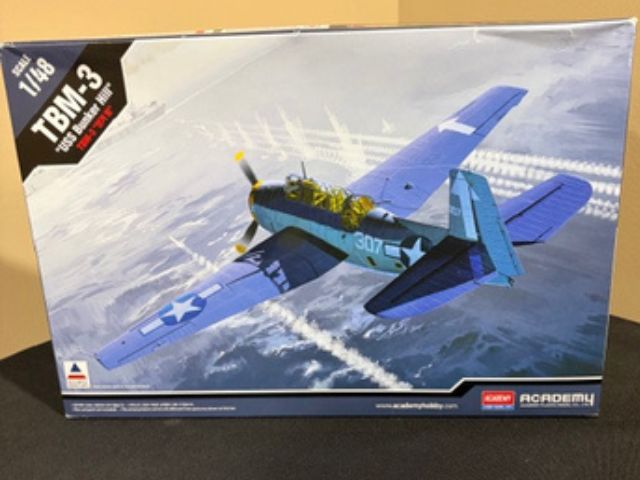
Written by
Steve Carmichael
I am a ww2 model enthusiast getting back into building scaled models after many years away. This site allows me to work on my web development skills while sharing what I am learning.