The Boeing Company
B-17 Flying Fortress
 Steve CarmichaelLast updated April 3, 2026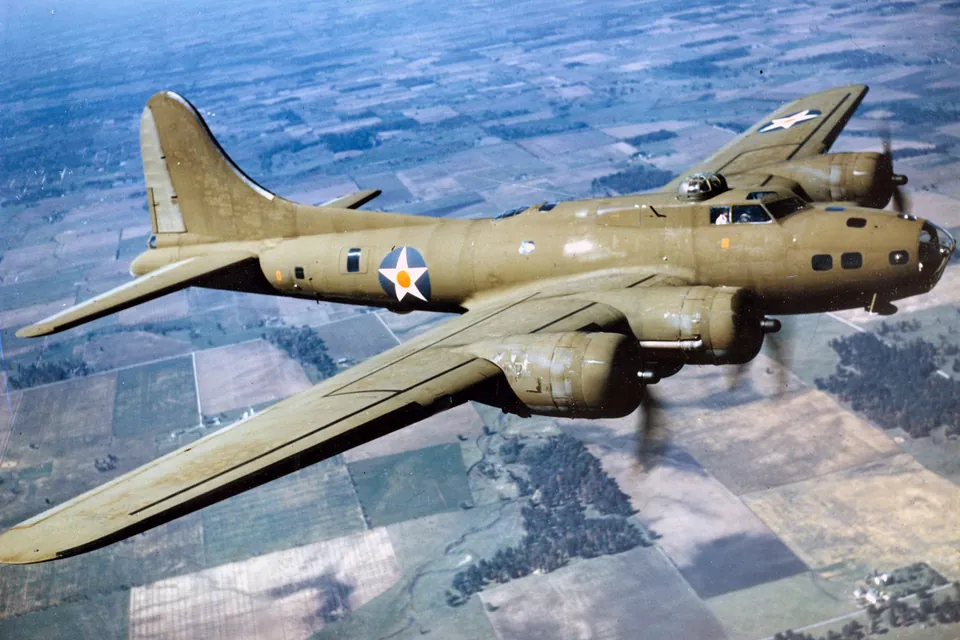
The B-17 Flying Fortress was a four-engine, turbo-supercharged heavy bomber that served as the primary daylight strategic bombing workhorse of the U.S. heavy bomber force in Europe. Across the complete production run, 12,731 aircraft were produced. Combat attrition was extreme: 4,735 B-17s were lost in combat in WWII, with training and noncombat losses of comparable magnitude.
B-17 Flying Fortress at a Glance
- Role
- Heavy Bomber
- Manufacturer
- The Boeing Company
- Nation
- United States
- Era
- World War II
By the Numbers
12,731
Built
4,735
Combat Losses
12,731
Built
4,735
Combat Losses
10
Crew
~46
Survive Today
4
Engines
13
Defensive Guns
Aircraft Description
The Boeing B-17 Flying Fortress became the symbol of American strategic bombing in Europe. With its bristling defensive armament and ability to absorb tremendous battle damage, the B-17 carried the daylight bombing campaign against Nazi Germany alongside the B-24 Liberator. The Eighth Air Force's massive formations of B-17s became an iconic image of the air war.
Paint Schemes and Markings
The B-17 Flying Fortress carried some of the most elaborate unit markings of any WWII aircraft type, with bomb group identification, squadron codes, and prolific nose art creating a rich visual history.
- Olive Drab over Neutral Gray (1941-late 1943): Dark Olive Drab (ANA 613) upper surfaces over Neutral Gray (ANA 603) undersides. All B-17E and B-17F models through spring 1943 were delivered in this scheme. Black de-icer boots on wing and tail leading edges. Some Pacific B-17Es received field-applied Medium Green blotches.
- Natural Metal Finish (late 1943 onward): Late-production B-17F and all B-17G models delivered unpainted. NMF B-17Gs began reaching 8th Air Force bomb groups in February 1944. During the transition, OD and NMF aircraft operated side by side in the same squadrons.
- 8th Air Force Bombardment Division Tail Markings: White geometric symbols 80 inches wide on the vertical stabilizer — Triangle for the 1st Bombardment Division, Square for the 3rd Bombardment Division. A letter inside the symbol identified the specific bomb group (e.g., Triangle-A for the 91st BG, Square-D for the 100th BG "Bloody Hundredth").
- Squadron Code Letters: Two-letter squadron codes in 48-inch gray letters applied forward of the fuselage national insignia. On NMF aircraft, codes were painted in black.
- Nose Art: B-17 nose art was among the most prolific of any WWII type. Subjects ranged from pin-up girls and cartoon characters to names and combat tallies. Mission tallies (small bomb silhouettes) were typically painted beneath the cockpit or near the nose art. The B-17's large, flat nose section provided an ideal canvas.
Design Features
Key engineering and design choices that defined the B-17 Flying Fortress's capabilities.
Powered Chin Turret (B-17G)
The Bendix remote-controlled chin turret with twin .50 caliber guns was the defining upgrade of the B-17G, added after devastating head-on attacks by Luftwaffe fighters exposed the B-17F's blind spot. It dramatically reduced frontal attack losses.
Turbo-Supercharged Engines
Four Wright R-1820 Cyclone engines with exhaust-driven General Electric turbo-superchargers maintained full power above 25,000 feet, allowing the B-17 to bomb from altitudes that made it harder for flak batteries to track and for interceptors to reach.
Self-Sealing Fuel Tanks
Layers of rubber and other materials around the fuel tanks would swell when contacted by fuel, automatically plugging bullet holes. This feature saved countless aircraft from catastrophic fuel fires after taking hits from fighters or flak.
Four Independent Fuel Systems
Each engine drew from its own fuel supply, so damage to one system did not affect the others. A B-17 could lose an engine to battle damage and continue flying on the remaining three — a capability that brought many crippled bombers home.
Staggered Waist Gun Positions
Late B-17G models offset the left and right waist gun windows so the two gunners would not bump into each other during combat — a simple modification born from combat experience that improved defensive firepower in the heat of battle.
Engines & Armament
Powerplant and weapons configuration for the B-17 Flying Fortress's primary production variant.
Powerplant
4x Wright R-1820-97 "Cyclone" turbo-supercharged radial engines, 1,200 hp each
Armament
13x .50 caliber M2 Browning machine guns (chin, dorsal, ventral ball, two waist, tail turrets plus cheek positions); up to 8,000 lbs of bombs
Specifications
Key dimensions and performance figures for the B-17 Flying Fortress's primary production variant.
- Crew
- 10
- Length
- 22.66 m(74.3 ft)
- Wingspan
- 31.62 m(103.7 ft)
- Height
- 5.82 m(19.1 ft)
- Wing Area
- 131.92 m²(1420 ft²)
- Max Speed
- 462 km/h(287 mph)
Variants & Models
Each B-17 Flying Fortress variant introduced changes to the airframe, engine, or armament. Visual ID features help modelers and spotters distinguish between versions.
Y1B-17
13
Built
- Powerplant
- 4x Wright R-1820-39, 930 hp
Visual ID
Pre-standard service-test configuration
Service test series; useful mainly for archival and museum provenance research
B-17B
39
Built
- Powerplant
- 4x Wright R-1820-51, 1,000 hp
Visual ID
Early "small tail" generation; lacks chin turret and later tail arrangements
First operational variant
B-17C
38
Built
- Powerplant
- 4x Wright R-1820-65, 1,200 hp
Visual ID
Early "small tail" generation; RAF Fortress I derived from this era
Often discussed in the context of early RAF employment
B-17D
42
Built
- Powerplant
- 4x Wright R-1820-65, 1,200 hp
Visual ID
Still early family; incremental improvements rather than the E-model redesign
Famous survivors can be from this early group
B-17E
512
Built
- Powerplant
- 4x Wright R-1820-65, 1,200 hp
Visual ID
Major redesign: tail and defensive positions change markedly vs B/C/D
Often treated as the first "modern Fortress" in recognition guides
B-17F
3,405
Built
- Powerplant
- 4x Wright R-1820-97, 1,200 hp
- Max Speed
- 523 km/h(325 mph)
- Range
- 4,506 km(2,800 mi)
- Ceiling
- 11,430 m(37,500 ft)
Visual ID
No chin turret; refined aerodynamics over E model
Boeing 2,300 + Douglas 605 + Vega 500. Museum fact sheet lists max speed 325 mph, range 2,800 mi, ceiling 37,500 ft.
B-17G
8,680
Built
- Powerplant
- 4x Wright R-1820-97 Cyclone, 1,200 hp
- Max Speed
- 483 km/h(300 mph)
- Range
- 2,977 km(1,850 mi)
- Ceiling
- 10,668 m(35,000 ft)
Visual ID
Powered chin turret under the nose is the defining late-war visual cue
Boeing 4,035 + Douglas 2,395 + Vega 2,250. Museum fact sheet lists max speed 300 mph, range 1,850 mi, ceiling 35,000 ft. Definitive late-war variant.
Development & Operational Timeline
Key milestones in the B-17 Flying Fortress's journey from design through operational service.
Model 299 Prototype First Flight
Boeing Model 299 makes its maiden flight from Boeing Field, Seattle.
Entry into U.S. Army Service
The B-17 enters operational service with the United States Army Air Corps.
RAF Operational Use Begins
The Royal Air Force begins operational use of the Fortress I (derived from B-17C).
U.S. Daylight Bombing Campaign Expands
The U.S. daylight heavy-bomber campaign in Europe expands significantly.
Schweinfurt-Regensburg Double-Strike
60 of 376 bombers shot down; more than 600 airmen killed, missing, or captured in a single day. Illustrated both B-17 capabilities and the devastating cost of deep penetration raids without continuous long-range escort.
B-17G Fielded with Chin Turret
The definitive B-17G variant enters service, featuring the powered chin turret as its defining visual feature — addressing the forward-defense gap exposed in earlier combat.
"Big Week" / Operation Argument
A major inflection point in the Combined Bomber Offensive, coupling heavy bomber mass with effective long-range escort and demonstrating the ability to sustain deep penetration raids.
Production Ends
B-17 production concludes. Conversion activity accelerates for special roles including air-sea rescue.
Rescue Designations Standardized
SB-17G / "B-17H" designations standardized in the postwar system for air-sea rescue conversions carrying an A-1 lifeboat.
Combat History
Major engagements and missions that defined the B-17 Flying Fortress's combat record.
First 8th Air Force Heavy Bomber Mission (Rouen)
August 17, 1942Twelve B-17Es of the 97th Bombardment Group struck the Sotteville-lès-Rouen railroad marshaling yards in occupied France — the first heavy bomber mission flown by the 8th Air Force from England. General Ira Eaker flew aboard the lead aircraft, "Yankee Doodle." RAF Spitfires provided escort for the short-range mission.
12
Dispatched
0
Aircraft Lost
0
Personnel Lost
The opening act of the American daylight strategic bombing campaign in Europe. Though a tiny mission by later standards, it validated the concept of high-altitude precision daylight bombing and established the 8th Air Force's operational pattern. The date — exactly one year before Schweinfurt-Regensburg — became a symbolic milestone.
Schweinfurt-Regensburg Double-Strike
August 17, 1943A two-pronged deep-penetration daylight raid targeting ball-bearing factories at Schweinfurt and a Messerschmitt assembly plant at Regensburg. The Regensburg force continued to North Africa as a shuttle mission.
376
Dispatched
60
Aircraft Lost
600
Personnel Lost
Emblematic of the escort-range crisis: demonstrated both B-17 capabilities and the unsustainable cost of unescorted deep raids, accelerating demand for long-range fighter escort.
Bremen-Vegesack Raid
October 8, 1943A major mission against the Focke-Wulf aircraft factory at Bremen-Vegesack and the port area of Bremen. This was part of a brutal week of losses — "Black Week" — that preceded the Second Schweinfurt raid six days later. The 1st and 3rd Bombardment Divisions sent B-17s against separate targets in the Bremen area.
399
Dispatched
30
Aircraft Lost
300
Personnel Lost
Part of the devastating October 1943 attrition that temporarily broke the offensive capability of the 8th Air Force. Combined with Schweinfurt on the 14th, the week's losses totaled over 150 heavy bombers — forcing a strategic pause in deep-penetration missions until long-range escorts arrived in quantity.
Münster Raid — 100th Bomb Group Decimation
October 10, 1943The 3rd Bombardment Division attacked the city center of Münster while the 1st Division struck targets at Coesfeld and Enschede. The 13th Combat Wing — led by the 100th Bombardment Group — bore the brunt of concentrated Luftwaffe attacks. The 100th lost 12 of its 13 dispatched aircraft in a single mission, earning its enduring nickname "The Bloody Hundredth."
274
Dispatched
30
Aircraft Lost
300
Personnel Lost
The Münster mission cemented the 100th Bomb Group's reputation as "The Bloody Hundredth" — a unit seemingly cursed with disproportionate losses. Coming just four days before Black Thursday at Schweinfurt, it was part of the October 1943 crisis that nearly broke the 8th Air Force. The concentrated loss pattern demonstrated how Luftwaffe fighters targeted the most vulnerable formation positions.
Second Schweinfurt Raid ("Black Thursday")
October 14, 1943A return mission to the Schweinfurt ball-bearing complex, two months after the devastating August 17 double-strike. The 291 B-17s flew without long-range fighter escort beyond the German border. Luftwaffe fighters and flak mounted a relentless defense across the entire route.
291
Dispatched
60
Aircraft Lost
650
Personnel Lost
Black Thursday was the single costliest unescorted bombing mission of the war for the 8th Air Force. The 20.7% loss rate — 60 of 291 B-17s destroyed, with 17 more written off after landing — effectively ended deep-penetration missions without long-range fighter escort. The mission directly accelerated P-51 Mustang deployment to the ETO.
"Big Week" / Operation Argument
February 20-25, 1944A concentrated series of heavy bomber missions against German aircraft production facilities, conducted with increasingly effective long-range escort coverage.
Demonstrated that Americans could penetrate the worst the Luftwaffe could muster with escort support, marking a turning point in the Combined Bomber Offensive.
First Major Berlin Raid
March 6, 1944The 8th Air Force launched its first large-scale daylight attack on Berlin, sending 730 heavy bombers — including over 500 B-17s — against the German capital. Dense cloud cover scattered the formations and forced many aircraft to bomb secondary targets. The Luftwaffe mounted one of its largest defensive efforts of the war, engaging the bombers and their P-51 escorts in running battles across Germany.
730
Dispatched
69
Aircraft Lost
700
Personnel Lost
The costliest single day in 8th Air Force history in terms of aircraft lost. However, unlike earlier disasters, the bombers now had long-range P-51 escort and the Luftwaffe's fighter losses were unsustainable. The willingness to accept heavy losses to strike Berlin — the most symbolically and strategically important target — demonstrated that the air war had entered its decisive phase. Subsequent Berlin missions in March 1944 further eroded Luftwaffe fighter strength.
Oil Campaign — Synthetic Fuel Attacks
May-September 1944Beginning May 12, 1944, the 8th Air Force launched a sustained campaign against German synthetic oil plants — the Achilles' heel of the Nazi war machine. Major targets included Leuna-Merseburg, Pölitz, Brüx, and Zeitz. The Leuna complex alone was attacked 22 times. The Germans recognized the existential threat and concentrated their remaining flak defenses around oil facilities, making these among the most heavily defended targets of the war.
Albert Speer later identified the oil campaign as the decisive factor in Germany's military collapse. Without fuel, the Luftwaffe could not train pilots or fly sorties, Panzer divisions could not maneuver, and the Wehrmacht's logistics system seized up. The Leuna plant's flak defenses — over 400 heavy guns — made it the most heavily defended single target in Europe. B-17 crews considered oil targets the most dangerous missions of the war.
D-Day Bombardment (Operation Overlord)
June 6, 1944On the morning of D-Day, over 1,000 8th Air Force heavy bombers — primarily B-17s — were tasked with bombing German beach defenses along the Normandy coast immediately before the amphibious landings. Due to heavy cloud cover, bombardiers delayed their release to avoid hitting Allied troops, and most bombs fell inland behind the beach defenses.
3
Aircraft Lost
A rare tactical failure for the 8th Air Force despite overwhelming air superiority. The decision to delay bomb release — prioritizing troop safety over target accuracy — was controversial but reflected the enormous stakes. The mission demonstrated the difficulty of using strategic bombers for close tactical support. The near-total absence of Luftwaffe opposition over the beaches confirmed Allied air supremacy achieved since Big Week.
Dresden Raid
February 15, 1945On February 15, 1945 — the day after the RAF's devastating nighttime firebombing — 311 B-17s of the 1st Bombardment Division struck the Dresden railroad marshaling yards in a follow-up daylight attack. A second force of 210 B-17s returned on February 15 to hit the rail yards again. The raids were part of Operation Thunderclap, intended to disrupt communications and transportation supporting the Eastern Front.
311
Dispatched
0
Aircraft Lost
0
Personnel Lost
The most controversial bombing operation of the European air war. While the 8th Air Force mission specifically targeted rail infrastructure — a legitimate military objective — the combined Allied raids on Dresden became a lasting symbol of the moral complexity of strategic bombing. The debate over military necessity versus civilian destruction continues to this day.
Unit Markings
The B-17 Flying Fortress served with units whose markings are documented in our markings reference guides.
8th Air Force Markings Lookup
Tail symbols, fuselage codes, and division color schemes for every strategic bomber and fighter group based in England.
15th Air Force Markings Lookup
Wing symbols, tail color schemes, and squadron markings for every strategic bomber and fighter group based in Italy.
5th Air Force Markings Lookup
Tail numbers, group insignia, and squadron markings for every bomber, attack, and fighter unit in the Southwest Pacific Theater.
Production & Service
From first flight to retirement — the B-17 Flying Fortress's operational lifespan at a glance.
- Number Built
- 12,731
- First Service
- 1938
- Last Built
- 1945
- Retired
- 1968
- Combat Losses
- 4,735
- Status
- Retired
Where to See One
Surviving B-17 Flying Fortress aircraft you can visit today. Airworthy aircraft may appear at air shows.
"Aluminum Overcast"
S/N: 44-83868
Variant: B-17G
Airworthy B-17G operated by the EAA. Nationwide tour offering warbird rides.
"Sally B" (G-BEDF)
S/N: 44-85784
Variant: B-17G
The sole airworthy B-17 in Europe. Regular UK airshow appearances. Based at IWM Duxford.
"Sentimental Journey"
S/N: 44-83514
Variant: B-17G
Airworthy B-17G. Tours nationally with the Commemorative Air Force Arizona Wing.
"Yankee Lady"
S/N: 44-85829
Variant: B-17G
Airworthy B-17G. Offers warbird rides. Under periodic long-term maintenance.
Sally-B
S/N: 44-85784
Variant: B-17G
Imperial War Museum Duxford
Duxford, United Kingdom
Duxford, Cambridgeshire, CB22 4QR
B-17 Preservation Ltd
Visit website →Official flying programme published online; last airworthy B-17 in Europe
Sentimental Journey
S/N: 44-83514
Variant: B-17G
Falcon Field
Mesa, Arizona
2017 N. Greenfield Road, Mesa, AZ 85215
Commemorative Air Force Airbase Arizona
Visit website →Tour schedule published seasonally
Ye Olde Pub
S/N: 44-8543
Variant: B-17G
"The Swoose"
S/N: 40-3097
Variant: B-17D
The oldest surviving B-17 and the only B-17D in existence. Under restoration as of 2023–25. Named after the novelty song "Alexander the Swoose."
Champaign Lady
S/N: 44-85813
Variant: B-17G
Urbana, Ohio
Visit website →Under restoration to operational
Desert Rat
S/N: 41-2595
Variant: B-17E
Marengo, Illinois
Visit website →Under restoration to operational; rare E-model survivor
Yankee Lady
S/N: 44-85829
Variant: B-17G
Madras, Oregon
Visit website →Long-term restoration/maintenance back to operational
"Memphis Belle"
S/N: 44-83575
Variant: B-17G
The most famous B-17 in history. Fully restored and on display since 2018. The aircraft that completed 25 combat missions, inspiring the wartime documentary and later films.
"Shoo Shoo Shoo Baby"
S/N: 42-32076
Variant: B-17G
8th Air Force combat veteran. Transferred from NASM. Displayed at the National Museum of the USAF.
Aluminum Overcast
S/N: 44-85740
Variant: B-17G
EAA Aviation Museum
Oshkosh, Wisconsin
3000 Poberezny Road, Oshkosh, WI 54902
Experimental Aircraft Association
Visit website →Long-term preservation/repair discussed publicly
B-17G (Museum of Aviation)
Variant: B-17G
B-17G on static display at the Museum of Aviation at Robins Air Force Base.
B-17G (SAC Museum)
Variant: B-17G
Strategic Air Command & Aerospace Museum
Ashland, Nebraska
Strategic Air Command & Aerospace Museum
Visit website →B-17G on static display at the Strategic Air Command & Aerospace Museum.
B-17G 44-83735 (IWM Duxford)
S/N: 44-83735
Variant: B-17G
Static display B-17G wearing 96th Bomb Group markings at IWM Duxford, UK.
Model Kits Available
Scale model kits of the B-17 Flying Fortress from leading manufacturers.
Revell 1/48 B-17G Flying Fortress
Revell · 1/48
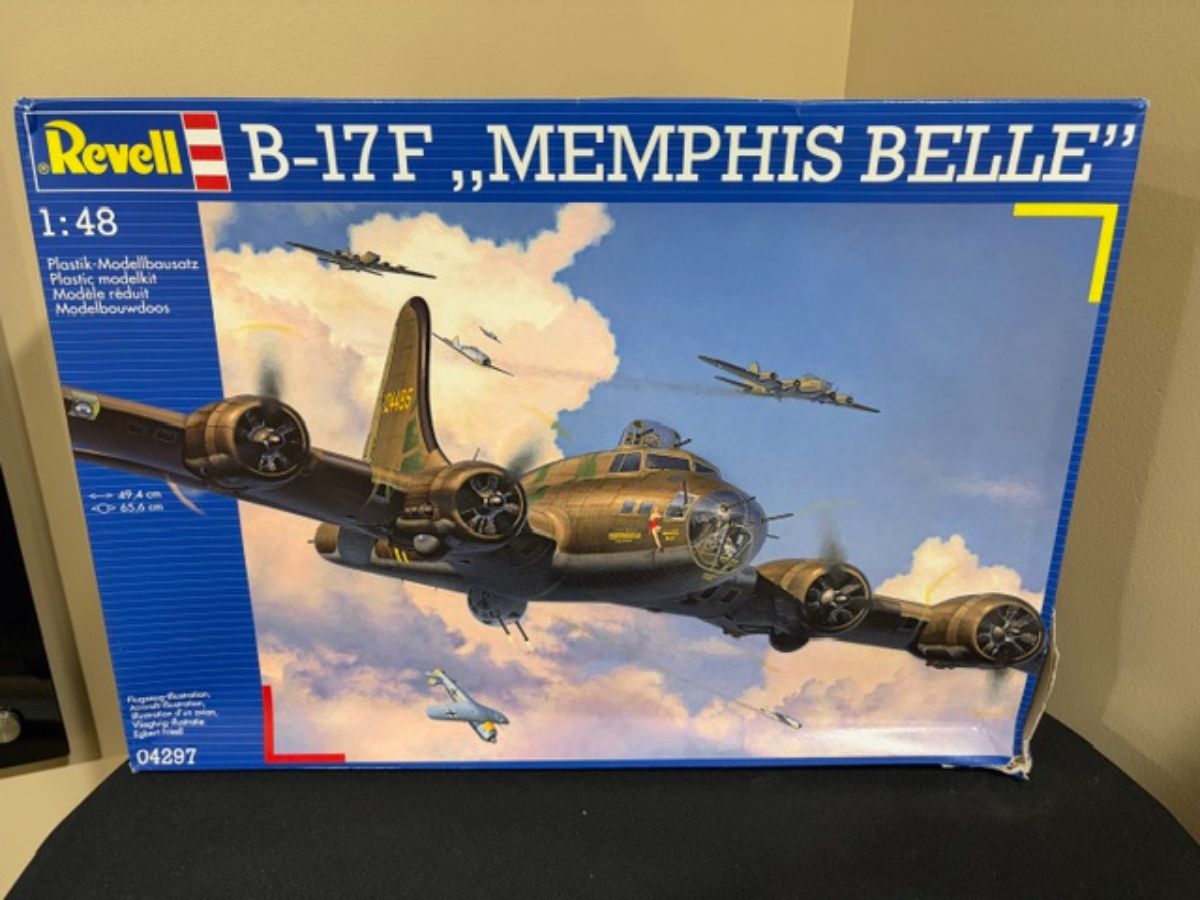
Revell 1/48 B-17F "Memphis Belle"
Revell · 1/48
Revell 1/72 B-17G Flying Fortress
Revell · 1/72
Written by
Steve Carmichael
I am a ww2 model enthusiast getting back into building scaled models after many years away. This site allows me to work on my web development skills while sharing what I am learning.