Consolidated Aircraft Corporation
B-24 Liberator
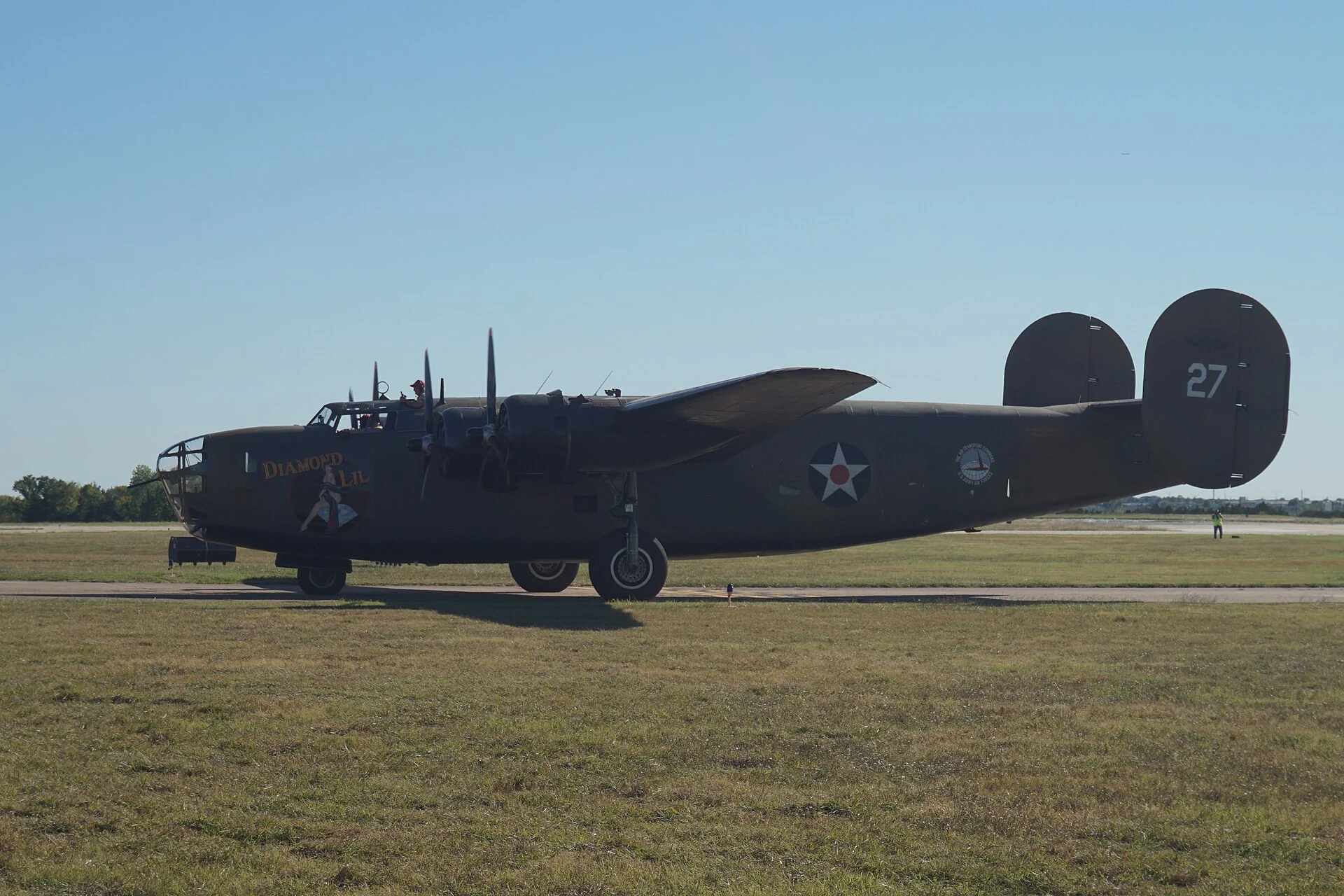
The Consolidated B-24 Liberator was the most-produced heavy bomber in aviation history, with approximately 18,482 built — more than any other American military aircraft of World War II. Its innovative high-aspect-ratio Davis wing delivered longer range and higher speed than the B-17, though it flew at lower altitudes and was less forgiving of battle damage. The B-24 served in every theater of the war: strategic bombing in Europe, the legendary low-level Ploesti oil refinery raids, anti-submarine patrols across the Atlantic, and long-range strikes from India and China. Ford's Willow Run plant famously produced one B-24 every 63 minutes at peak output.
Quick Facts
- Role
- Heavy Bomber
- Manufacturer
- Consolidated Aircraft Corporation
- Nation
- United States
- Era
- World War II
- Produced
- 18,482
~18,482
Built
5
Factories
10
Crew
~16
Survive Today
~2,100 mi
Range
10
Defensive Guns
Aircraft Description
The Consolidated B-24 Liberator was the most-produced heavy bomber in history and the most-produced American military aircraft of World War II, with approximately 18,482 built across five factories. Its high-aspect-ratio Davis wing gave it longer range and higher speed than the B-17, making it essential for long-distance missions in the Pacific, Mediterranean, and Atlantic theaters. The B-24 served in every combat theater of the war — from strategic bombing over Europe to anti-submarine patrols in the Atlantic and long-range strikes in the China-Burma-India theater.
Engines & Armament
Powerplant
4x Pratt & Whitney R-1830-65 "Twin Wasp" 14-cylinder twin-row radial engines, 1,200 hp each
Armament
10x .50 caliber M2 Browning machine guns (nose, dorsal, ventral ball, two waist, tail turrets); up to 8,000 lbs of bombs in two internal bomb bays
Design Features
Davis Wing
The B-24's high-aspect-ratio Davis wing was its defining engineering innovation. The long, narrow airfoil generated exceptional lift-to-drag ratio, giving the Liberator greater range and speed than the B-17. However, the wing was less tolerant of battle damage — a structural hit that a B-17's shorter, thicker wing might survive could prove fatal to a B-24.
Tricycle Landing Gear
Unlike the B-17's conventional tailwheel arrangement, the B-24 used a nosewheel tricycle landing gear — advanced for the era. This gave better ground handling and visibility during taxi, but the gear retracted forward into the wing, creating the distinctive pods visible under the wing leading edge.
Twin Vertical Stabilizers
The B-24's twin tail fins are its most recognizable silhouette feature. The twin-tail design provided directional stability for the long, slab-sided fuselage. Later N-models switched to a single large vertical stabilizer, making them visually distinct from all earlier Liberators.
Roller-Shutter Bomb Bay Doors
Instead of conventional hinged doors, the B-24 used innovative roller-shutter bomb bay doors that retracted upward along tracks inside the fuselage. This eliminated the drag penalty of open bomb bay doors and allowed the aircraft to maintain speed during bomb runs — a significant tactical advantage over the B-17's slower hinged doors.
Five-Factory Production
To meet wartime demand, B-24s were built at five plants simultaneously: Consolidated in San Diego and Fort Worth, Ford at Willow Run (Michigan), North American in Dallas, and Douglas in Tulsa. Ford's Willow Run plant — the world's largest factory under one roof at 3.5 million square feet — famously applied automobile mass-production techniques to bomber manufacturing.
Specifications
- Crew
- 10
- Length
- 20.47 m
- Wingspan
- 33.53 m
- Height
- 5.64 m
- Wing Area
- 97.36 m²
- Max Speed
- 467 km/h
Variants & Models
| Variant | Engines | Max Speed | Range | Ceiling | Armament | Built |
|---|---|---|---|---|---|---|
| XB-24 | 4x P&W R-1830-33, 1,100 hp | 439 km/h | 7,564 km | 9,601 m | .30 cal nose guns; no turrets | 2 |
| B-24D | 4x P&W R-1830-43, 1,200 hp | 468 km/h | 3,540 km | 7,407 m | 10x .50 cal (nose, dorsal, ventral, waist, tail) | 2,696 |
| B-24H | 4x P&W R-1830-43/41, 1,200 hp | — | — | — | 12x .50 cal (tail turret ammo increased to 12,000 rounds) | 3,100 |
| B-24J | 4x P&W R-1830-65/43, 1,200 hp | 467 km/h | 3,380 km | 8,534 m | 10x .50 cal (nose, dorsal, Sperry ventral, waist, tail) + AN/APS-5 radar | 6,678 |
| B-24L | 4x P&W R-1830-65, 1,200 hp | — | — | — | 10x .50 cal + AN/APQ-7 "Eagle" radar blisters under nose | 1,667 |
| B-24M | 4x P&W R-1830-65, 1,200 hp | — | — | — | 10x .50 cal; shorter tail gun housing on some | 2,593 |
| B-24N | 4x P&W R-1830-65-A, 1,200 hp | — | — | — | 10x .50 cal | 250 |
| C-87 Liberator Express | 4x P&W R-1830, 1,200 hp | — | — | — | Minimal defensive armament | 287 |
| PB4Y-1 (Navy) | 4x P&W R-1830, 1,200 hp | — | — | — | Modified from B-24D/J; no tail turret; open tail barbette | 976 |
XB-24
- Engines
- 4x P&W R-1830-33, 1,100 hp
- Max Speed
- 439 km/h
- Range
- 7,564 km
- Ceiling
- 9,601 m
- Built
- 2
- Armament
- .30 cal nose guns; no turrets
More details
ID Features: Round engine nacelle cowlings; fixed landing gear pods; three-blade Curtiss propellers
Notes: Two prototypes (s/n 39-556 and 39-557). First flight December 29, 1939 at Lindbergh Field, San Diego.
B-24D
- Engines
- 4x P&W R-1830-43, 1,200 hp
- Max Speed
- 468 km/h
- Range
- 3,540 km
- Ceiling
- 7,407 m
- Built
- 2,696
- Armament
- 10x .50 cal (nose, dorsal, ventral, waist, tail)
More details
ID Features: Deep bomb bay fairings; larger tail fins than prototype; distinctive "greenhouse" nose
Notes: Major early production variant. Consolidated San Diego built 2,381; Fort Worth built 305. First variant to see widespread combat.
B-24H
- Engines
- 4x P&W R-1830-43/41, 1,200 hp
- Built
- 3,100
- Armament
- 12x .50 cal (tail turret ammo increased to 12,000 rounds)
More details
ID Features: Taller tail fins; heavier landing gear; reinforced airframe
Notes: Consolidated San Diego 738 + Fort Worth 1,780 + Ford 582. Standardized .50 cal armament throughout.
B-24J
- Engines
- 4x P&W R-1830-65/43, 1,200 hp
- Max Speed
- 467 km/h
- Range
- 3,380 km
- Ceiling
- 8,534 m
- Built
- 6,678
- Armament
- 10x .50 cal (nose, dorsal, Sperry ventral, waist, tail) + AN/APS-5 radar
More details
ID Features: Angled-frame greenhouse windshield; squared tail fins (late-J); Sperry belly turret; autopilot (COAT)
Notes: Most-produced variant. Built at all five factories: Consolidated SD 2,792 + FW 1,558 + Ford 1,587 + North American 536 + Douglas 205.
B-24L
- Engines
- 4x P&W R-1830-65, 1,200 hp
- Built
- 1,667
- Armament
- 10x .50 cal + AN/APQ-7 "Eagle" radar blisters under nose
More details
ID Features: Radar blisters under nose; foot-operated brakes replaced handbrakes; otherwise identical profile to J
Notes: Consolidated San Diego 417 + Fort Worth 1,250. Added L-band radar capability.
B-24M
- Engines
- 4x P&W R-1830-65, 1,200 hp
- Built
- 2,593
- Armament
- 10x .50 cal; shorter tail gun housing on some
More details
ID Features: Externally identical to J/L except M-series had shorter tail gun housing on some low-cost variants
Notes: Consolidated San Diego 916 + Fort Worth 1,677. Simplified hydraulic plumbing. Final mass-production USAAF variant.
B-24N
- Engines
- 4x P&W R-1830-65-A, 1,200 hp
- Built
- 250
- Armament
- 10x .50 cal
More details
ID Features: Single large triangular vertical tail fin (unique among Liberators); lengthened nose; streamlined ballast
Notes: Final production variant. Consolidated-only (no Boeing-built N models). Visually distinctive single-fin tail.
C-87 Liberator Express
- Engines
- 4x P&W R-1830, 1,200 hp
- Built
- 287
- Armament
- Minimal defensive armament
More details
ID Features: Windows and cargo doors replacing bomb bays; transport interior
Notes: Transport variant of B-24D/G. Used for VIP transports, fuel tankers, and "Hump" operations over the Himalayas.
PB4Y-1 (Navy)
- Engines
- 4x P&W R-1830, 1,200 hp
- Built
- 976
- Armament
- Modified from B-24D/J; no tail turret; open tail barbette
More details
ID Features: No tail turret; modified waist guns; open tail barbette in early versions
Notes: U.S. Navy designation for approximately 976 B-24D/Js militarized for maritime patrol. The PB4Y-2 Privateer was a separate, extensively redesigned derivative with a single tail fin.
Production & Service
- Number Built
- 18,482
- First Service
- 1941
- Last Built
- 1945
- Retired
- 1968
- Status
- Retired
Development & Operational Timeline
USAAC Contract Awarded
The U.S. Army Air Corps contracts Consolidated Aircraft to build a new heavy bomber (Model 32) that would out-perform the B-17. Chief test pilot Bill Wheatley would fly the prototype later that year.
XB-24 Prototype First Flight
The prototype XB-24 (AAF 39-556) makes its maiden 17-minute flight from Lindbergh Field, San Diego. It met initial requirements with a 7-man crew, 110 ft span, and 27,500 lb empty weight.
Entry into Service
The B-24 enters operational service. Early models are delivered to the RAF as Liberator I/II for Atlantic patrol and to USAAF units for training and coastal defense.
Multi-Factory Production Begins
Ford's massive Willow Run plant near Ypsilanti, Michigan begins B-24 production alongside Consolidated's two plants and new lines at North American (Dallas) and Douglas (Tulsa). At peak, Willow Run produced one bomber every 63 minutes.
China-Burma-India Theater Operations
The 14th Air Force ("Flying Tigers") and other B-24 units operate extensively from India and China, striking Japanese shipping, oil refineries, and targets across Burma, Thailand, and French Indochina. The B-24's range makes it essential for the vast distances of the CBI theater.
Atlantic Anti-Submarine Campaign
B-24 Liberators and RAF Coastal Command Liberator GR variants close the mid-Atlantic "Air Gap," using their superior range to hunt U-boats that had previously operated beyond the reach of Allied patrol aircraft. This contribution is critical to winning the Battle of the Atlantic.
Operation Tidal Wave — Ploesti Raid
178 B-24D/Js from Libya launch a daring low-level attack on Romanian oil refineries at Ploesti. 53 aircraft are shot down and hundreds of crewmen killed or captured, but significant damage is inflicted on Axis fuel production. Five Medals of Honor are awarded — the most for any single air action in history.
Peak Production at Willow Run
Ford's Willow Run plant reaches peak output, delivering 428 B-24s in a single month — one bomber every 63 minutes. The plant's 3.5 million square feet of floor space makes it the largest factory under one roof in the world.
Production Ends
B-24 production concludes after approximately 18,482 aircraft — the highest total of any heavy bomber and any American military aircraft in WWII. Most B-24s are rapidly retired or scrapped after V-J Day.
Postwar Service and Retirement
USAAF/USAF rapidly retires most B-24s by 1946. The Indian Air Force operates Liberators until 1968 — the last military user of the type. By 1951, only one B-24 remains in American service.
Combat History
Battle of the Atlantic — Anti-Submarine Patrols
1942-1945B-24 Liberators and RAF Coastal Command Liberator variants conducted long-range anti-submarine patrols across the Atlantic, closing the mid-Atlantic "Air Gap" that U-boats had exploited to devastating effect.
The B-24's exceptional range (over 2,000 miles with combat load) made it the only Allied land-based aircraft capable of covering the mid-Atlantic gap. This contribution was essential to winning the Battle of the Atlantic and securing Allied supply lines.
European Strategic Bombing Campaign
1942-1945B-24 groups of the 8th Air Force (England) and 15th Air Force (Italy) conducted strategic bombing of German oil, ball-bearing, and aircraft production facilities alongside B-17 formations.
While the B-17 is more often associated with the European bombing campaign, B-24 groups flew thousands of combat sorties over Europe. The 15th Air Force in Italy was particularly reliant on B-24s for long-range missions over the Alps and into Austria, Hungary, and the Balkans.
Operation Tidal Wave — Ploesti Raid
August 1, 1943A massive low-level B-24 raid launched from Benghazi, Libya against the Ploesti oil refineries in Romania — the Axis powers' primary fuel source. The attacking force flew at treetop level through intense flak and fighter defenses.
178
Dispatched
53
Aircraft Lost
The costliest single air mission of the war in terms of percentage losses (nearly 30%). Demonstrated the B-24's range capability — the 2,400-mile round trip was beyond any other Allied heavy bomber. Five Medals of Honor were awarded, the most for any single air action in USAAF history.
Where to See One
Diamond Lil
S/N: 40-2366
Variant: B-24A
CAF – Dixie Wing
Peachtree City, Georgia
Commemorative Air Force
One of only two airworthy Liberators. Polished aluminum finish. Subject of extensive restoration.
Witchcraft
S/N: 44-44052
Variant: B-24J
Collings Foundation
Stow, Massachusetts
Collings Foundation
One of only two airworthy Liberators worldwide. Continues to fly displays. Often seen in bare metal with "freeport mac" nose art.
Bungay Buckaroo
S/N: 44-44175
Variant: B-24J
Pima Air & Space Museum
Tucson, Arizona
Pima Air & Space Museum
Built 1944 by Consolidated San Diego. Served with 446th Bomb Group. Restored to original bare-metal finish.
Joe
S/N: 44-44272
Variant: B-24J
Fantasy of Flight Museum
Polk City, Florida
Fantasy of Flight
On static display. Local history stories exist about this aircraft.
Queen Bee
S/N: 44-50206
Variant: B-24L
RAF Museum
London, United Kingdom
Royal Air Force Museum
Ex-USA kit, named "The Queen Bee." One of the few Liberators preserved outside the United States.
Shady Lady
S/N: 44-41916
Variant: B-24M
Castle Air Museum
Atwater, California
Castle Air Museum
Recovered from Bolivia in 1977. Restored over 8.5 years with 36,000 volunteer hours. Painted in 93rd BG (Ploesti) markings.
Strawberry Bitch
S/N: 42-72843
Variant: B-24D
National Museum of the United States Air Force
Dayton, Ohio
United States Air Force
Famous 8th AF aircraft (457th BG) with nose art. Now displayed indoors at the NMUSAF.