North American Aviation
B-25 Mitchell
 Steve CarmichaelLast updated April 3, 2026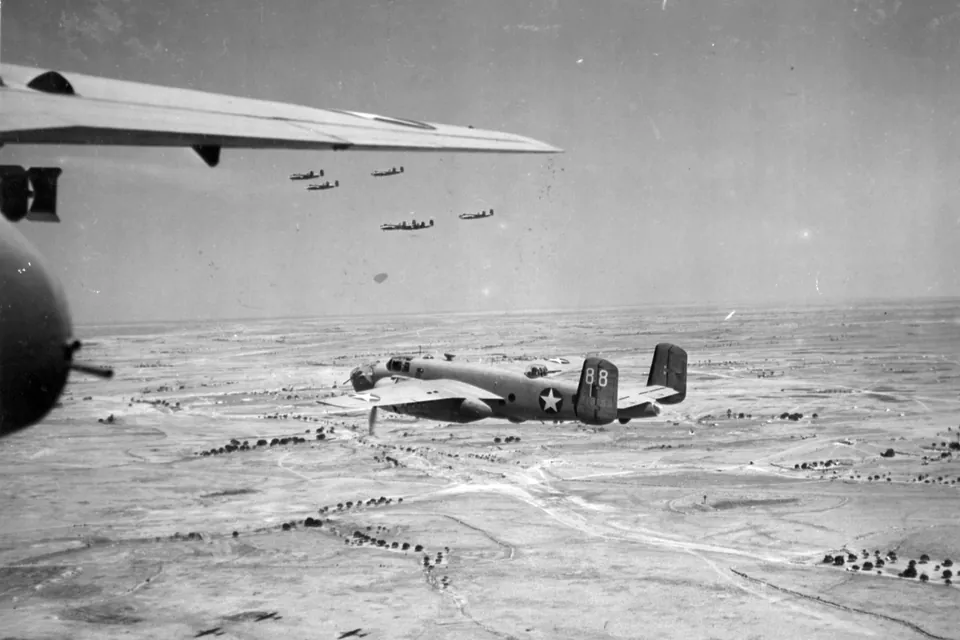
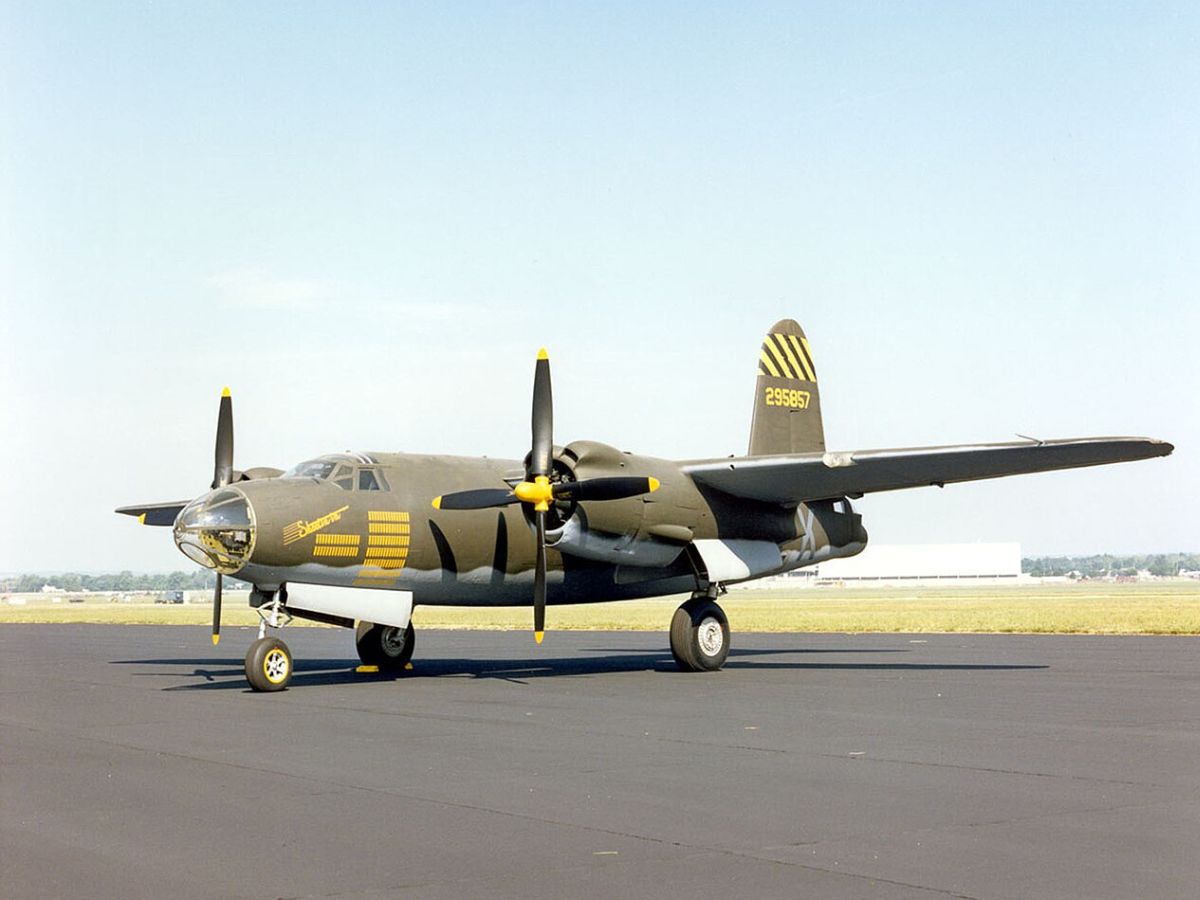
The B-25 Mitchell was a twin-engine medium bomber designed and produced by North American Aviation for United States Army Air Forces employment across World War II's major combat areas. Official AAF statistics record 9,816 B-25 acceptances through August 1945, with peak acceptances in 1944. Production was split between two plants: 3,208 at Inglewood and 6,608 at Kansas City (Fairfax). The aircraft's most famous single event is the 18 April 1942 Doolittle Raid on Japan. Although intended for medium-altitude level bombing, the B-25 became strongly associated with low-level tactics—treetop bombing, strafing, and skip bombing—especially in Pacific operations.
B-25 Mitchell at a Glance
- Role
- Medium Bomber
- Manufacturer
- North American Aviation
- Nation
- United States
- Era
- World War II
By the Numbers
9,816
Built
9,816
AAF Acceptances
16 aircraft
Doolittle Raid
5
Crew
2
Engines
3,208
Inglewood Plant
6,608
Kansas City Plant
Aircraft Description
The North American B-25 Mitchell is best known for the Doolittle Raid of April 1942, when sixteen B-25s launched from the aircraft carrier USS Hornet to bomb Tokyo — the first air raid to strike the Japanese home islands. Named after air power advocate General Billy Mitchell, it became one of the most versatile and widely used medium bombers of the war.
Paint Schemes and Markings
The B-25 Mitchell served across multiple theaters and roles, from the famous Doolittle Raid to Pacific strafer missions, each with distinctive markings that reflected its versatile service.
- Olive Drab over Neutral Gray (1941-1944): Standard USAAF scheme — Dark Olive Drab (ANA 613) uppers over Neutral Gray (ANA 603) undersides. Black de-icer boots on wing and tail leading edges. The most common B-25 scheme throughout the war, especially in the Pacific where many aircraft retained OD paint through V-J Day.
- Doolittle Raid Markings (April 18, 1942): The 16 B-25B Mitchells were freshly manufactured in standard OD over Neutral Gray. Pre-war insignia with white star on blue disc and red center dot. Minimal unit markings. Lower gun turrets removed; fake wooden gun barrels (broomsticks painted black) installed in the tail as deterrents. Notable aircraft names included "Hari-Kari-er" and "Whiskey Pete."
- Natural Metal Finish (late 1944 onward): Late-production B-25J models delivered unpainted. Less common than on fighters — many B-25s retained camouflage paint through the war's end.
- Pacific Strafer Markings: "Pappy" Gunn's field-modified B-25C/D strafers in the SWPA featured solid metal noses replacing bombardier glazing, with four to eight forward-firing .50 cal guns. Factory B-25J strafer noses were sometimes painted flat black or left in natural metal. The 345th Bomb Group "Air Apaches" carried distinctive nose art and bat silhouette markings.
- Marine PBJ-1: USMC B-25s (designated PBJ-1) received Navy tri-color or overall Sea Blue schemes for Pacific operations.
Design Features
Key engineering and design choices that defined the B-25 Mitchell's capabilities.
Distinctive Wing Dihedral Break
Early flight testing revealed dangerous stability issues in the original straight-wing design. Engineers eliminated the outer wing dihedral, creating the B-25's signature flat-winged profile with a visible break at the engine nacelles. This simple change tamed the handling and defined the aircraft's silhouette.
Extensive Field Modification Culture
The B-25 was one of the most heavily field-modified aircraft of the war. Squadrons in the Pacific routinely added extra forward-firing guns, removed defensive positions, and improvised bomb racks — all with tacit approval from North American Aviation, who designed the airframe to tolerate modification.
Dual Nose Configurations (B-25J)
The most-produced variant offered two completely different noses: a glazed 'greenhouse' nose for high-altitude level bombing with a bombardier, and a solid nose packed with eight .50 caliber guns for low-level strafing. This versatility let the same airframe serve as both a precision bomber and a ground-attack gunship.
Two-Plant Production
B-25s were built at two North American Aviation facilities: the original Inglewood, California plant (3,208 aircraft) and a massive new factory in Kansas City/Fairfax, Kansas (6,608 aircraft). The Kansas City plant alone produced more B-25s than all but a handful of aircraft types in the entire war.
Low-Altitude Attack Doctrine
While designed as a medium-altitude bomber, the B-25 became legendary for treetop-level attacks. Skip bombing — bouncing bombs off the water into ship hulls — was pioneered with B-25s in the Southwest Pacific. The technique was devastatingly effective against Japanese shipping and required extraordinary pilot skill and nerve.
Engines & Armament
Powerplant and weapons configuration for the B-25 Mitchell's primary production variant.
Powerplant
2x Wright R-2600 "Cyclone 14" twin-row radial engines (variant-specific: R-2600-9 early production, R-2600-13 later variants)
Armament
Varied extensively by variant: early models (B-25B) had dorsal and retractable ventral turrets with nose gun; gunship variants (B-25G) added a 75mm cannon; the B-25H carried cannon plus heavy forward-firing .50 cal guns with forward dorsal turret; the B-25J offered either a glazed bomber nose or solid 8-gun strafer nose
Specifications
Key dimensions and performance figures for the B-25 Mitchell's primary production variant.
- Crew
- 5
- Length
- 16.13 m(52.9 ft)
- Wingspan
- 20.6 m(67.6 ft)
- Height
- 4.98 m(16.3 ft)
- Wing Area
- 57.4 m²(618 ft²)
- Max Speed
- 438 km/h(272 mph)
Variants & Models
Each B-25 Mitchell variant introduced changes to the airframe, engine, or armament. Visual ID features help modelers and spotters distinguish between versions.
B-25-NA
24
Built
- Powerplant
- 2x Wright R-2600-9
Visual ID
Early tail arrangement and wing configuration; "gull wing" dihedral change becomes standard after early stability fix
First production series. Contract/serial block data and early wing change narrative appear in factory-history reconstructions.
B-25A-NA
40
Built
- Powerplant
- 2x Wright R-2600-9
Visual ID
Visually very close to B-25-NA; identification described as difficult, with self-sealing fuel cells and armor not always visible in photos
Often best identified by serial/documentation rather than visible features.
B-25B-NA
120
Built
- Powerplant
- 2x Wright R-2600-9
- Max Speed
- 457 km/h(284 mph)
- Range
- 2,092 km(1,300 mi)
- Ceiling
- 7,163 m(23,501 ft)
Visual ID
Twin turrets on rear fuselage; open tail skid; described as first B-25 to go to war
Doolittle Raid aircraft were modified B-25B-NA; the model is highlighted for carrier-deck feasibility.
B-25C-NA
1,625
Built
- Powerplant
- 2x Wright R-2600-13
- Max Speed
- 457 km/h(284 mph)
- Range
- 2,414 km(1,500 mi)
- Ceiling
- 6,462 m(21,201 ft)
Visual ID
Early and later nose gun fit evolves; exhaust variants across blocks; retains dorsal + retractable ventral turret architecture
C vs D is often "serial number only" in field photos. Produced at Inglewood plant.
B-25D-NC
2,290
Built
- Powerplant
- 2x Wright R-2600-13
- Max Speed
- 451 km/h(280 mph)
- Range
- 2,414 km(1,500 mi)
- Ceiling
- 6,462 m(21,201 ft)
Visual ID
Similar to B-25C in general appearance; produced at Kansas City/Fairfax plant
Largest C/D-era production block. Narrative includes plant logistics and dates that may not appear in official statistical tables.
B-25G-NA
463
Built
- Powerplant
- 2x Wright R-2600-13
- Max Speed
- 443 km/h(275 mph)
- Range
- 2,510 km(1,560 mi)
- Ceiling
- 7,407 m(24,301 ft)
Visual ID
Short solid nose housing 75mm cannon; early production retains certain turret features, later deletions appear by serial block
Key gunship step. Production accounting may include conversions from C models.
B-25H-NA
1,000
Built
- Powerplant
- 2x Wright R-2600-13
- Max Speed
- 438 km/h(272 mph)
- Range
- 2,173 km(1,350 mi)
- Ceiling
- 7,254 m(23,799 ft)
Visual ID
Easily identified by tail gun arrangement plus forward-moved dorsal turret and heavy forward armament; described as easy to identify
Some aircraft later altered (field removals/nose swaps), complicating photo ID.
B-25J-NC
4,390
Built
- Powerplant
- 2x Wright R-2600-13
- Range
- 2,173 km(1,350 mi)
- Ceiling
- 7,376 m(24,199 ft)
Visual ID
Two distinct nose types: glazed "greenhouse" bomber nose or solid 8-gun strafer nose; last major production series
Largest single variant block. Plant narrative describes late-war "final 72" completion into October 1945 after production cessation instructions.
Development & Operational Timeline
Key milestones in the B-25 Mitchell's journey from design through operational service.
Contract and General Order Signed
The contract and general order for the B-25 program is signed, emerging from an urgent prewar requirement cycle specifying a 3,000 lb bomb load, 2,000-mile range, and top speed above 300 mph.
First Flight
The B-25 makes its maiden flight. Early flight test reveals a stability issue ("Dutch roll") during bombing runs, leading to the elimination of dihedral on the outer wing panels—a defining visual cue of production aircraft.
First Army Acceptances
The B-25 begins operational acceptance into the United States Army Air Corps inventory, marking transition from prototype/testing into fleet build-up.
Doolittle Raid on Japan
Sixteen modified B-25B aircraft launch from the carrier USS Hornet to strike targets in Japan—the first air raid on the Japanese home islands. Most crews reached China by bailout or crash-landing; one aircraft landed in the Soviet Union. The raid was a morale-raising response demonstrating offensive capability early in the Pacific war.
Peak Annual Acceptances
AAF acceptance statistics show 1944 as the peak year for B-25 production, with aircraft streaming from both the Inglewood and Kansas City plants at maximum rate.
Low-Altitude Attack Mission Report (Vunakanau)
Mission Report No. 74 describes a low-altitude strike conducted from "treetop level" at airspeeds of 240–260 mph, with 11 aircraft dropping 387 parafrag bombs and expending 15,150 rounds of .50 cal ammunition—an emblem of the B-25's low-altitude doctrine shift.
Empire State Building Crash
A U.S. Army B-25 strikes the Empire State Building in dense fog while attempting to reach LaGuardia Airport from Bedford, Massachusetts—a highly documented urban disaster that became one of the most referenced events in B-25 public history.
AAF Acceptance Tables End
Official AAF acceptance tables close with 9,816 total B-25 acceptances. The final 72 aircraft at the Kansas City/Fairfax plant are completed into October 1945 after production cessation instructions.
Last Documented U.S. Military Flight
Serial 44-30854, a trainer-configured B-25, makes the last documented U.S. military B-25 flight. Final removal from USAF inventory follows later in 1960.
Combat History
Major engagements and missions that defined the B-25 Mitchell's combat record.
Doolittle Raid on Japan
April 18, 1942Sixteen modified B-25B aircraft launched from the carrier USS Hornet to strike targets in Tokyo and other Japanese cities. The concept involved launching Army twin-engine bombers from a carrier deck—an operational novelty requiring extremely short takeoff performance, intensive crew training, extended-range fuel modifications, and removal of the belly turret. Crews trained with "broomstick" tail guns to create the illusion of tail armament.
16
Dispatched
16
Aircraft Lost
Defined the B-25's "public fame" moment. Air Force historical summaries emphasize the objective (morale and strategic signaling), the novelty of the launch method, and the demonstration that Japan was vulnerable to air attack early in the war.
Low-Level Pacific Operations
1943-1945B-25 units in the Pacific developed aggressive low-altitude attack profiles including treetop-level bombing, strafing, and skip bombing against shipping and shore targets. A January 1944 mission report describes attacks from "treetop level" at 240–260 mph, with 11 aircraft dropping 387 parafrag bombs and expending 15,150 rounds of .50 caliber ammunition in a single strike. This adaptability was a response to theater-specific requirements and field modification culture.
Demonstrated the B-25's doctrinal flexibility—shifting from its designed role as a medium-altitude level bomber to an aggressive ground-attack and anti-shipping platform. The gunship variants (G, H) and strafer-nose J models were direct products of this operational evolution.
Unit Markings
The B-25 Mitchell served with units whose markings are documented in our markings reference guides.
12th Air Force Markings Lookup
Tail markings, cowling colors, and squadron identification for every tactical bomber and fighter group in the Mediterranean Theater.
5th Air Force Markings Lookup
Tail numbers, group insignia, and squadron markings for every bomber, attack, and fighter unit in the Southwest Pacific Theater.
Production & Service
From first flight to retirement — the B-25 Mitchell's operational lifespan at a glance.
- Number Built
- 9,816
- First Service
- 1941
- Retired
- 1979
- Status
- Retired
Where to See One
Surviving B-25 Mitchell aircraft you can visit today. Airworthy aircraft may appear at air shows.
Barbie III
S/N: 43-4106
Variant: B-25H-1-NA
USA
Civil registration N5548N. Rare airworthy H-model gunship variant.
In the Mood
S/N: 44-29199
Variant: B-25J-20-NC
USA
Civil registration N9117Z.
Miss Hap
S/N: 40-2168
Variant: B-25-NA
USA
Civil registration N282B. One of the oldest surviving B-25s; early-production NA model.
Panchito
S/N: 44-30734
Variant: B-25J-25-NC
Delaware Aviation Museum
Georgetown, Delaware
21781 Aviation Avenue, Georgetown, DE 19947
Delaware Aviation Museum Foundation
Visit website →Civil registration N9079Z. Museum exhibit page retells the wartime naming story and mission context.
Red Bull B-25J
S/N: 44-86893
Variant: B-25J-35-NC
Civil registration N6123C. Austria-based airworthy B-25 operated by Red Bull's aviation collection.
Sarinah
S/N: 44-29507
Variant: B-25J-20-NC
Netherlands
Civil registration PH-XXV. Netherlands-based airworthy B-25.
Air Force Armament Museum B-25
S/N: 44-30854
Variant: TB-25J
Air Force Armament Museum
Eglin Air Force Base, Florida
100 Museum Drive, Eglin AFB, FL 32542
Air Force Armament Museum
Visit website →Displayed in Tokyo Raid scheme. Same serial as the aircraft that made the last documented U.S. military B-25 flight on 21 May 1960.
Hurlburt Air Park B-25J
S/N: 43-28222
Variant: B-25J-10-NC
Postwar storage and removal from inventory (1957) documented in base fact sheet. Includes preserved 1982 letter from B-25 squadron commander Robert T. Smith rebutting claims that cannon-equipped B-25s were ineffective.
National Museum USAF B-25B
S/N: 43-3374
Variant: B-25B
National Museum of the United States Air Force
Dayton, Ohio
1100 Spaatz Street, Wright-Patterson AFB, Dayton, OH 45433
United States Air Force
Visit website →Display aircraft rebuilt to represent the lead B-25B of the Tokyo Raid (Doolittle Raid) configuration.
Model Kits Available
Scale model kits of the B-25 Mitchell from leading manufacturers.
Browse all aircraft kits →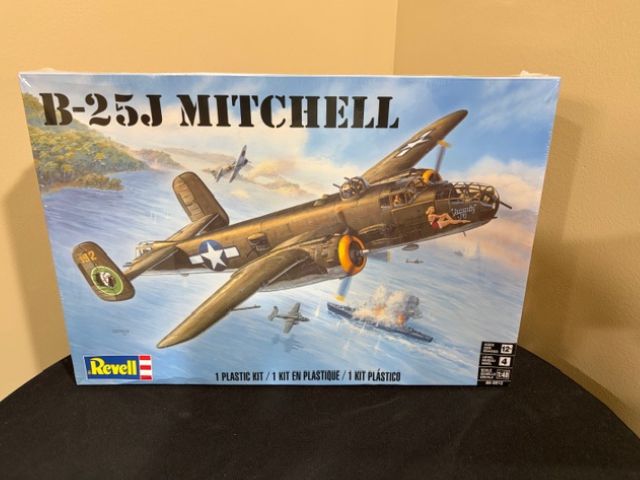
Written by
Steve Carmichael
I am a ww2 model enthusiast getting back into building scaled models after many years away. This site allows me to work on my web development skills while sharing what I am learning.