North American Aviation
AT-6 Texan
 Steve CarmichaelLast updated April 3, 2026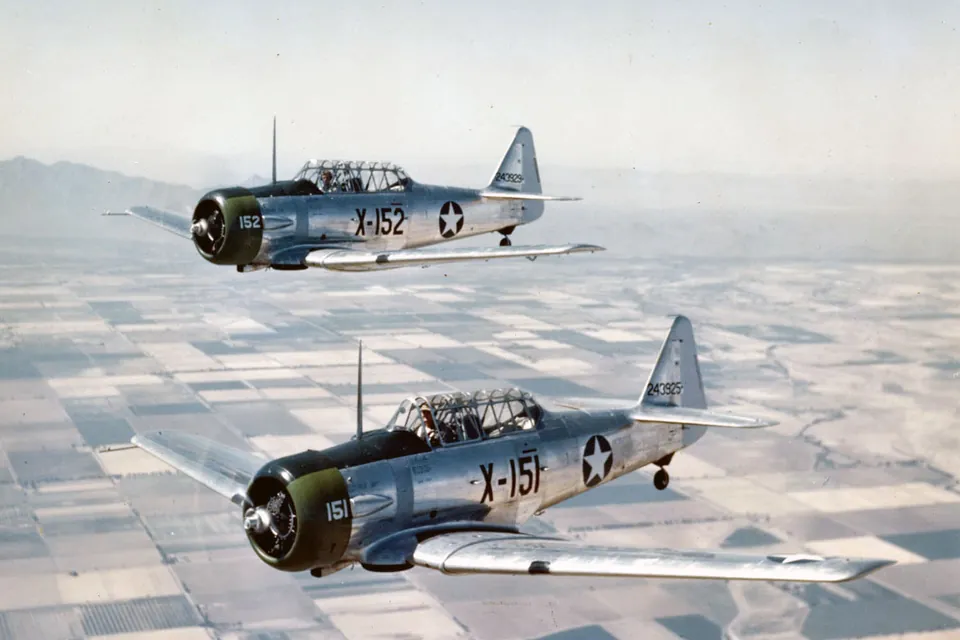
The North American AT-6 Texan was the most widely used advanced trainer of World War II, with 15,495 built across all variants. Nicknamed "The Pilot Maker," it served as the final advanced trainer before pilots transitioned to frontline combat aircraft. Virtually every American pilot who flew in WWII earned his wings in the AT-6. Known as the Harvard in British and Commonwealth service, approximately 500 remain airworthy worldwide today — one of the most numerous surviving WWII aircraft types.
AT-6 Texan at a Glance
- Role
- Trainer Aircraft
- Manufacturer
- North American Aviation
- Nation
- United States
- Era
- World War II
By the Numbers
15,495
Built
15,495
Built
2
Crew
34 nations
Operators
~500
Airworthy Today
"Pilot Maker"
Nickname
600 hp P&W Wasp
Engine
Aircraft Description
The North American AT-6 Texan was the most widely used advanced trainer of World War II, earning it the nickname "Pilot Maker." Virtually every American military pilot trained in a Texan at some point. With over 15,000 built, it served with air forces around the world and remained in use as a trainer into the 1990s. The Texan's handling characteristics made it an excellent transition aircraft to fighter types.
The Pilot Maker
Virtually every American military pilot who flew in World War II — from P-51 Mustang aces to B-29 bomber captains — trained on the AT-6 Texan at some point in their progression from cadet to combat pilot. The AT-6 occupied a critical position in the training pipeline: it was the aircraft where student pilots first encountered retractable landing gear, a controllable-pitch propeller, the torque of a powerful radial engine, and the speeds and handling characteristics that approximated a frontline combat aircraft. If a student could master the Texan, he had a reasonable chance of mastering a Mustang.
Design Philosophy
North American Aviation designed the AT-6 to be demanding enough to prepare students for combat aircraft while forgiving enough that mistakes didn't always kill them. The 600 hp Pratt & Whitney Wasp engine produced significant torque and left-turning tendency on takeoff — forces that were deliberately not engineered out of the design because students needed to learn to handle them. The AT-6 stalled sharply if mishandled, but the stall was recoverable. It spun predictably but required proper technique to recover. These were the skills that saved lives in combat aircraft.
The British Commonwealth Air Training Plan
While the AT-6 was central to USAAF training, its impact on the British and Commonwealth air forces was equally profound. The British Commonwealth Air Training Plan (BCATP), based primarily in Canada and using the Harvard designation for the AT-6, trained 131,553 aircrew for the Allied war effort — the single largest air training program in history. Canadian-built Harvards (AT-16, produced by Noorduyn Aviation in Montreal) supplemented US-built aircraft, and the type became as iconic in Canada as it was in Texas.
Korean War: The "Mosquito" FAC
The AT-6's only sustained combat use came in the Korean War, where redesignated T-6 "Mosquito" aircraft served as forward air controllers with the 6147th Tactical Air Control Group. Flying low and slow over the battlefield — sometimes at treetop level — T-6 pilots located enemy positions, marked them with smoke rockets, and directed fighter-bomber strikes. The slow, unarmed T-6 was desperately vulnerable to ground fire, and FAC pilots suffered significant casualties. But the Texan's low speed and maneuverability — liabilities in air-to-air combat — proved ideal for the observation role.
The Sound of the Texan
The AT-6 is perhaps the most frequently heard WWII aircraft in modern media. Its distinctive engine sound — a throaty, snarling growl from the Pratt & Whitney R-1340 Wasp and large-diameter propeller — has been used as a stand-in for the Japanese Mitsubishi A6M Zero in dozens of WWII films, from Tora! Tora! Tora! to Pearl Harbor. Modified AT-6s with shortened wings and Japanese markings have portrayed Zeros on screen more often than any actual Japanese aircraft type.
Paint Schemes and Markings
The AT-6 Texan wore high-visibility training schemes designed to make student pilots conspicuous in the air — a sharp contrast to the camouflage of combat aircraft.
- Overall Silver/Aluminum (1940–1945): Overall Aluminum lacquer finish. The standard scheme for most USAAF training aircraft throughout the war. Fabric control surfaces received silver dope. Blue fuselage bands indicated instrument training assignments.
- Yellow Wings / Olive Drab Fuselage (1939–42): Chrome Yellow (ANA 614) wings and horizontal tail surfaces with Olive Drab (ANA 613) fuselage. Pre-war USAAC training scheme designed for high visibility and safety.
- Olive Drab / Neutral Gray: Some AT-6s deployed to combat zones received standard OD (ANA 613) over Neutral Gray (ANA 603). Korean War T-6 "Mosquito" FAC aircraft received theater-appropriate camouflage.
- Navy SNJ Schemes: Natural metal or Silver lacquer overall with Orange Yellow (ANA 614) bands on upper and lower wing surfaces, cowl ring, and sometimes rear fuselage. The orange-yellow markings warned fleet aircraft of student operations.
Design Features
Key engineering and design choices that defined the AT-6 Texan's capabilities.
Retractable Landing Gear
The AT-6 was the first advanced trainer most student pilots flew with retractable landing gear, teaching the critical habit of checking gear position before landing. Forgetting to lower the gear — 'gear-up' landings — was one of the most common training accidents, and the AT-6 taught this lesson in a forgiving airframe rather than in a frontline fighter where the consequences were far more severe. The manual gear retraction system also gave students familiarity with hydraulic systems.
Tandem Seating with Full Dual Controls
Both the front and rear cockpits had complete flight controls — stick, rudder pedals, throttle, and instruments. The instructor in the rear seat could observe the student's hands and feet and intervene instantly if needed. An intercom allowed communication between cockpits, and the instructor could take over control at any moment. This arrangement closely mimicked the single-seat cockpit environment students would encounter in operational fighters.
Controllable-Pitch Propeller
The AT-6 introduced student pilots to propeller pitch management — a skill required on every frontline fighter and bomber. Learning to set the correct propeller pitch for takeoff, cruise, and landing was critical, and forgetting proper pitch management was a leading cause of engine failures and accidents in operational aircraft. The AT-6 taught this skill in a relatively low-stakes environment.
Torque and P-Factor Characteristics
With 600 hp driving a large-diameter propeller, the AT-6 produced significant torque and left-turning tendency on takeoff — forces that were deliberately left uncorrected in the aircraft's design. Student pilots learned to anticipate and counteract these forces with right rudder on takeoff, building muscle memory for the far more powerful torque of P-51 Mustangs, F4U Corsairs, and other fighters that would be their next step.
All-Metal Monocoque Construction
The AT-6's stressed-skin aluminum construction familiarized student pilots with the feel and handling characteristics of modern all-metal combat aircraft before they encountered them at operational training units. The transition from fabric-covered primary trainers like the PT-17 Stearman to the all-metal AT-6 was a significant step in a student pilot's progression, preparing them for the weight, speed, and handling of frontline types.
Engines & Armament
Powerplant and weapons configuration for the AT-6 Texan's primary production variant.
Powerplant
1x Pratt & Whitney R-1340-AN-1 Wasp, nine-cylinder air-cooled radial, 600 hp. The distinctive sound of the Texan — a throaty growl from the counter-rotating propeller and radial engine — is recognizable from a distance and has been frequently used in WWII films to portray Japanese Zero fighters due to the similar acoustic signature.
Armament
Standard training configuration: unarmed. Optional armament for gunnery training: one .30 cal fixed forward-firing machine gun in cowl, one .30 cal flexible in rear cockpit. Light bomb training capability: up to 100 lbs of practice bombs on underwing racks. The SNJ-5C (Navy) added a tail hook for carrier qualification training. The AT-6 was not a combat aircraft; armament was for training purposes only.
Specifications
Key dimensions and performance figures for the AT-6 Texan's primary production variant.
- Crew
- 2
- Length
- 8.8 m(28.9 ft)
- Wingspan
- 13 m(42.7 ft)
- Height
- 3.56 m(11.7 ft)
- Wing Area
- 23.57 m²(254 ft²)
- Max Speed
- 335 km/h(208 mph)
Variants & Models
Each AT-6 Texan variant introduced changes to the airframe, engine, or armament. Visual ID features help modelers and spotters distinguish between versions.
NA-16Prototype
1
Built
- Powerplant
- 1x Wright R-975, 400 hp
Visual ID
Fixed landing gear; original prototype
Original fixed-gear prototype first flown April 1, 1935. The design basis for all subsequent AT-6/Harvard/SNJ variants.
BC-1Basic Combat
180
Built
- Powerplant
- 1x P&W R-1340-47, 600 hp
- Max Speed
- 335 km/h(208 mph)
Visual ID
Initial production for USAAC; retractable gear
Initial production variant for the USAAC. First use of retractable landing gear in the trainer lineage. 180 built.
AT-6Texan
- Powerplant
- 1x P&W R-1340-47, 600 hp
- Max Speed
- 335 km/h(208 mph)
- Range
- 1,175 km(730 mi)
- Ceiling
- 7,315 m(23,999 ft)
Visual ID
First use of AT-6 designation
First variant designated AT-6 (Advanced Trainer). Adopted the "Texan" name. Refinements over the BC-1 in equipment and instruments.
AT-6A
1,847
Built
- Powerplant
- 1x P&W R-1340-49, 600 hp
- Max Speed
- 335 km/h(208 mph)
- Range
- 1,175 km(730 mi)
- Ceiling
- 7,315 m(23,999 ft)
Visual ID
Minor equipment changes from AT-6
Improved AT-6 with updated engine variant. 1,847 built. The workhorse early-war trainer variant.
AT-6C
2,970
Built
- Powerplant
- 1x P&W R-1340-AN-1, 600 hp
- Max Speed
- 335 km/h(208 mph)
- Range
- 1,175 km(730 mi)
- Ceiling
- 7,315 m(23,999 ft)
Visual ID
Plywood rear fuselage section to conserve aluminum
Wartime production variant with plywood rear fuselage decking to conserve strategic aluminum supplies. 2,970 built at the Dallas plant.
AT-6D
4,388
Built
- Powerplant
- 1x P&W R-1340-AN-1, 600 hp
- Max Speed
- 335 km/h(208 mph)
- Range
- 1,175 km(730 mi)
- Ceiling
- 7,315 m(23,999 ft)
Visual ID
All-metal construction restored; 24-volt electrical system
Reverted to all-metal construction. Updated 24-volt electrical system. 4,388 built — the most numerous USAAF variant.
AT-6F
956
Built
- Powerplant
- 1x P&W R-1340-AN-1, 600 hp
- Max Speed
- 335 km/h(208 mph)
- Range
- 1,175 km(730 mi)
- Ceiling
- 7,315 m(23,999 ft)
Visual ID
Strengthened rear fuselage and landing gear
Final WWII USAAF variant with structural reinforcements. 956 built.
SNJ-1 through SNJ-6
- Powerplant
- 1x P&W R-1340, 600 hp
- Max Speed
- 335 km/h(208 mph)
- Range
- 1,175 km(730 mi)
- Ceiling
- 7,315 m(23,999 ft)
Visual ID
US Navy designation; SNJ-5C has arresting hook under tail
US Navy designations corresponding to USAAF AT-6 variants. SNJ-1 through SNJ-6 mirrored the AT-6 through AT-6F progression. The SNJ-5C added an arresting hook for carrier qualification training.
Harvard I–IV
- Powerplant
- 1x P&W R-1340, 600 hp
- Max Speed
- 335 km/h(208 mph)
- Range
- 1,175 km(730 mi)
- Ceiling
- 7,315 m(23,999 ft)
Visual ID
RAF/Commonwealth designation
RAF and Commonwealth designations. Harvard I corresponded to the BC-1A, Harvard II to the AT-6A, Harvard III to the AT-6D, Harvard IV to the AT-6F. Used extensively in the British Commonwealth Air Training Plan in Canada.
AT-16Harvard (Canadian)
1,500
Built
- Powerplant
- 1x P&W R-1340, 600 hp
- Max Speed
- 335 km/h(208 mph)
- Range
- 1,175 km(730 mi)
- Ceiling
- 7,315 m(23,999 ft)
Visual ID
Canadian-built by Noorduyn Aviation
Canadian-built Harvards produced by Noorduyn Aviation in Montreal. 1,500 built for the British Commonwealth Air Training Plan. Designated AT-16 in USAAF service.
Development & Operational Timeline
Key milestones in the AT-6 Texan's journey from design through operational service.
NA-16 Prototype First Flight
The North American NA-16 prototype makes its maiden flight. The fixed-gear trainer demonstrates the design concepts — tandem seating, all-metal construction, and adequate performance — that will evolve into the AT-6 Texan.
BC-1 Enters USAAC Service
The BC-1 (Basic Combat) enters service with the US Army Air Corps. With retractable landing gear and a 600 hp engine, it is the first advanced trainer to demand the same skills pilots will need in combat aircraft.
AT-6 Designation Adopted
The Advanced Trainer designation AT-6 is adopted, and the "Texan" name becomes official. The standardized training curriculum now centers on the AT-6 as the mandatory step between primary trainers and operational fighters.
British Commonwealth Air Training Plan
The AT-6/Harvard becomes central to the massive British Commonwealth Air Training Plan in Canada, which will train 131,553 aircrew for the Allied war effort. Canadian-built Harvards (AT-16) supplement US-built aircraft.
Peak Wartime Production
AT-6 production peaks as the wartime training program expands to its maximum throughput. Factories in Dallas, Texas, and Inglewood, California produce thousands of Texans. Approximately 75 of every 200 USAAF advanced training hours are logged in the AT-6.
Korean War: T-6 "Mosquito" FAC Operations
Redesignated T-6 in 1948, Texans serve as forward air control (FAC) "Mosquito" aircraft over Korea. T-6 pilots fly low and slow over the battlefield, marking targets with smoke rockets for fighter-bombers — genuine combat duty that costs the T-6 force significant casualties.
Last US Active Service Retirement
The last AT-6/T-6 Texans are retired from US active military service, ending over two decades of continuous service. The type continues in military use with numerous foreign air forces.
South Africa Retires Final Harvards
The South African Air Force retires its last Harvard trainers, ending 60 years of military service for the AT-6/Harvard lineage — one of the longest operational careers of any WWII-era aircraft.
Combat History
Major engagements and missions that defined the AT-6 Texan's combat record.
Wartime Training Program
1940–1945The AT-6 was the centerpiece of the USAAF and USN advanced training programs that produced hundreds of thousands of military pilots during the war. Virtually every American pilot who flew in WWII — from P-51 Mustang aces to B-17 bomber captains — earned their wings in the AT-6 Texan. The aircraft taught critical skills: retractable gear management, propeller pitch control, formation flying, instrument navigation, gunnery, and managing the torque of a powerful radial engine.
The AT-6's contribution to Allied victory was indirect but absolute. Without a trainer that could safely teach the skills needed for combat aircraft, the massive expansion of the air forces would have been impossible. The "Pilot Maker" nickname was earned — no other aircraft type had a more fundamental impact on the human side of the air war.
British Commonwealth Air Training Plan
1940–1945The Harvard (AT-6) was the backbone of the British Commonwealth Air Training Plan (BCATP) in Canada, which trained 131,553 aircrew from Britain, Canada, Australia, New Zealand, and other Commonwealth nations. Canadian-built Harvards (AT-16, 1,500 produced by Noorduyn Aviation) supplemented US-built aircraft. The BCATP was the single largest air training program in history.
The BCATP provided the trained aircrew that manned RAF Bomber Command, Fighter Command, and Coastal Command throughout the war. Without the Harvard trainer at the center of this program, the Commonwealth contribution to the air war would have been impossible at the scale achieved.
Korean War T-6 "Mosquito" FAC
1950–1953Redesignated T-6 in 1948, the Texan saw genuine combat service in the Korean War as a forward air control (FAC) aircraft. T-6 "Mosquito" pilots from the 6147th Tactical Air Control Group flew low-level missions over the battlefield, locating enemy positions and marking them with smoke rockets for fighter-bombers. The slow, unarmed T-6 was extremely vulnerable to ground fire, and FAC pilots suffered significant casualties.
The Korean War T-6 Mosquito operations represented the only sustained combat use of the type. FAC pilots demonstrated extraordinary courage, flying their slow trainers into the teeth of enemy fire to direct the strikes that supported ground forces. The T-6's low speed and maneuverability — liabilities in air combat — proved advantages for the observation and target-marking role.
Counter-Insurgency Operations
1950s–1960sHarvards and T-6s saw combat in postwar counter-insurgency operations with the French Air Force in Algeria and French Indochina, and with the Portuguese Air Force in Africa. Armed with underwing rockets and machine guns, the slow but rugged trainers proved effective in the light attack role against guerrilla forces without air defenses.
Demonstrated the AT-6/Harvard's versatility beyond its training role. The type's ability to operate from rough fields, carry light armament, and loiter over the battlefield made it a practical counter-insurgency aircraft for air forces that could not afford dedicated attack types.
Production & Service
From first flight to retirement — the AT-6 Texan's operational lifespan at a glance.
- Number Built
- 15,495
- First Service
- 1937
- Retired
- 1995
- Status
- Retired
Where to See One
Surviving AT-6 Texan aircraft you can visit today. Airworthy aircraft may appear at air shows.
AT-6D (American Airpower Museum)
Variant: AT-6D
Two airworthy AT-6D aircraft used as primary proficiency trainers for the museum's warbird fleet.
SNJ-2 (Military Aviation Museum)
Variant: SNJ-2
Rare early Navy SNJ-2 variant. Airworthy.
SNJ-5 (Lone Star)
Variant: SNJ-5
Airworthy SNJ-5. Warbird rides available.
SNJ-5 BuNo 90790
S/N: 90790
Variant: SNJ-5
Airworthy SNJ-5. Used in film and TV productions including Baa Baa Black Sheep.
AT-6 (Palm Springs Air Museum)
Variant: AT-6
AT-6 on static display at the Palm Springs Air Museum.
AT-6 (USAF Museum)
Variant: AT-6
AT-6 on display at the National Museum of the US Air Force.
AT-6 (Warhawk Air Museum)
Variant: AT-6
AT-6 on static display at the Warhawk Air Museum.
SNJ-6 (Lyon Air Museum)
Variant: SNJ-6
Historically documented SNJ-6 on static display at Lyon Air Museum.
T-6F (Museum of Flight)
Variant: T-6F
T-6F on static display at the Museum of Flight in Seattle.
Model Kits Available
Scale model kits of the AT-6 Texan from leading manufacturers.
Browse all aircraft kits →Written by
Steve Carmichael
I am a ww2 model enthusiast getting back into building scaled models after many years away. This site allows me to work on my web development skills while sharing what I am learning.