Douglas Aircraft Company
A-20 Havoc
 Steve CarmichaelLast updated April 3, 2026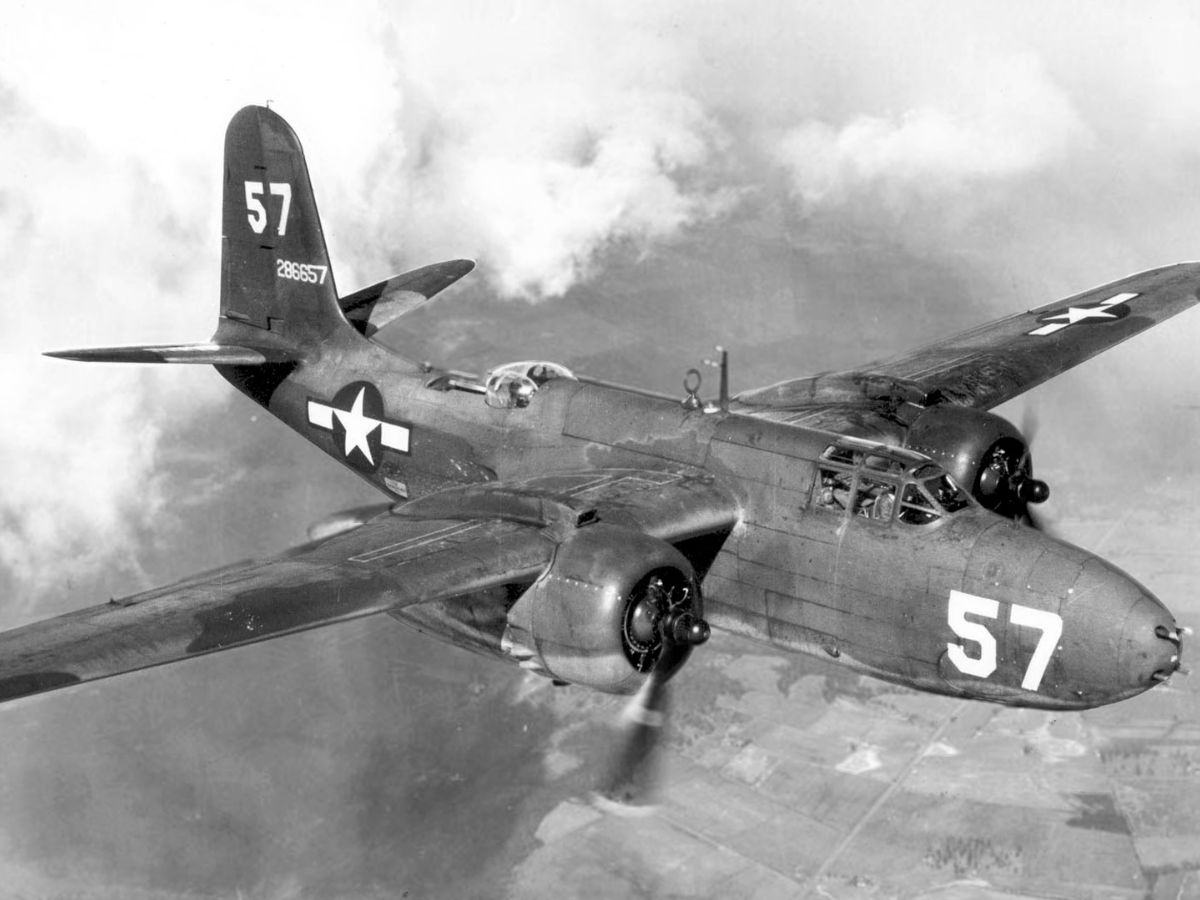
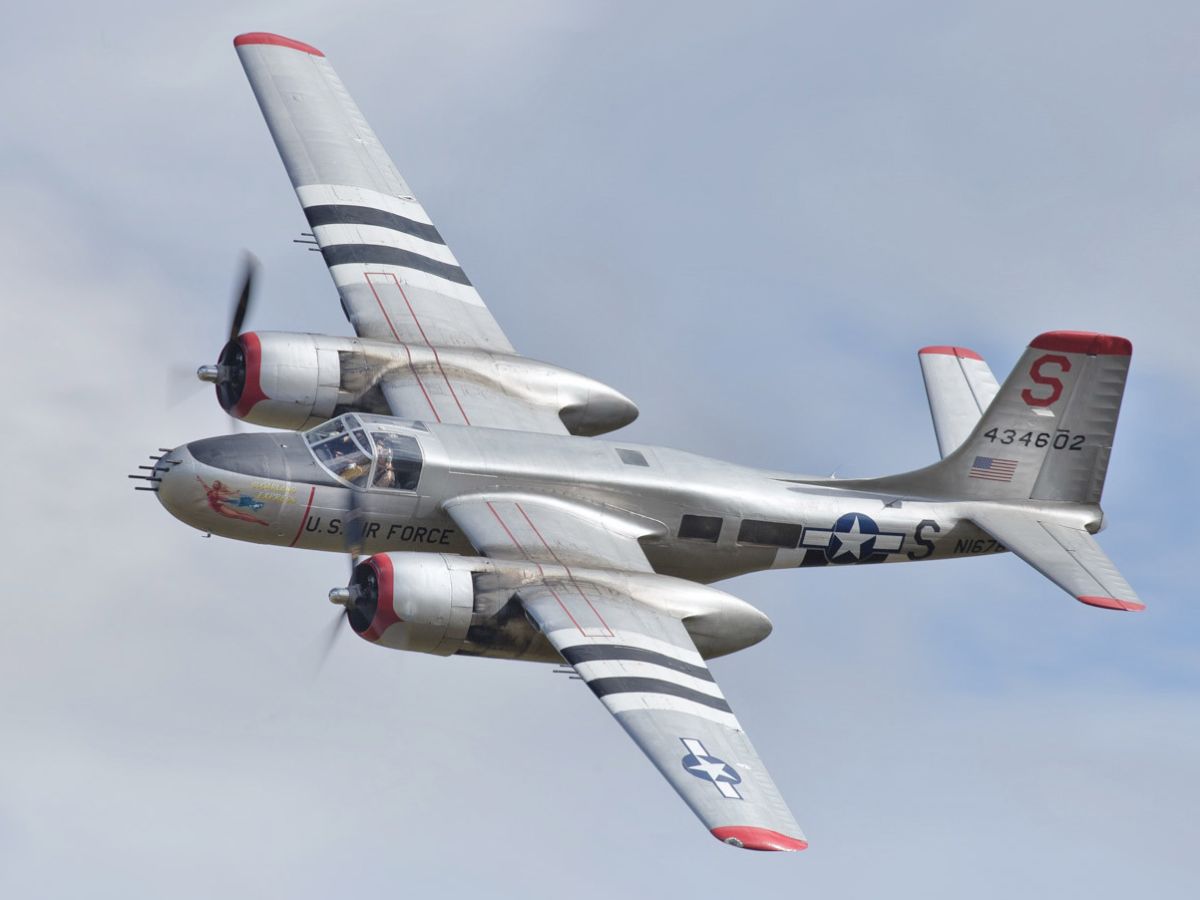
The Douglas A-20 Havoc was the most widely produced American light attack bomber of World War II, with 7,478 built and serving with the air forces of the United States, Great Britain, the Soviet Union, France, Australia, Brazil, and the Netherlands. Designed by Ed Heinemann at Douglas Aircraft, it combined speed, ruggedness, and versatility in roles ranging from low-level strafing and skip-bombing in the Pacific to medium-altitude tactical bombing in Europe and massive Lend-Lease service with the Soviet Union, where over 2,900 were delivered.
A-20 Havoc at a Glance
- Role
- Light Attack Bomber
- Manufacturer
- Douglas Aircraft Company
- Nation
- United States
- Era
- World War II
By the Numbers
7,478
Built
1,015
Combat Losses
7,478
Built
3
Crew
7
Nations Served
2,908
Soviet Lend-Lease
A-20G (2,850)
Most-Produced
Aircraft Description
The Douglas A-20 Havoc was the most widely produced American light attack bomber of World War II, with 7,478 built and serving with the air forces of seven Allied nations. Designed by Ed Heinemann at Douglas Aircraft, it combined speed, ruggedness, and versatility in roles ranging from low-level strafing and skip-bombing in the Pacific to medium-altitude tactical bombing in Europe and massive Lend-Lease service with the Soviet Union, where over 2,900 were delivered.
Design Origins
The Douglas A-20 Havoc traced its lineage to a 1936 private venture by the Douglas Aircraft Company's El Segundo, California division. Chief engineer Ed Heinemann, one of the most prolific American aircraft designers of the 20th century, conceived the Douglas Model 7A as a high-performance attack aircraft. The design was refined into the larger, more powerful Model 7B, which first flew on October 26, 1938, powered by two Pratt & Whitney R-1830 Twin Wasp radial engines. The prototype demonstrated exceptional speed and handling for a twin-engine attack aircraft, reaching over 300 mph and exhibiting fighter-like agility that would define the type throughout its career.
French and British Orders
The Model 7B attracted immediate attention from foreign military delegations, particularly the French Purchasing Commission, which was urgently seeking modern combat aircraft as war loomed in Europe. In February 1939, France ordered 100 aircraft under the designation DB-7 (Douglas Bomber 7), making it one of the first American combat aircraft ordered by a foreign power in the prewar period. These aircraft featured Wright R-2600 Twin Cyclone engines and various modifications to suit French requirements. By the time Germany invaded France in May 1940, approximately 70 DB-7s had been delivered to the Armee de l'Air, and some saw limited action during the Battle of France. After the French surrender, remaining and subsequent orders were diverted to the Royal Air Force, which designated the bomber variants "Boston" and converted many into "Havoc" night fighters and intruder aircraft. The RAF ultimately received over 1,100 DB-7/Boston/Havoc aircraft and employed them extensively for low-level daylight raids over occupied Europe and night intruder operations.
USAAF Adoption and Variants
The USAAF initially showed modest interest, ordering 63 A-20 models for evaluation. Subsequent orders grew rapidly as war approached: the A-20A (143 built) and A-20B (999 built) introduced incremental improvements, while the A-20C (948 built) became the first major Lend-Lease variant. The transformation came with the A-20G, which replaced the glazed bombardier nose with a solid nose packed with forward-firing armament — initially four 20mm cannon, but soon standardized with six .50-caliber machine guns. With 2,850 produced, the A-20G became the definitive Havoc and the backbone of USAAF light attack operations. The A-20H (412 built) introduced the more powerful R-2600-29 engine rated at 1,700 hp, while the A-20J (450 built) and A-20K (413 built) reintroduced the glazed bombardier nose for lead-ship pathfinder duties. Total production across all variants reached 7,478 aircraft, with 7,098 built by Douglas and 380 by Boeing.
Pacific Theater Operations
In the Southwest Pacific, the A-20 found its most dramatic role as a low-level ship killer and ground attack platform. The 5th Air Force, under General George Kenney, transformed the A-20 into a formidable weapon through field modifications pioneered by Paul "Pappy" Gunn. Gun-nose conversions packed multiple .50-caliber machine guns into the forward fuselage, and the aircraft were used for devastating skip-bombing attacks — releasing bombs at low altitude that would skip across the water's surface into the hulls of enemy ships. The technique proved spectacularly effective during the Battle of the Bismarck Sea in March 1943, where A-20s and modified B-25s destroyed an entire Japanese convoy of eight transports and four destroyers. A-20s also attacked Japanese airfields using "parafrag" bombs — small fragmentation bombs retarded by parachutes that allowed the aircraft to clear the blast area. The 3rd Attack Group and 312th Bombardment Group were among the primary A-20 units in the Pacific, conducting relentless low-level operations across New Guinea, the Philippines, and the Dutch East Indies.
European Theater Operations
In the European and Mediterranean theaters, the A-20 served primarily as a medium-altitude tactical bomber. The 12th Air Force employed A-20s during Operation Torch, the Allied invasion of North Africa in November 1942, and continued using them through the campaigns in Tunisia, Sicily, and Italy. The 47th Bombardment Group was the primary A-20 unit in the Mediterranean. In England, the 9th Air Force built up a substantial A-20 force for the pre-invasion bombing campaign, with the 410th, 416th, and 409th Bombardment Groups conducting extensive operations against V-1 launch sites, bridges, marshaling yards, and transportation targets in France, the Low Countries, and Germany. During the Normandy invasion on June 6, 1944, A-20s flew tactical support missions with distinctive black-and-white invasion stripes painted on wings and fuselage. The 9th Air Force's A-20 groups continued intensive operations through the liberation of France and into Germany, though by late 1944 the type was being progressively replaced by the faster A-26 Invader.
Soviet Lend-Lease
The Soviet Union was by far the largest single recipient of A-20 aircraft, receiving over 2,900 under the Lend-Lease program — nearly 40% of total production. The Soviets designated all variants simply as "Boston" and employed them across a remarkable range of missions: medium-altitude bombing, low-level attack, anti-shipping torpedo bombing in the Arctic and Black Sea, photo-reconnaissance, and radar-equipped night fighting. Soviet pilots valued the A-20 for its speed, durability, and reliable engines. Aircraft were delivered via the Alaska-Siberia (ALSIB) ferry route through Fairbanks, Alaska, across Siberia, as well as through the Persian Gulf corridor and the Arctic convoys to Murmansk. Soviet A-20s served on every front from Stalingrad to Berlin and remained in service into the early 1950s, long after USAAF retirement.
Transition to the A-26 Invader
By mid-1944, the Douglas A-26 Invader — also designed by Ed Heinemann as a direct successor to the A-20 — began arriving in combat theaters. The A-26 offered higher speed, greater bomb load, and longer range, powered by the more powerful Pratt & Whitney R-2800 Double Wasp engines — the same powerplant used by the P-47 Thunderbolt. The transition was not instantaneous; many A-20 groups continued flying combat missions well into 1945. The last A-20 was delivered in September 1944, and by VE Day most USAAF A-20 units had either converted to A-26s or been deactivated.
Paint Schemes and Camouflage
The A-20 Havoc wore a wide variety of paint schemes across its seven-nation service, reflecting the diversity of theaters and operators that employed it.
- Olive Drab over Neutral Gray (1941–1944): The standard USAAF camouflage of Olive Drab (ANA 613) upper surfaces over Neutral Gray (ANA 603) undersurfaces. The ubiquitous scheme on USAAF A-20s from 1941 through 1943, and continuing on many aircraft through 1944. Early aircraft carried the national insignia with red center dot, removed after May 1942.
- Desert Camouflage (1942–1943): Aircraft serving in North Africa and the Mediterranean with the 12th Air Force often received desert tan and earth brown camouflage patterns adapted from RAF Middle East schemes. The 47th Bombardment Group's A-20s frequently wore these distinctive desert patterns during the Torch and Tunisian campaigns.
- RAF Dark Green/Dark Earth (1940–1945): RAF Bostons wore standard British Temperate Land Scheme of Dark Green and Dark Earth upper surfaces over Sky or Medium Sea Grey undersurfaces, with RAF roundels and fin flashes. Night-fighter Havoc variants were finished in overall matt black with flame-dampening exhaust shrouds.
- Soviet Schemes (1942–1950s): Soviet "Bostons" typically received a dark green upper surface scheme, sometimes with light blue undersurfaces, carrying red stars and tactical numbers. Some aircraft retained factory-applied OD/NG camouflage with Soviet insignia painted over USAAF markings.
- Natural Metal Finish (Late 1944): Some late-production A-20J and A-20K aircraft were delivered in natural metal finish as the USAAF abandoned camouflage paint to save weight and production time, though this was less common on A-20s than on fighters and heavy bombers.
- Invasion Stripes (June 1944): All tactical aircraft for the Normandy operations received alternating black and white identification bands on wings and rear fuselage, applied hastily in the days before D-Day. 9th Air Force A-20s wore these distinctive markings through the summer of 1944.
Design Features
Key engineering and design choices that defined the A-20 Havoc's capabilities.
Shoulder-Mounted Wing
The A-20 featured a distinctive shoulder-mounted wing position, which provided excellent ground clearance for the engine nacelles while keeping the landing gear short and sturdy. This configuration gave the aircraft a clean aerodynamic profile and contributed to its excellent low-altitude performance — a critical advantage for the strafing and skip-bombing missions that defined its Pacific theater role.
Tricycle Landing Gear
One of the first American combat aircraft to feature tricycle landing gear (nosewheel configuration), which provided excellent ground handling, forward visibility during taxiing, and greatly reduced the risk of ground-loops that plagued conventional tailwheel aircraft. This feature made the A-20 popular with pilots transitioning from trainers and contributed to its low accident rate.
Solid Gun Nose (A-20G/H)
The most visually distinctive feature of the A-20G and A-20H variants was the solid metal gun nose, replacing the glazed bombardier compartment of earlier models. The solid nose housed six .50-caliber machine guns and gave the aircraft a more aggressive, streamlined appearance that is the type's most recognizable identification feature for modelers.
Twin Wright R-2600 Engine Nacelles
The large, smoothly cowled nacelles housing the Wright R-2600 Twin Cyclone engines were prominent identification features, positioned at roughly one-third span on the shoulder-mounted wing. The nacelles extended well aft of the wing trailing edge, housing the main landing gear retraction mechanism in their rear sections.
Glazed Navigator Nose (A-20J/K)
Lead-ship pathfinder variants (A-20J and A-20K) retained a frameless, blown Plexiglas bombardier nose for the Norden bombsight, providing a visual contrast to the solid-nose G and H models. Formation aircraft would bomb on the leader's signal, so only one glazed-nose aircraft was needed per formation.
Martin Dorsal Turret
Later A-20G aircraft (from the 751st production example onward) and all A-20H/J/K variants featured a powered Martin turret with twin .50-caliber guns, creating a distinctive raised profile on the rear fuselage. Earlier aircraft used a simpler manually-operated ring mount — an important distinction for modelers building specific aircraft.
Slim, Tapered Fuselage
The fuselage was notably narrow and well-streamlined for a twin-engine bomber, contributing to the aircraft's high speed. The clean design, absence of a ventral ball turret, and smooth exterior skin gave the A-20 a speed advantage over many contemporaries of similar size, allowing it to outrun some fighters at low altitude.
Engines & Armament
Powerplant and weapons configuration for the A-20 Havoc's primary production variant.
Powerplant
2x Wright R-2600-23 Twin Cyclone, 14-cylinder twin-row air-cooled radial engines, each producing 1,600 hp at takeoff. The R-2600 series had a displacement of 42.7 liters (2,603 cu in), a bore of 155.6 mm, and a stroke of 160.3 mm. Each engine drove a three-blade Hamilton Standard constant-speed propeller. The R-2600-23 used a single-speed, two-stage supercharger and ran on 100-octane fuel. Later A-20H and A-20K variants upgraded to the R-2600-29, rated at 1,700 hp, providing improved high-altitude performance. The R-2600 was valued for its reliability and smooth operation, giving the A-20 its characteristically smooth, powerful acceleration that pilots often compared favorably to single-engine fighters.
Armament
The A-20G carried six .50-caliber (12.7 mm) Browning M2 machine guns in the solid nose with approximately 350 rounds per gun. Defensive armament consisted of a powered Martin dorsal turret mounting twin .50-caliber machine guns with 400 rounds per gun (introduced on the 751st production A-20G; earlier aircraft had a manually-operated single .50-caliber flexible mount), and a single .50-caliber machine gun in a ventral tunnel position with 400 rounds. The bomb bay accommodated up to 907 kg (2,000 lb) internally, with external wing racks increasing the maximum ordnance load to 1,814 kg (4,000 lb). Typical loads included four 500 lb GP bombs, clusters of 20 lb fragmentation bombs, or parachute-retarded fragmentation bombs ("parafrags"). In the Pacific, A-20s frequently carried 500 lb bombs for skip-bombing attacks against shipping.
Specifications
Key dimensions and performance figures for the A-20 Havoc's primary production variant.
- Crew
- 3
- Length
- 14.63 m(48.0 ft)
- Wingspan
- 18.69 m(61.3 ft)
- Height
- 5.36 m(17.6 ft)
- Wing Area
- 43.11 m²(464 ft²)
- Max Speed
- 546 km/h(339 mph)
Variants & Models
Each A-20 Havoc variant introduced changes to the airframe, engine, or armament. Visual ID features help modelers and spotters distinguish between versions.
DB-7Boston I / Boston II (RAF)
370
Built
- Powerplant
- 2x Pratt & Whitney R-1830-S3C4-G Twin Wasp, 1,100 hp each
- Max Speed
- 475 km/h(295 mph)
- Range
- 1,480 km(920 mi)
- Ceiling
- 7,620 m(25,000 ft)
Visual ID
Narrower fuselage than later models, shorter engine nacelles, French or RAF markings, smaller vertical stabilizer
Original export variant for France and Britain. French DB-7s saw limited combat during the Battle of France in May-June 1940. Surviving French aircraft and subsequent production were diverted to the RAF as Boston I (trainers) and Boston II (operational). 270 DB-7 and 100 DB-7A built.
A-20AHavoc
143
Built
- Powerplant
- 2x Wright R-2600-11 Twin Cyclone, 1,600 hp each
- Max Speed
- 531 km/h(330 mph)
- Range
- 1,610 km(1,000 mi)
- Ceiling
- 8,655 m(28,396 ft)
Visual ID
Glazed bombardier nose, early-style single dorsal gun mount, USAAF markings with pre-1942 insignia
First production USAAF variant. Featured Wright R-2600-11 engines and improved armament over the export DB-7 series. Served primarily in training and early combat roles in the Pacific.
A-20BHavoc
999
Built
- Powerplant
- 2x Wright R-2600-11 Twin Cyclone, 1,600 hp each
- Max Speed
- 540 km/h(336 mph)
- Range
- 1,520 km(944 mi)
- Ceiling
- 7,470 m(24,508 ft)
Visual ID
Glazed bombardier nose, majority delivered in Soviet markings with red stars and tactical numbers
Major production variant. Most were delivered to the Soviet Union under Lend-Lease, where they were designated "Boston" and used for medium bombing, anti-shipping, and reconnaissance. Featured revised fuel system and improved armor protection.
A-20CHavoc / Boston IIIA (RAF)
948
Built
- Powerplant
- 2x Wright R-2600-23 Twin Cyclone, 1,600 hp each
- Max Speed
- 540 km/h(336 mph)
- Range
- 1,650 km(1,025 mi)
- Ceiling
- 7,380 m(24,213 ft)
Visual ID
Glazed bombardier nose, self-sealing fuel tank bulges, often in desert or RAF camouflage schemes
Major Lend-Lease variant built to British specifications with self-sealing fuel tanks and British-compatible equipment. Served with the USAAF, RAF, and Soviet forces. Many saw action during the North African campaign with the 47th Bombardment Group.
A-20GHavoc
2,850
Built
- Powerplant
- 2x Wright R-2600-23 Twin Cyclone, 1,600 hp each
- Max Speed
- 546 km/h(339 mph)
- Range
- 1,650 km(1,025 mi)
- Ceiling
- 7,225 m(23,704 ft)
Visual ID
Solid metal gun nose with six .50 cal ports, Martin dorsal turret on late production (from 751st aircraft), most recognizable Havoc silhouette
Most-produced variant and definitive Havoc model. Replaced the glazed bombardier nose with a solid nose packed with six .50-caliber machine guns. Early A-20Gs initially carried four 20mm cannon, quickly changed to the six-gun arrangement. Backbone of USAAF light attack operations from 1943 to 1945.
A-20HHavoc
412
Built
- Powerplant
- 2x Wright R-2600-29 Twin Cyclone, 1,700 hp each
- Max Speed
- 557 km/h(346 mph)
- Range
- 1,650 km(1,025 mi)
- Ceiling
- 7,620 m(25,000 ft)
Visual ID
Externally identical to late-production A-20G; only engine designation plate differs
Improved A-20G with more powerful R-2600-29 engines rated at 1,700 hp each, providing better performance at altitude. Otherwise identical to late-production A-20G with Martin dorsal turret and six-gun solid nose.
A-20JHavoc / Boston IV (RAF)
450
Built
- Powerplant
- 2x Wright R-2600-23 Twin Cyclone, 1,600 hp each
- Max Speed
- 540 km/h(336 mph)
- Range
- 1,650 km(1,025 mi)
- Ceiling
- 7,225 m(23,704 ft)
Visual ID
Frameless blown Plexiglas bombardier nose with Norden bombsight, Martin dorsal turret
Pathfinder/lead-ship variant with frameless blown Plexiglas bombardier nose accommodating the Norden bombsight. Used to lead formations of solid-nose A-20G/H aircraft, with wingmen bombing on the leader's signal. 169 delivered to RAF as Boston IV.
A-20KHavoc / Boston V (RAF)
413
Built
- Powerplant
- 2x Wright R-2600-29 Twin Cyclone, 1,700 hp each
- Max Speed
- 557 km/h(346 mph)
- Range
- 1,650 km(1,025 mi)
- Ceiling
- 7,620 m(25,000 ft)
Visual ID
Frameless glazed bombardier nose like A-20J, last production variant; some delivered in natural metal finish
Final production variant. Pathfinder version with glazed bombardier nose like the A-20J but powered by the more powerful R-2600-29 engines. Last A-20K delivered September 1944, ending Havoc production. 90 delivered to RAF as Boston V.
Development & Operational Timeline
Key milestones in the A-20 Havoc's journey from design through operational service.
Douglas Model 7B First Flight
The Douglas Model 7B prototype, designed by Ed Heinemann at the Douglas Aircraft Company's El Segundo division, made its maiden flight in California, demonstrating performance that would attract immediate international orders.
France Orders 100 DB-7s
The French Purchasing Commission placed an order for 100 DB-7 light bombers, making it one of the first American combat aircraft ordered by a foreign power in the prewar period. The order catalyzed full-scale production of the design.
DB-7s Enter Combat with French Air Force
French Armee de l'Air DB-7s flew their first combat missions against advancing German forces during the Battle of France, becoming among the first American-built aircraft to see action in the Second World War.
RAF Receives First Boston Aircraft
Following the fall of France, surviving French orders were diverted to the Royal Air Force, which received its first DB-7 aircraft and designated them Boston I (trainers) and Boston II (operational bombers). The RAF would ultimately receive over 1,100 Boston/Havoc aircraft.
A-20s Present at Pearl Harbor
Several A-20A aircraft of the 58th Bombardment Squadron were among the USAAF aircraft caught on the ground during the Japanese attack on Pearl Harbor, Hawaii, marking the type's involuntary entry into American combat history.
First USAAF A-20 Combat Mission in Europe
USAAF A-20 crews flew their first combat mission in the European theater, participating in a joint RAF operation over the Netherlands. American crews flew borrowed RAF Boston IIIs on this Independence Day mission.
A-20s Support Operation Torch
A-20s of the 47th Bombardment Group (12th Air Force) participated in Operation Torch, the Allied invasion of French North Africa, marking the beginning of extensive A-20 operations in the Mediterranean theater.
Battle of the Bismarck Sea
A-20s of the 3rd Attack Group, 5th Air Force, participated in the devastating skip-bombing attack that destroyed an entire Japanese convoy of 8 transports and 4 destroyers in the Bismarck Sea — one of the most decisive air-to-sea engagements of the Pacific war.
Wewak Airfield Raids
5th Air Force A-20s of the 3rd Attack Group conducted devastating low-level strafing and parafrag bombing attacks against Japanese airfields at Wewak, New Guinea, destroying an estimated 100+ aircraft on the ground and crippling Japanese air power in the theater.
A-20G Production Begins
Production of the A-20G, the most-produced Havoc variant with its distinctive solid gun nose housing six .50-caliber machine guns, commenced at the Douglas Long Beach plant. The A-20G would become the definitive version with 2,850 built.
A-20s Support D-Day Invasion
9th Air Force A-20 groups (409th, 410th, and 416th Bombardment Groups) flew tactical bombing missions in support of the Normandy landings, wearing distinctive black-and-white invasion stripes for identification.
Last A-20 Delivered
The final A-20K rolled off the Douglas production line, ending production of the Havoc series after 7,478 aircraft built across all variants. The type was succeeded in production and service by the Douglas A-26 Invader.
Combat History
Major engagements and missions that defined the A-20 Havoc's combat record.
Battle of France — DB-7 Combat Debut
May–June 1940French Armee de l'Air DB-7s flew tactical bombing missions against advancing German forces during the fall of France. Aircraft attacked bridges, troop columns, and armored formations at low altitude, suffering heavy losses to German fighters and flak but demonstrating the design's speed and toughness.
60
Dispatched
30
Aircraft Lost
First combat use of the DB-7/A-20 design. Despite the losses, the aircraft's performance under fire impressed observers and validated the design. Surviving aircraft and unfilled French orders were diverted to the RAF, ensuring the type's continued development.
Operation Torch — North Africa
November 1942 – May 1943A-20s of the 47th Bombardment Group (12th Air Force) supported the Allied invasion of French North Africa and the subsequent campaign against Axis forces in Tunisia. A-20s conducted tactical bombing of airfields, supply lines, ports, and troop concentrations across North Africa.
70
Dispatched
25
Aircraft Lost
Proved the A-20 as an effective medium-altitude tactical bomber in the Mediterranean theater and established the operational patterns used by the 47th BG throughout the subsequent Sicilian and Italian campaigns.
Battle of the Bismarck Sea
March 2–4, 19435th Air Force A-20s of the 3rd Attack Group conducted devastating low-level skip-bombing and strafing attacks against a Japanese convoy of 16 ships (8 transports, 8 destroyers) attempting to reinforce Lae, New Guinea. Combined attacks with B-25s sank or disabled all 8 transports and 4 of 8 destroyers.
30
Dispatched
1
Aircraft Lost
Demonstrated the devastating effectiveness of skip-bombing tactics pioneered by Paul "Pappy" Gunn and transformed Allied air-to-sea warfare in the Pacific. Japan never again attempted a major convoy reinforcement within range of Allied air power in the Southwest Pacific.
Soviet Northern Fleet Anti-Shipping Operations
1943–1945Soviet Naval Aviation A-20 "Boston" aircraft of the Northern Fleet conducted torpedo-bombing and skip-bombing attacks against German convoys along the Norwegian coast and in Arctic waters. Soviet crews adapted American tactics and fitted some A-20s with Soviet torpedo racks for anti-shipping strikes.
Demonstrated the versatility of the A-20 in anti-shipping roles under some of the harshest operating conditions of the war. The Soviet Union received over 2,900 A-20s under Lend-Lease — nearly 40% of total production — making it the largest single operator of the type.
Wewak Airfield Raids
August 17–18, 19435th Air Force A-20s of the 3rd Attack Group conducted devastating low-level strafing and parafrag bombing attacks against Japanese airfields at Wewak, New Guinea, catching hundreds of aircraft on the ground. Using parachute-retarded fragmentation bombs, the A-20s destroyed an estimated 100+ Japanese aircraft.
40
Dispatched
3
Aircraft Lost
One of the most successful ground-attack missions of the Pacific war. The raids crippled Japanese air power in New Guinea and established air superiority for subsequent Allied ground operations at Nadzab and Finschhafen.
Operation Crossbow — V-1 Site Attacks
December 1943 – September 19449th Air Force A-20 groups conducted extensive bombing attacks against German V-1 flying bomb launch sites ("ski sites") in the Pas-de-Calais region of northern France. These precision attacks required accurate medium-altitude bombing against small, heavily camouflaged targets.
30
Aircraft Lost
Constituted a significant portion of pre-D-Day 9th Air Force operations. The precision required for these missions demonstrated the A-20's accuracy as a tactical bomber and the skill of its crews in hitting small, defended targets.
Operation Overlord — D-Day Tactical Support
June 6, 19449th Air Force A-20 groups (409th, 410th, and 416th Bombardment Groups) flew multiple sorties against German coastal defenses, artillery positions, and transportation targets in support of the Normandy landings. All aircraft carried distinctive black-and-white invasion stripes for identification.
150
Dispatched
5
Aircraft Lost
Demonstrated the A-20's role as a precision tactical bomber in the most critical Allied operation of the war. The 9th Air Force's A-20 groups continued intensive operations through the breakout from Normandy and across France.
Unit Markings
The A-20 Havoc served with units whose markings are documented in our markings reference guides.
9th Air Force Markings Lookup
Squadron codes, cowling colors, and tail markings for every tactical fighter and bomber group in the ETO.
12th Air Force Markings Lookup
Tail markings, cowling colors, and squadron identification for every tactical bomber and fighter group in the Mediterranean Theater.
5th Air Force Markings Lookup
Tail numbers, group insignia, and squadron markings for every bomber, attack, and fighter unit in the Southwest Pacific Theater.
Production & Service
From first flight to retirement — the A-20 Havoc's operational lifespan at a glance.
- Number Built
- 7,478
- First Service
- 1941
- Last Built
- 1944
- Retired
- 1945
- Combat Losses
- 1,015
- Status
- Retired
Where to See One
Surviving A-20 Havoc aircraft you can visit today. Airworthy aircraft may appear at air shows.
A-20G Havoc (ex-Soviet)
Variant: A-20G
Imperial War Museum Duxford
Duxford, Cambridgeshire, United Kingdom
Imperial War Museum
Visit website →Former Soviet Air Force A-20G recovered from a crash site in Russia. Under restoration at IWM Duxford.
A-20G "Boston" (Soviet Air Force)
Variant: A-20G
Central Air Force Museum
Monino, Moscow Oblast, Russia
Russian Air Force
Former Soviet Air Force Lend-Lease A-20G on static display at the Central Air Force Museum near Moscow. Displayed in Soviet wartime markings with red stars and tactical numbers.
A-20G Havoc
S/N: 43-21475
Variant: A-20G
A-20G on outdoor static display at one of the largest aviation museums in the United States.
A-20G-25-DO Havoc
S/N: 43-9436
Variant: A-20G
A-20G on static display at the premier USAF aviation collection. One of the best-preserved examples of the most-produced Havoc variant.
A-20G-35-DO Havoc
S/N: 43-21709
Variant: A-20G
A-20G on static display at the Museum of Flight in Seattle. Recovered and restored from a Pacific theater crash site.
Written by
Steve Carmichael
I am a ww2 model enthusiast getting back into building scaled models after many years away. This site allows me to work on my web development skills while sharing what I am learning.