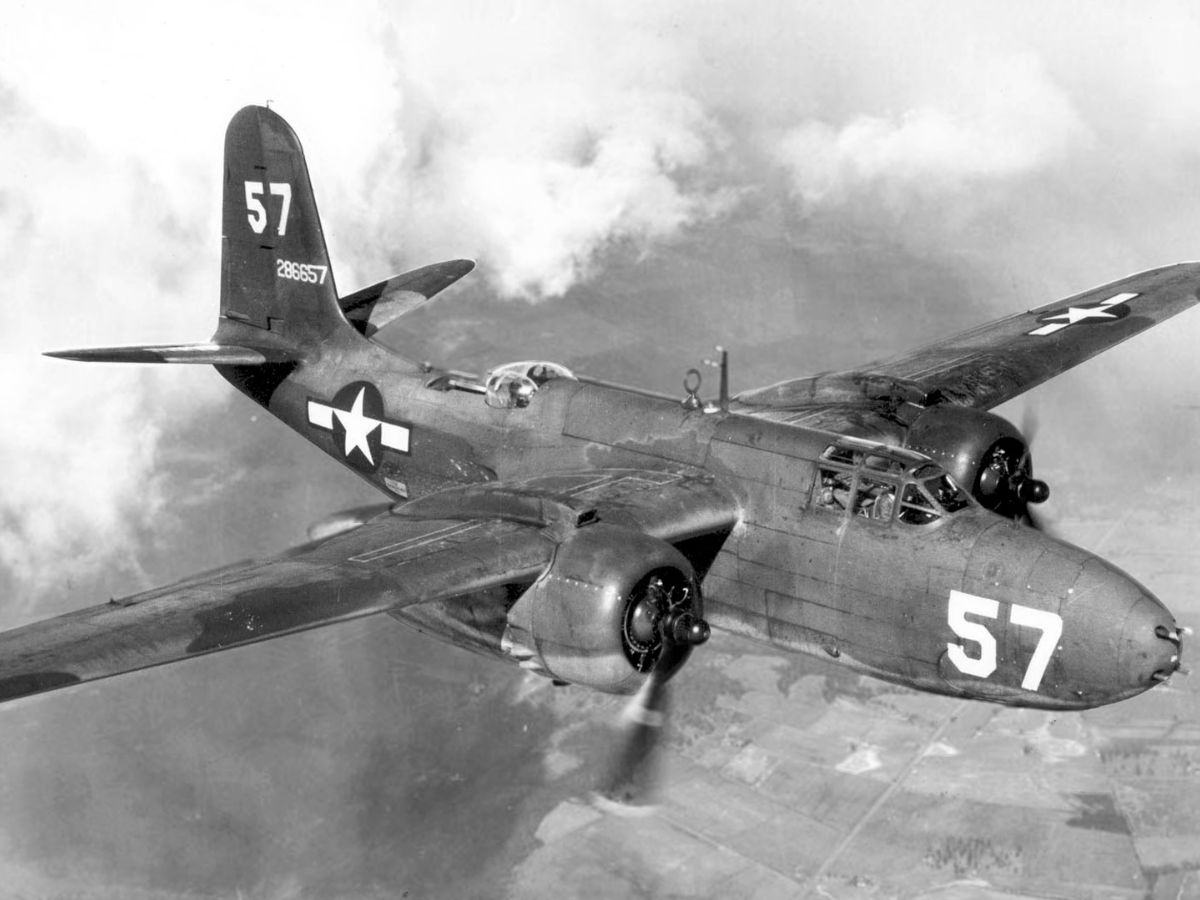
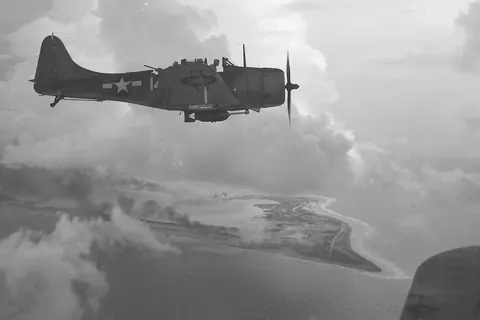
Douglas Aircraft Company
A-26 Invader
 Steve CarmichaelLast updated March 16, 2026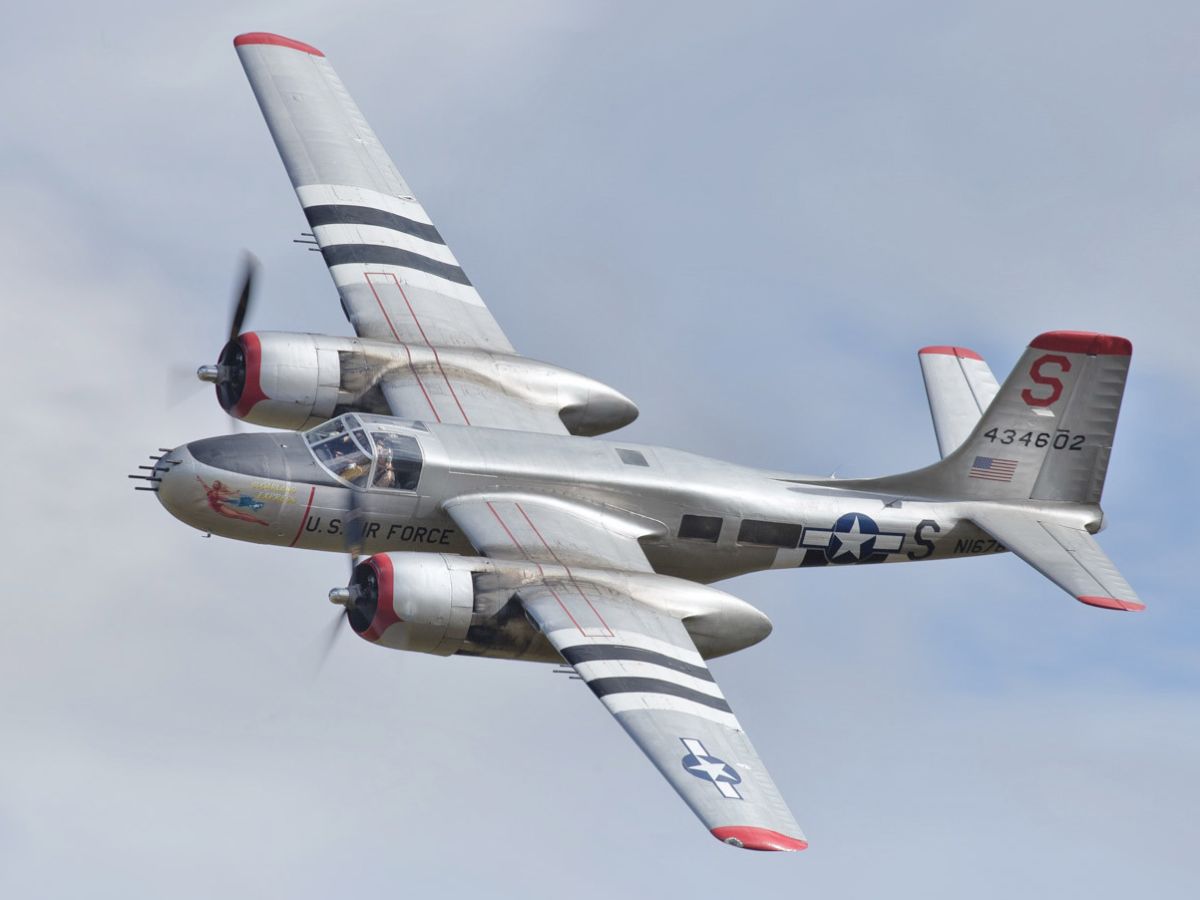
The Douglas A-26 Invader was the finest American attack bomber of World War II, designed by the legendary Ed Heinemann — who also created the SBD Dauntless and A-20 Havoc. Entering combat in mid-1944 with the 5th Air Force in the Pacific and the 9th Air Force in Europe, the Invader was faster than most contemporary fighters at low altitude and could carry up to 6,000 pounds of bombs. Its innovative laminar-flow wing, remotely controlled gun turrets, and interchangeable nose sections made it a generation ahead of the aircraft it replaced. The A-26 served in WWII, Korea, and Vietnam — one of the longest combat careers of any American military aircraft.
A-26 Invader at a Glance
- Role
- Attack Bomber
- Manufacturer
- Douglas Aircraft Company
- Nation
- United States
- Era
- World War II
By the Numbers
2,452
Built
67
Combat Losses
2,452
Built
3
Crew
355 mph
Top Speed
WWII, Korea, Vietnam
Three-War Veteran
6,000 lb
Max Bomb Load
Aircraft Description
The Douglas A-26 Invader was the most capable American attack bomber of World War II and one of the few combat aircraft to serve in three major wars. Designed by Ed Heinemann as a successor to the A-20 Havoc, the Invader combined higher speed, heavier armament, and greater bomb load in a sleek airframe powered by twin Pratt & Whitney R-2800 Double Wasp engines. With 2,452 built during WWII, the A-26 replaced both the A-20 Havoc and B-26 Marauder in frontline service and went on to fight in Korea and Vietnam.
Origins: The Heinemann Touch
The A-26 Invader was the product of one of aviation's most gifted designers. Ed Heinemann of Douglas Aircraft had already created two of the war's most important American combat aircraft — the SBD Dauntless dive bomber that turned the tide at Midway, and the A-20 Havoc that served as the USAAF's primary attack bomber from 1941 to 1944. In January 1941, the Army Air Corps issued a requirement for a successor to the A-20, and Heinemann's team at Douglas El Segundo set to work on a design that would incorporate every aerodynamic advance available.
The result was a quantum leap forward. Where the A-20 used a conventional airfoil, the A-26 employed a laminar-flow wing — the NACA 65-215 series — that dramatically reduced drag. Where the A-20 relied on manned turrets that created aerodynamic drag, the A-26 used remotely controlled dorsal and ventral turrets aimed through periscopic sights. Where the A-20 was limited to either a gun nose or a bombardier nose at the factory, the A-26's modular nose design allowed field-level interchange between the solid gun nose (A-26B) and the glass bombardier nose (A-26C). The prototype XA-26 first flew on July 10, 1942, piloted by the legendary air racer Benny Howard, and immediately demonstrated performance that exceeded most contemporary single-engine fighters.
Design Innovation
The A-26 represented the state of the art in 1942 attack bomber design. Its laminar-flow wing — the same technology being applied to the P-51 Mustang — gave it a top speed of 355 mph, making it faster than any other American twin-engine bomber and faster than many single-engine fighters of the early war period. The aircraft was powered by two Pratt & Whitney R-2800 Double Wasp engines, each producing 2,000 hp — the same engine family that powered the P-47 Thunderbolt, F4U Corsair, and F6F Hellcat.
The remotely controlled turrets were perhaps the most innovative feature. By eliminating manned turret positions, Heinemann reduced both drag and crew size. The single gunner in the rear fuselage controlled both the dorsal and ventral turrets through periscopic sights, providing 360-degree defensive coverage with just one crew member instead of the three or four gunners required by the A-20 and B-26 Marauder. This efficiency — more capability with fewer crew — was a hallmark of Heinemann's design philosophy.
Pacific Debut: 5th Air Force
The A-26 entered combat not in Europe but in the Pacific, where the 3rd Bombardment Group (Light) of the 5th Air Force flew the type's first missions from Hollandia, New Guinea, on June 23, 1944. The 3rd BG was an ideal choice: veterans of extensive A-20 Havoc operations in the Southwest Pacific, they could provide a direct comparison between the old and new types.
The verdict was emphatic. The A-26B's eight forward-firing .50-caliber machine guns — compared to the A-20G's six — delivered 33% more firepower in strafing attacks. Its 355 mph top speed gave it a 75 mph advantage over the A-20, dramatically reducing exposure time over defended targets. Its 6,000 lb bomb load doubled the A-20's capacity. The 3rd BG flew A-26s through the Philippine liberation campaign, attacking Japanese airfields, shipping, and ground positions on Luzon and throughout the archipelago. Their enthusiastic combat reports helped overcome initial resistance to the aircraft in the European theater.
European Theater: The 9th Air Force Controversy
The A-26's introduction to the European theater was far more turbulent. On September 6, 1944, the 553rd Bombardment Squadron flew the type's first ETO combat missions while attached to the 386th Bombardment Group of the 9th Air Force. The reception was mixed at best. Experienced A-20 and B-26 pilots, accustomed to the A-20's panoramic greenhouse canopy that offered excellent visibility for low-level attack work, criticized the A-26's conventional cockpit layout with its limited downward and sideward visibility. Brigadier General Robert M. Lee submitted a critical report that temporarily threatened the type's acceptance in the ETO.
The controversy was resolved through a combination of cockpit modifications, revised tactics, and simple experience. As more pilots flew the A-26 and discovered its extraordinary speed and firepower advantages, opposition faded rapidly. The 416th Bombardment Group became one of the first complete groups to convert from A-20s to A-26s in November 1944, followed by other A-20 and B-26 Marauder groups. By the spring of 1945, the A-26 was replacing both types across the 9th Air Force.
Mediterranean Theater: 12th Air Force
The 12th Air Force also transitioned to the A-26 in the final months of the war. The 47th Bombardment Group — the primary A-20 Havoc unit in the Mediterranean since the North African campaign — converted to A-26 Invaders in late 1944. Operating from bases in Italy and France, the 47th BG flew tactical bombing and strafing missions against German targets in northern Italy and Austria. The transition was smoother than in the ETO, benefiting from operational lessons already learned by the 9th Air Force.
The Invader at War's End
By V-E Day, the A-26 Invader had proven itself as the finest tactical attack bomber in the USAAF inventory. Its late entry into the war — combat operations spanning only the last eleven months of the European conflict — meant that its overall contribution was more limited than that of the A-20 Havoc or B-26 Marauder it replaced. But in capability, the A-26 was a generation ahead. It was faster, better armed, carried more bombs, had longer range, and required fewer crew members than either predecessor. Production ended after 2,452 aircraft — 1,355 A-26B gun-nose and 1,091 A-26C bombardier-nose variants — when massive follow-on orders for 2,150 improved A-26D and A-26E models were cancelled after V-J Day.
Three Wars: Korea and Vietnam
The A-26's story did not end with WWII. Redesignated B-26 in 1948 (causing lasting confusion with the retired Martin B-26 Marauder), the Invader was among the first USAF aircraft in combat when the Korean War began in June 1950. The 3rd Bombardment Wing — the same unit that had introduced the type to combat in New Guinea — flew B-26 Invaders throughout the Korean War, specializing in dangerous night intruder missions against enemy supply convoys.
Two decades later, forty remanufactured Counter Invaders (designated B-26K, then A-26A) deployed to Thailand for Vietnam War operations along the Ho Chi Minh Trail. The A-26A's ability to loiter for extended periods and deliver heavy ordnance made it effective for nocturnal interdiction — the same role it had perfected in Korea. The last Counter Invaders were retired in 1969, ending a combat career that spanned 25 years and three major wars — a record matched by very few American military aircraft.
Paint Schemes and Camouflage
The A-26 Invader wore fewer camouflage variations than its predecessors, largely because it entered service during the period when the USAAF was transitioning to natural metal finishes.
- Olive Drab over Neutral Gray (1944): Early production A-26B and A-26C models were delivered in the standard USAAF camouflage of Olive Drab (ANA 613) upper surfaces over Neutral Gray (ANA 603) undersurfaces. These camouflaged aircraft served primarily with the 3rd Bombardment Group in the Pacific and with early ETO units. National insignia was the star-and-bar with "Insignia Blue" surround introduced in June 1943.
- Natural Metal Finish (Mid-1944 onward): The majority of A-26 production was delivered in unpainted natural metal finish, reflecting the USAAF's abandonment of camouflage paint in 1944 to save weight and production time. Most 9th Air Force and 12th Air Force A-26s operated in natural metal, giving the Invader a distinctively modern appearance compared to the camouflaged A-20s and B-26s it replaced. Anti-glare panels in flat black were applied ahead of the cockpit.
- Invasion Stripes (1944–1945): A-26s arriving in the ETO during and after the Normandy invasion period carried the standard Allied identification stripes — alternating black and white bands on wings and rear fuselage. As with other types, fuselage stripes were removed relatively quickly while wing stripes persisted on some aircraft into early 1945.
- Pacific Theater Schemes: 5th Air Force A-26s in the Southwest Pacific wore both OD/NG camouflage and natural metal finish, depending on when they were delivered. Some aircraft received field-applied dark green or black undersurfaces for low-level attack missions. Unit markings included the 3rd BG's distinctive diagonal stripe tail markings.
- Korean War Schemes: B-26 Invaders (as redesignated) in Korea were typically painted overall glossy black for night intruder missions, with minimal markings — a dramatic contrast to the gleaming natural metal of their WWII service. Day-mission aircraft retained natural metal or received overall medium gray schemes.
- Group Markings (9th Air Force): 9th Air Force A-26 groups used distinctive identification markings similar to those on the B-26 Marauder groups they replaced. The 416th BG used colored tail bands, while other groups adopted their own distinctive schemes. Squadron and individual aircraft codes were applied in standard 9th Air Force format.
Design Features
Key engineering and design choices that defined the A-26 Invader's capabilities.
Laminar Flow Wing
The A-26 was one of the first combat aircraft to employ a laminar-flow airfoil — specifically the NACA 65-215 series. This advanced wing profile maintained smooth airflow over a greater portion of the wing chord, significantly reducing drag compared to conventional airfoils. The laminar-flow wing was a major reason the A-26 could reach 355 mph, making it faster than the A-20 Havoc by over 75 mph despite carrying a heavier load. The same technology was being applied to the P-51 Mustang.
Remotely Controlled Turrets
The A-26 pioneered the use of remotely controlled dorsal and ventral turrets on a twin-engine attack aircraft. The gunner in the rear fuselage aimed both turrets via periscopic sights, eliminating the need for exposed manned turret positions. This dramatically reduced aerodynamic drag compared to the manned turrets on the A-20 and B-26, and allowed the A-26 to achieve its exceptional speed while retaining strong defensive armament.
Interchangeable Nose Sections
One of the A-26's most innovative features was its modular nose design. The A-26B solid gun nose — packed with six to eight .50-caliber machine guns — could be swapped with the A-26C glass bombardier nose (housing a Norden bombsight) at depot level. This gave commanders tactical flexibility: gun-nose A-26Bs led low-level strafing attacks while glass-nose A-26Cs provided precision bombing capability within the same squadron.
Double-Slotted Flaps
The A-26 featured large double-slotted flaps that dramatically increased lift coefficient for takeoff and landing. These advanced flaps — unusual for the era — gave the A-26 docile low-speed handling characteristics despite its relatively high wing loading, making it far more pilot-friendly than the notoriously demanding B-26 Marauder it replaced.
Internal Bomb Bay
The A-26 featured a spacious internal bomb bay capable of carrying 4,000 lb of ordnance — bombs, incendiaries, or fragmentation clusters — entirely within the fuselage. This clean internal carriage reduced drag significantly compared to external bomb racks, contributing to the aircraft's speed advantage. Combined with 2,000 lb of external stores on wing racks, the A-26 could deliver 6,000 lb total — matching many heavy bombers of the early war period.
Tricycle Landing Gear
Like its predecessor the A-20 Havoc, the A-26 featured tricycle landing gear with a steerable nosewheel, providing excellent forward visibility during taxi and ground handling. The main gear retracted rearward into the engine nacelles. The wide-track gear and nosewheel configuration made the A-26 significantly easier to operate from the semi-prepared airstrips common in forward combat areas.
Pratt & Whitney R-2800 Double Wasp
The A-26's two R-2800 engines each produced 2,000 hp — a significant upgrade from the 1,600 hp Wright R-2600 engines of the A-20 Havoc. The R-2800 was the same engine family that powered the P-47 Thunderbolt, F4U Corsair, and F6F Hellcat, giving the A-26 fighter-like performance in a twin-engine attack bomber. The engines' reliability and the availability of a vast spare parts network across the USAAF simplified logistics.
Engines & Armament
Powerplant and weapons configuration for the A-26 Invader's primary production variant.
Powerplant
2x Pratt & Whitney R-2800-71 or R-2800-79 Double Wasp, 18-cylinder twin-row air-cooled radial engines, each producing 2,000 hp at takeoff. The R-2800 was the most powerful production radial engine of the war, with a displacement of 2,804 cubic inches (46 liters). Each engine drove a four-blade Curtiss Electric constant-speed fully-feathering propeller. The R-2800 featured a two-speed two-stage supercharger, water injection for emergency power, and ran on 100/130-octane fuel. The same R-2800 engine family powered the P-47 Thunderbolt, F4U Corsair, F6F Hellcat, and B-26 Marauder, making it the most important American aero engine of the war. The A-26's installation was notably clean, with tight-fitting cowlings that minimized drag and contributed to the aircraft's exceptional speed — 355 mph, faster than many single-engine fighters of the early war period.
Armament
The A-26B carried a devastating array of forward-firing armament: six .50-caliber (12.7 mm) Browning M2 machine guns in the solid nose (increased to eight on late-production aircraft), plus provisions for up to eight additional .50-caliber guns in underwing gun packs (four per wing), giving a theoretical maximum of sixteen forward-firing heavy machine guns. Two remotely controlled dorsal and ventral turrets each mounted twin .50-caliber guns, operated via periscopic sights by the gunner in the rear fuselage — a significant innovation that eliminated manned turret drag. The internal bomb bay accommodated up to 4,000 lb of bombs, with external wing racks adding another 2,000 lb for a maximum ordnance load of 6,000 lb. The A-26C bombardier-nose variant replaced the gun nose with a glass nose housing a Norden bombsight, retaining two fixed .50-caliber guns in the chin. Both variants could carry 14 five-inch HVAR rockets on underwing rails.
Specifications
Key dimensions and performance figures for the A-26 Invader's primary production variant.
- Crew
- 3
- Length
- 15.24 m(50.0 ft)
- Wingspan
- 21.34 m(70.0 ft)
- Height
- 5.64 m(18.5 ft)
- Wing Area
- 50.17 m²(540 ft²)
- Max Speed
- 571 km/h(355 mph)
Variants & Models
Each A-26 Invader variant introduced changes to the airframe, engine, or armament. Visual ID features help modelers and spotters distinguish between versions.
XA-26Prototype
3
Built
- Powerplant
- 2x Pratt & Whitney R-2800-27 Double Wasp, 2,000 hp each
- Max Speed
- 571 km/h(355 mph)
- Range
- 2,253 km(1,400 mi)
- Ceiling
- 6,736 m(22,100 ft)
Visual ID
Clean bomber-style glass nose (XA-26), early cowling shape, prototype features. XA-26A had SCR-720 radar in nose. XA-26B initially fitted with 75mm T13E1 cannon.
Three prototypes built at Douglas El Segundo, California. The XA-26 (42-19504) first flew on July 10, 1942, piloted by Benny Howard. The XA-26A was a dedicated night fighter variant with radar; the XA-26B tested a 75mm cannon installation that proved impractical and was later replaced with conventional .50-caliber machine guns.
A-26BInvader (Gun Nose)
1,355
Built
- Powerplant
- 2x Pratt & Whitney R-2800-71 or -79 Double Wasp, 2,000 hp each
- Max Speed
- 571 km/h(355 mph)
- Range
- 2,253 km(1,400 mi)
- Ceiling
- 6,736 m(22,100 ft)
Visual ID
Solid metal nose with gun ports (6 or 8 depending on block), remotely controlled dorsal and ventral turrets, clean cowlings, laminar-flow wing. Late blocks had 8 nose guns.
The primary production variant and the backbone of WWII A-26 operations. The solid gun nose made it devastatingly effective for low-level strafing attacks. Early A-26B-1 through B-15 blocks had six nose guns; the B-20 and later blocks increased to eight. Built at Douglas Long Beach, California. 1,355 produced.
A-26CInvader (Bombardier Nose)
1,091
Built
- Powerplant
- 2x Pratt & Whitney R-2800-71 or -79 Double Wasp, 2,000 hp each
- Max Speed
- 571 km/h(355 mph)
- Range
- 2,253 km(1,400 mi)
- Ceiling
- 6,736 m(22,100 ft)
Visual ID
Frameless glass bombardier nose with Norden bombsight, two chin-mounted .50 cal guns, otherwise identical to A-26B from the wing back.
Glass-nose variant for precision level bombing. The navigator/bombardier sat in the transparent nose compartment with a Norden bombsight for accurate medium-altitude bombing. Typically, one or two A-26Cs led formations of A-26Bs to the target. Built at Douglas Tulsa, Oklahoma plant. 1,091 produced.
A-26D / A-26EProposed Improved Variants
0
Built
- Powerplant
- 2x Pratt & Whitney R-2800-83 Double Wasp, 2,100 hp each
Visual ID
Never produced — cancelled at war's end
The A-26D (Long Beach) and A-26E (Tulsa) were planned improved variants with uprated R-2800-83 engines and other refinements. Large orders were placed — 750 A-26Ds and 150 A-26Es — but all were cancelled following V-J Day in August 1945 before any were completed.
JD-1 / JD-1DNavy Target Tug
150
Built
- Powerplant
- 2x Pratt & Whitney R-2800-71 Double Wasp, 2,000 hp each
- Max Speed
- 571 km/h(355 mph)
- Range
- 2,253 km(1,400 mi)
Visual ID
Navy gray paint scheme, target-towing equipment, armament removed
U.S. Navy designation for A-26B/C airframes converted to target tug and utility roles. Used for aerial gunnery training, towing sleeve targets for fleet exercises. Approximately 150 transferred to the Navy. Some JD-1D variants were later modified for drone launching and control duties.
On Mark B-26K / A-26ACounter Invader
40
Built
- Powerplant
- 2x Pratt & Whitney R-2800-103W Double Wasp, 2,500 hp each
- Max Speed
- 563 km/h(350 mph)
- Range
- 2,414 km(1,500 mi)
- Ceiling
- 7,620 m(25,000 ft)
Visual ID
Wing-tip fuel tanks, strengthened wings with 8 hardpoints, upgraded engines, modern avionics. Redesignated A-26A in 1966 for political reasons (Thailand prohibited "bombers").
Cold War remanufacture by On Mark Engineering for counterinsurgency operations. Forty B-26 airframes were completely rebuilt with uprated engines, strengthened wings with eight underwing hardpoints, tip tanks, and modern avionics. Deployed to Thailand in 1966 for Vietnam War operations as the A-26A Counter Invader. Redesignated from B-26K to A-26A because the Thai government would not permit "bombers" at its bases.
Development & Operational Timeline
Key milestones in the A-26 Invader's journey from design through operational service.
USAAC Issues Requirement for A-20 Successor
The U.S. Army Air Corps issues a requirement for a new attack bomber to replace the Douglas A-20 Havoc. Douglas Aircraft assigns the project to chief engineer Ed Heinemann, who had also designed the A-20 and the SBD Dauntless dive bomber. Heinemann's team begins work on a clean-sheet design incorporating the latest aerodynamic advances, including a laminar-flow wing.
XA-26 First Flight
The XA-26 prototype (42-19504) makes its maiden flight from Douglas's El Segundo, California plant, piloted by renowned air racer and test pilot Benny Howard. The aircraft demonstrates excellent performance, reaching speeds that exceed most contemporary single-engine fighters. Three prototypes are built: the XA-26 (bomber nose), XA-26A (night fighter with radar), and XA-26B (gun nose with 75mm cannon).
A-26B Production Begins
Full-scale production of the A-26B begins at the Douglas Long Beach, California plant. The A-26C glass-nose variant enters production at Douglas's Tulsa, Oklahoma facility. The production A-26B features six forward-firing .50-caliber machine guns in a solid nose, replacing the impractical 75mm cannon tested in the XA-26B prototype.
First Combat Mission — 5th Air Force, New Guinea
A-26B Invaders of the 3rd Bombardment Group (Light), 5th Air Force, fly the type's first combat mission from Hollandia, New Guinea. The 3rd BG, veterans of extensive A-20 Havoc operations, immediately appreciate the Invader's superior speed, range, and firepower. The A-26 proves devastating in the low-level strafing role against Japanese airfields and shipping in the Southwest Pacific.
First ETO Combat Mission — 9th Air Force
A-26 Invaders fly their first combat missions in the European theater with the 553rd Bombardment Squadron, attached to the 386th Bombardment Group of the 9th Air Force. The initial ETO reception is mixed — some pilots complain about restricted cockpit visibility compared to the A-20's greenhouse canopy. Despite the criticism, the A-26 demonstrates dramatically superior performance in speed, bomb load, and range.
416th Bombardment Group Converts to A-26
The 416th Bombardment Group becomes one of the first 9th Air Force groups to fully convert from A-20 Havocs to A-26 Invaders. The transition addresses the cockpit visibility complaints through operational experience and modified tactics. Other A-20 and B-26 groups begin conversion, and the A-26 progressively replaces both types in the tactical air forces.
A-26 Groups Engaged During Battle of the Bulge
A-26 Invader groups of the 9th Air Force fly intensive missions against German forces during the Battle of the Bulge. When weather permits, A-26s attack German armor, supply convoys, rail lines, and troop concentrations in the Ardennes. The aircraft's speed and heavy forward armament prove highly effective against ground targets.
Support for Rhine Crossing Operations
A-26 Invader groups provide tactical air support for Operation Lumberjack and Operation Varsity — the Allied crossings of the Rhine River into the German heartland. A-26s strike bridges, marshaling yards, and defensive positions ahead of advancing Allied forces.
Final European Combat Missions
A-26 Invader groups fly their final combat missions in Europe as the war draws to a close. By V-E Day, the A-26 has replaced the A-20 Havoc and is rapidly replacing the B-26 Marauder across the 9th Air Force. The type is recognized as a outstanding tactical bomber, though its late entry limited its overall contribution to the European air war.
Last A-26 Delivered; Orders Cancelled
The last A-26 rolls off the Douglas production line, ending production after 2,452 aircraft (1,355 A-26B and 1,091 A-26C models, plus prototypes and pre-production aircraft). Massive follow-on orders for 2,150 improved A-26D and A-26E models are cancelled following V-J Day.
Redesignated B-26 Invader
In the USAF designation system overhaul of 1948, the A-26 is redesignated B-26 when the "A for Attack" category is temporarily eliminated. This creates lasting confusion with the retired Martin B-26 Marauder — a completely different aircraft. The Invader retains the B-26 designation through the Korean War.
Among First USAF Aircraft in Korean War Combat
B-26 Invaders (as they are now designated) of the 3rd Bombardment Group are among the very first USAF aircraft to fly combat missions in the Korean War, attacking North Korean ground forces just two days after the invasion. The Invader becomes the primary USAF night intruder over Korea, disrupting enemy supply lines along the main supply routes. B-26 groups fly throughout the war until the 1953 armistice.
A-26A Counter Invader in Vietnam
Forty remanufactured B-26K Counter Invader aircraft — redesignated A-26A to satisfy Thai basing restrictions on "bombers" — deploy to Nakhon Phanom Royal Thai Air Force Base for interdiction missions along the Ho Chi Minh Trail. The A-26A's ability to loiter for extended periods and deliver heavy ordnance makes it effective for night armed reconnaissance. The last Counter Invaders are retired in 1969, ending a combat career spanning 25 years.
Combat History
Major engagements and missions that defined the A-26 Invader's combat record.
5th Air Force Combat Debut — New Guinea
June 23, 1944The 3rd Bombardment Group (Light) of the <a href="/research/markings/5th-air-force" class="text-olive-600 hover:underline">5th Air Force</a> flew the A-26 Invader's first combat mission from Hollandia, Dutch New Guinea. The 3rd BG, previously operating A-20 Havocs, was selected as the first unit to receive the new aircraft due to its extensive attack bomber experience. A-26Bs flew low-level strafing missions against Japanese airfields and coastal shipping, demonstrating their devastating forward firepower and superior speed.
0
Aircraft Lost
The Pacific debut was important because the 5th Air Force provided the A-26 with its first real combat validation. The 3rd BG pilots confirmed the type's superiority over the A-20 Havoc in every measurable category: speed, range, bomb load, and forward firepower. Their enthusiastic reports helped overcome resistance to the type in the ETO.
First ETO Missions — 9th Air Force
September 6, 1944The 553rd Bombardment Squadron flew the A-26's first European combat missions while attached to the 386th Bombardment Group of the <a href="/research/markings/9th-air-force" class="text-olive-600 hover:underline">9th Air Force</a>. The introduction was controversial: some experienced A-20 and B-26 pilots criticized the A-26's cockpit layout, particularly the restricted forward visibility compared to the A-20's greenhouse-style canopy. A critical report by Brigadier General Robert M. Lee temporarily threatened the type's acceptance in the ETO.
The ETO debut controversy is a key chapter in the A-26's story. The visibility complaints — largely from pilots accustomed to the A-20's panoramic greenhouse canopy — led to modifications and revised operational procedures. Within weeks, pilots who gained experience on the type recognized its overwhelming performance advantages, and opposition faded. The episode demonstrated the challenges of introducing a new aircraft type in mid-war.
12th Air Force Mediterranean Operations
Late 1944 – May 1945The 47th Bombardment Group of the <a href="/research/markings/12th-air-force" class="text-olive-600 hover:underline">12th Air Force</a> — previously the primary A-20 Havoc unit in the Mediterranean — converted to A-26 Invaders in late 1944. Operating from bases in Italy and France, the 47th BG flew tactical bombing and strafing missions against German targets in northern Italy and Austria during the final months of the European war.
The 47th BG's conversion demonstrated the A-26's suitability as a direct A-20 replacement across all theaters. The transition was smoother in the Mediterranean than in the ETO, partly because the 47th BG had the benefit of operational lessons learned during the 9th Air Force's earlier introduction of the type.
Battle of the Bulge — Ardennes Support
December 1944 – January 1945When weather cleared during the German Ardennes offensive, <a href="/research/markings/9th-air-force" class="text-olive-600 hover:underline">9th Air Force</a> A-26 groups flew intensive missions against German armor, convoys, and supply lines. The A-26's speed allowed it to respond rapidly to developing tactical situations, while its heavy forward armament — up to sixteen .50-caliber machine guns — proved devastating against soft-skinned vehicles and troop concentrations.
The Bulge was the A-26's first major test in the ETO under sustained combat conditions. The aircraft performed well in the harsh winter weather, and its speed advantage over the A-20 and B-26 allowed faster mission turnaround. The experience accelerated the transition of remaining A-20 and B-26 groups to the Invader.
Philippine Liberation Campaign
January – August 1945A-26 Invaders of the 3rd Bombardment Group, <a href="/research/markings/5th-air-force" class="text-olive-600 hover:underline">5th Air Force</a>, participated in the liberation of the Philippines, flying low-level strafing and bombing missions against Japanese positions on Luzon and other islands. The A-26's eight forward-firing .50-caliber guns and 6,000 lb bomb load made it exceptionally effective against Japanese defensive positions, supply dumps, and transportation targets.
The Philippine campaign showcased the A-26's versatility in the Pacific theater. The 3rd BG flew a mix of low-level strafing, medium-altitude bombing, and armed reconnaissance missions, demonstrating the Invader's ability to replace both the A-20 attack bomber and the B-25 strafer in the Southwest Pacific.
Rhine Crossing and Advance into Germany
March – April 1945<a href="/research/markings/9th-air-force" class="text-olive-600 hover:underline">9th Air Force</a> A-26 groups supported Operation Lumberjack (the Remagen bridgehead) and Operation Varsity (airborne crossing of the Rhine) with tactical bombing and strafing missions. A-26s struck bridges, marshaling yards, airfields, and defensive positions ahead of the advancing Allied armies, then supported the rapid drive across Germany in April 1945.
During the final campaign in Germany, A-26 groups operated at an intensive tempo, flying multiple daily sorties. The Invader's speed and range allowed it to strike deep targets that would have been beyond the effective radius of the A-20 Havoc, demonstrating the operational advantages that justified its introduction.
Korean War — Night Intruder Operations
1950–1953Redesignated B-26 Invaders of the 3rd and 452nd Bombardment Wings were among the first USAF aircraft in combat in Korea, flying from bases in Japan and later from Korean airfields. The Invader became the primary USAF night intruder, flying nocturnal armed reconnaissance missions to interdict Chinese and North Korean supply convoys moving south under cover of darkness. B-26 crews used radar, flares, and later onboard searchlights to locate and attack truck convoys along the main supply routes.
Korea was the Invader's longest and most intensive war. B-26 groups flew thousands of night sorties over three years, developing innovative tactics for nocturnal interdiction that would influence air doctrine for decades. The Invader's long range, heavy ordnance load, and twin-engine reliability made it ideally suited for the dangerous low-level night missions over mountainous Korean terrain.
Unit Markings
The A-26 Invader served with units whose markings are documented in our markings reference guides.
9th Air Force Markings Lookup
Squadron codes, cowling colors, and tail markings for every tactical fighter and bomber group in the ETO.
12th Air Force Markings Lookup
Tail markings, cowling colors, and squadron identification for every tactical bomber and fighter group in the Mediterranean Theater.
5th Air Force Markings Lookup
Tail numbers, group insignia, and squadron markings for every bomber, attack, and fighter unit in the Southwest Pacific Theater.
Production & Service
From first flight to retirement — the A-26 Invader's operational lifespan at a glance.
- Number Built
- 2,452
- First Service
- 1944
- Last Built
- 1945
- Retired
- 1972
- Combat Losses
- 67
- Status
- Retired
Where to See One
Surviving A-26 Invader aircraft you can visit today. Airworthy aircraft may appear at air shows.
A-26B Invader "Lady Liberty"
S/N: 44-34165
Variant: A-26B
Private Owner / Air Show Circuit
Various, United States
Private
One of approximately a dozen airworthy A-26 Invaders worldwide. The A-26 has one of the highest survival rates of any WWII combat type — roughly 50 aircraft remain in various conditions — thanks to extensive postwar civilian and military use that kept airframes maintained well beyond most contemporaries.
A-26C Invader "Whoa Nellie"
S/N: 43-22634
Variant: A-26C
One of several airworthy A-26 Invaders maintained by the Commemorative Air Force. Regularly flies at air shows across the United States, giving the public a rare opportunity to see and hear this historic attack bomber in flight.
A-26B Invader
S/N: 44-34602
Variant: A-26B
A-26B on outdoor static display. Features the solid gun nose with six .50-caliber machine gun ports characteristic of the A-26B variant.
A-26B Invader
S/N: 44-34104
Variant: A-26B
A-26B on static outdoor display at the former Castle Air Force Base. Displayed in Korean War-era markings, reflecting the type's extensive service in that conflict.
A-26C Invader
S/N: 44-35733
Variant: A-26C
A-26C on static display in the WWII Gallery, displayed in natural metal finish with 9th Air Force markings. One of the best-preserved examples of the glass-nose bombardier variant.
Written by
Steve Carmichael
I am a ww2 model enthusiast getting back into building scaled models after many years away. This site allows me to work on my web development skills while sharing what I am learning.