Grumman Aircraft Engineering Corporation
F4F Wildcat
 Steve CarmichaelLast updated April 3, 2026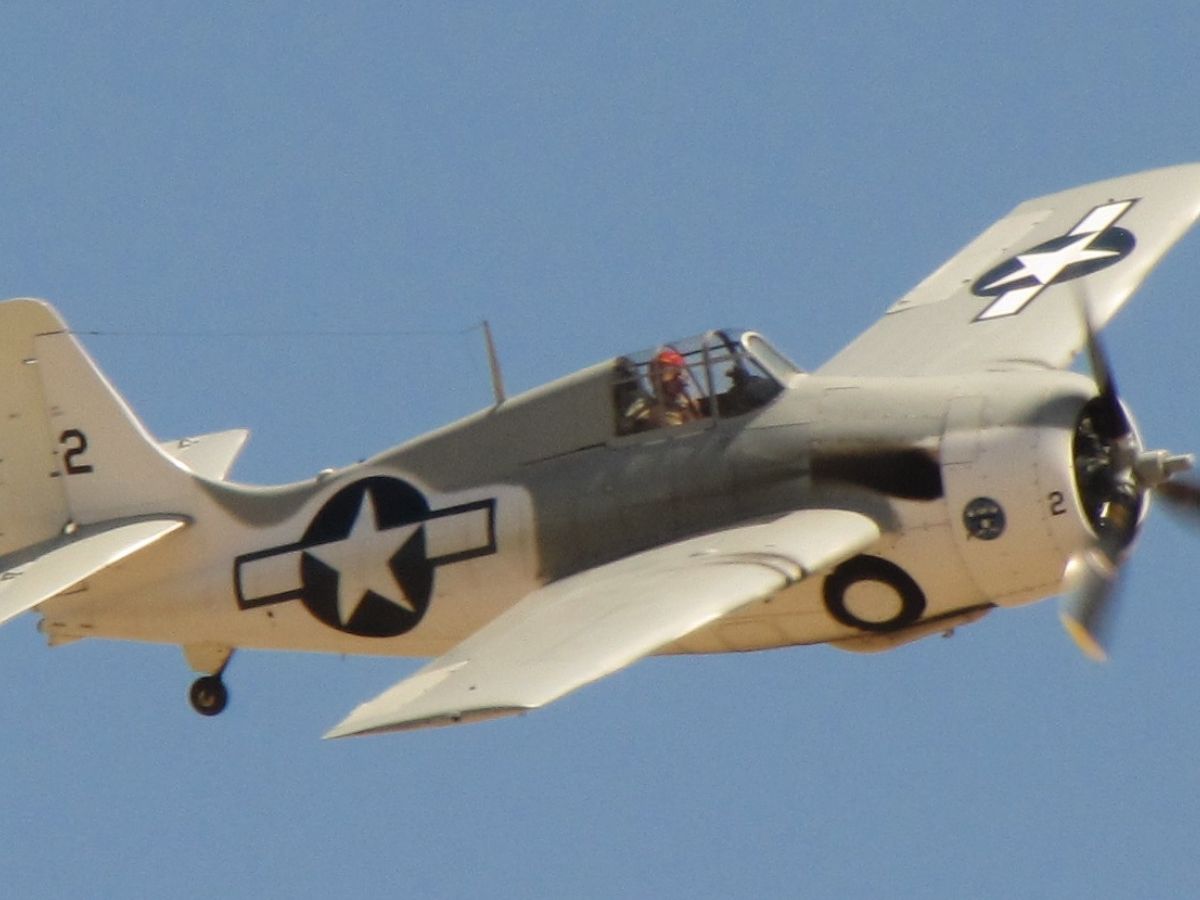
The F4F Wildcat held the line in the Pacific during the darkest months of World War II — from Pearl Harbor through the Guadalcanal campaign. It was the fighter that defended Wake Island, turned back Japanese bombers at Coral Sea and Midway, and slugged it out over Henderson Field for six brutal months. Though superseded on fleet carriers by the F6F Hellcat in late 1943, the Wildcat continued serving on escort carriers until V-J Day. Across 15,553 combat sorties, Wildcats claimed 1,327 enemy aircraft for 178 aerial losses — a 6.9:1 kill ratio achieved through rugged design, superior pilot training, and the revolutionary Thach Weave defensive tactic.
F4F Wildcat at a Glance
- Role
- Carrier-Based Fighter
- Manufacturer
- Grumman Aircraft Engineering Corporation
- Nation
- United States
- Era
- World War II
By the Numbers
7,885
Built
178
Combat Losses
~7,885
Built
178
Aerial Losses
1
Crew
6.9:1
Kill Ratio
~23
Survive Today
4-6 x .50 cal
Guns
Aircraft Description
The Grumman F4F Wildcat was the United States Navy's primary carrier-based fighter from 1940 through mid-1943, bearing the brunt of the air war in the Pacific during its most desperate phase. Though outperformed by the Japanese Zero in speed, climb, and maneuverability, the Wildcat's rugged construction, self-sealing fuel tanks, and pilot armor gave it a critical survivability advantage. American pilots developed innovative tactics — most notably the Thach Weave — to exploit the Wildcat's strengths and neutralize the Zero's advantages, achieving a remarkable 6.9-to-1 kill ratio across all variants.
Origins: From Biplane to Monoplane
The Wildcat's lineage traces back to Grumman's series of barrel-fuselaged biplane fighters — the FF, F2F, and F3F — that established the company as the Navy's premier fighter manufacturer and earned it the enduring nickname "The Iron Works." In 1935, while the F3F was still in flight testing, Grumman began work on its next fighter, the G-16, a biplane design given the Navy designation XF4F-1.
The biplane era was ending. When the Navy showed clear preference for the competing Brewster F2A Buffalo monoplane, Grumman recognized the XF4F-1 would be uncompetitive and abandoned it entirely. Chief engineer William Schwendler and his team designed an entirely new monoplane fighter, the G-18, designated XF4F-2.
Development and Competition
The XF4F-2 made its first flight on September 2, 1937, powered by a Pratt & Whitney R-1830-66 Twin Wasp engine. In Navy trials against the Brewster XF2A-1, the Grumman was faster but suffered persistent engine overheating problems. The Navy chose the Brewster, ordering the F2A Buffalo into production — a decision that would prove disastrous when the Buffalo was slaughtered by Japanese fighters at the Battle of Midway.
However, the Navy hedged its bet by contracting Grumman to continue development. The result was the extensively redesigned XF4F-3, which made its first flight on February 12, 1939. With a larger wing, completely redesigned tail surfaces, and the more powerful R-1830-76 engine with a two-stage supercharger, the XF4F-3 proved markedly superior to the Brewster in every category. The Navy ordered 78 F4F-3s in August 1939.
The Folding Wing: Grumman's Masterstroke
One of the most consequential innovations in naval aviation came from an unlikely source. According to company legend, Leroy Grumman conceived his Sto-Wing folding mechanism using a paperclip and a pink gum eraser on his desk, demonstrating how the wings could rotate 90 degrees to lie flat alongside the fuselage. The system was mechanically simple, robust, and effective — it nearly tripled the number of fighters a carrier could accommodate.
The folding wing was introduced on the F4F-4 variant, which first flew on April 14, 1941. This proved crucial for escort carrier operations later in the war, where the small CVE flight decks and hangars demanded the most efficient possible use of space.
Into Combat: Pearl Harbor to Wake Island
The Wildcat entered combat on the first day of America's war. At Wake Island, Marine Fighting Squadron VMF-211, equipped with 12 F4F-3 Wildcats, conducted one of the most legendary defensive actions in military history. Only four aircraft survived the initial Japanese air attack on December 8, 1941, yet the surviving Wildcats and their pilots fought for 15 days.
Captain Henry Elrod sank the Japanese destroyer Kisaragi with a direct bomb hit — the first enemy surface warship sunk by a U.S. aircraft in the war. The small garrison repelled the first Japanese invasion attempt on December 11, an almost unprecedented achievement. Wake finally fell on December 23 after a second, overwhelming assault. Elrod received a posthumous Medal of Honor.
Butch O'Hare: The Navy's First Ace
On February 20, 1942, Lieutenant Edward "Butch" O'Hare of VF-3 was flying combat air patrol when nine Japanese G4M "Betty" twin-engine bombers were detected heading for the carrier USS Lexington. With his wingman's guns jammed, O'Hare attacked alone. In four minutes of intense combat, he shot down five bombers and damaged a sixth, single-handedly breaking up the attack and saving the Lexington. He became the Navy's first ace of the war and received the Medal of Honor. Chicago's O'Hare International Airport is named in his honor. O'Hare was killed in action on November 26, 1943, during a night fighter mission.
The Thach Weave: Tactics Over Technology
The A6M Zero outperformed the Wildcat in virtually every performance metric — it was faster, climbed better, and could out-turn the American fighter with ease. Conventional one-on-one dogfighting against the Zero was suicide. The solution came from Lieutenant Commander John S. "Jimmy" Thach, who devised what would become the most important aerial combat tactic of the Pacific war.
Working with matchsticks on his kitchen table in Coronado, California, Thach simulated hundreds of dogfight scenarios. He positioned two sections (pairs) of his four-plane flight abreast of each other at a distance equal to the Wildcat's turning radius. When a Zero attacked the tail of one section, both sections would turn toward each other. This created a crossing pattern — a "weave" — that set up the second section for a deflection shot at the attacker. If the Zero turned away, it exposed itself; if it pressed the attack, it flew into the guns of the crossing section.
Thach first employed the tactic in combat at the Battle of Midway in June 1942. It worked immediately and devastatingly. The Thach Weave was quickly adopted as standard doctrine by all Navy and Marine Corps fighter pilots, and variants were adopted by the USAAF. It proved so effective that the basic principle remained relevant into the jet age.
Coral Sea and Midway: Carrier Battles
At the Battle of the Coral Sea (May 4-8, 1942), F4F-3 Wildcats from VF-2 aboard USS Lexington and VF-42 aboard USS Yorktown provided combat air patrol during the first carrier-versus-carrier battle in history. The battle revealed that available fighter numbers were insufficient for adequate combat air patrol coverage, a lesson that influenced future carrier air group composition.
The Battle of Midway (June 4-7, 1942) saw the combat debut of the F4F-4 with its folding wings and six-gun armament. Each of the three American carriers — Enterprise, Hornet, and Yorktown — carried 27 F4F-4s. Twenty-three Wildcats were lost in action, a 28% loss rate, but the battle ended with the destruction of four Japanese fleet carriers and marked the turning point of the Pacific war.
Guadalcanal: The Wildcat's Defining Campaign
The six-month Guadalcanal campaign (August 1942 - February 1943) was the crucible that defined the Wildcat's legacy. Marine squadrons VMF-223, VMF-224, VMF-121, and VMF-212 operated from Henderson Field, the "unsinkable aircraft carrier" carved out of the jungle on the island's northern coast.
Conditions were brutal. Pilots flew multiple sorties daily from a bomb-cratered dirt strip, often scrambling with minutes of warning against incoming Japanese bomber formations escorted by Zeros. Aircraft were repaired with salvaged parts. Malaria, dysentery, and exhaustion were constant companions.
During the critical initial phase from August through November 1942, 115 Wildcats were lost against 106 Zeros to all causes. But the Wildcat's ruggedness proved decisive — American pilots routinely survived crashes and damage that would have been fatal in a Zero. The Japanese, in contrast, lost experienced pilots they could not replace.
Three Marine Wildcat pilots earned the Medal of Honor over Guadalcanal: Captain Joseph Foss (26 victories), Major John L. Smith (19 victories), and Major Robert E. Galer (13 victories). In total, 34 Marine pilots and 27 Navy pilots became aces while flying the Wildcat.
The Atlantic and Mediterranean
The Wildcat's war was not limited to the Pacific. In British service as the Martlet (later redesignated Wildcat in January 1944), the aircraft scored the type's first air combat victory — a Ju 88 over Scapa Flow on Christmas Day 1940.
In December 1941, six Martlets aboard HMS Audacity, the Royal Navy's first operational escort carrier, proved devastatingly effective against Luftwaffe Fw 200 Condor maritime patrol bombers during the escort of Convoy HG 76. This action proved the escort carrier concept and shaped Allied anti-submarine warfare strategy for the remainder of the war.
During Operation Torch (November 1942), F4F-4 Wildcats from USS Ranger and three escort carriers engaged Vichy French fighters — including Dewoitine D.520s and Curtiss Hawk 75s — over the North African landing beaches near Casablanca.
Escort Carrier Warriors: The FM-1 and FM-2
When Grumman shifted its production lines to the F6F Hellcat in 1943, General Motors' Eastern Aircraft Division at Linden, New Jersey took over Wildcat production. The FM-1 was essentially an F4F-4 that wisely reverted to four guns for longer trigger time. The FM-2, based on the XF4F-8 lightweight prototype, was the definitive escort carrier Wildcat.
Powered by the Wright R-1820-56 Cyclone engine producing 1,350 hp, the FM-2 had a superior climb rate and a distinctively taller vertical stabilizer. It was designed specifically for the demanding requirements of escort carrier operations — short deck runs, rapid scrambles, and combat against both aircraft and submarines. The last 1,400 FM-2s were fitted with launch stubs for six 5-inch HVAR rockets, adding a potent ground attack capability.
FM-2 production — 4,777 aircraft — exceeded all other Wildcat variants combined, testimony to the escort carrier's critical role in both the Atlantic U-boat war and Pacific island-hopping campaigns.
Battle off Samar: The Wildcat's Last Great Fight
On October 25, 1944, FM-2 Wildcats from the escort carriers of Taffy 3 participated in one of the most desperate naval engagements of the war. When the Japanese Center Force — including the battleship Yamato, the largest warship ever built — appeared off Samar in the Philippines, the tiny escort carriers had only FM-2 Wildcats and TBM Avengers to defend themselves.
Wildcat pilots pressed home strafing runs against battleships and heavy cruisers with nothing but .50 caliber machine guns. After expending their ammunition, some pilots made dry runs — diving on warships with empty guns — to distract the Japanese gunners and draw fire away from the escort carriers. Their extraordinary courage helped save Taffy 3 from annihilation.
Performance vs. the Zero
On paper, the A6M Zero outclassed the Wildcat in nearly every category. The Zero was approximately 30 mph faster, climbed roughly twice as fast, and could out-turn the Wildcat with ease. In a conventional turning dogfight, the Zero was virtually unbeatable.
But the Wildcat held advantages that did not show up on specification sheets. It could absorb roughly ten times the battle damage of a Zero and keep flying. Its self-sealing fuel tanks prevented the catastrophic fuel fires that claimed so many Zeros. Pilot armor plate stopped bullets that would have killed Japanese pilots flying in unprotected cockpits. The Wildcat was also faster in a dive, giving pilots the ability to break off unfavorable engagements.
Combined with the Thach Weave and disciplined hit-and-run tactics — dive, fire, and extend rather than turning to dogfight — these advantages produced an overall kill ratio of approximately 6.9:1 across all Wildcat variants. The lesson was clear: ruggedness, pilot protection, and smart tactics could overcome raw performance advantages.
Notable Aces
The Wildcat produced an extraordinary crop of fighter aces during the critical early years of the Pacific war:
- Captain Joseph J. Foss, USMC — 26 victories (VMF-121, Guadalcanal). Medal of Honor. Later governor of South Dakota and first commissioner of the American Football League.
- Major John L. Smith, USMC — 19 victories (VMF-223, Guadalcanal). Medal of Honor.
- Captain Marion E. Carl, USMC — 18 victories, 16.5 in Wildcats (VMF-223). First Marine ace. Fought at Midway and Guadalcanal. Later became a renowned test pilot.
- Major Robert E. Galer, USMC — 13 victories (VMF-224, Guadalcanal). Medal of Honor.
- Lieutenant Edward "Butch" O'Hare, USN — 7 victories, 5 in a single mission (VF-3). Medal of Honor. First Navy ace of WWII. KIA November 26, 1943.
- Lieutenant Commander John S. "Jimmy" Thach, USN — 6 victories (VF-3). Developer of the Thach Weave. Rose to admiral rank postwar.
- Major Joe Bauer, USMC — 11 victories (VMF-212, Guadalcanal). Medal of Honor (posthumous). KIA November 14, 1942.
- 1st Lieutenant Jefferson DeBlanc, USMC — 9 victories (VMF-112). Medal of Honor. Shot down 5 aircraft in a single mission over Guadalcanal.
Paint Schemes and Markings
Wildcat paint schemes evolved through four distinct phases as the Navy's camouflage doctrine changed during the war:
- Blue-Gray over Light Gray (October 1941 - early 1943): Non-Specular Blue-Gray (ANA 603) upper surfaces over Non-Specular Light Gray (ANA 602) undersides. This was the iconic scheme at Pearl Harbor, Coral Sea, Midway, and early Guadalcanal — the most frequently modeled Wildcat scheme.
- Tri-Color Scheme (January 1943 - March 1944): Semi-Gloss Sea Blue (ANA 606) uppers, Intermediate Blue (ANA 608) sides, Insignia White (ANA 601) undersides. FM-1 and early FM-2 aircraft left the factory in these colors.
- Overall Glossy Sea Blue (March 1944 onward): Entire aircraft in Glossy Sea Blue (ANA 623). Late-production FM-2s carried this finish. Became the sole carrier aircraft scheme from October 1944.
- British Martlet schemes: Temperate Sea Scheme with Dark Slate Grey and Extra Dark Sea Grey uppers over Sky undersides. Later Wildcat V/VI aircraft sometimes delivered in US Navy scheme.
The national insignia also changed during the Wildcat's service: the pre-war blue circle with white star and red center dot lost its red dot in May-June 1942 (to avoid confusion with the Japanese Hinomaru), gained white side bars with red outlines in June 1943, and finally received blue outlines replacing the red in September 1943.
Design Features
Key engineering and design choices that defined the F4F Wildcat's capabilities.
Sto-Wing Folding Mechanism
Leroy Grumman's ingenious folding-wing design — reportedly conceived using a paperclip and a pink gum eraser — allowed the F4F-4 and later variants to fold their wings alongside the fuselage by rotating them 90 degrees. This nearly tripled the number of fighters a carrier could accommodate, a crucial advantage in the confined hangars of escort carriers.
Rugged Airframe Construction
The Wildcat could absorb roughly ten times the battle damage of a Japanese Zero and still bring its pilot home. Heavy gauge aluminum skin, redundant structural members, and a compact barrel-shaped fuselage gave it extraordinary toughness — a direct lineage from Grumman's biplane fighters (FF, F2F, F3F) that earned the company the nickname 'The Iron Works.'
Pilot Protection
Self-sealing fuel tanks and pilot armor plate were standard features that the Zero completely lacked. When combined with the robust airframe, these features meant that American pilots routinely survived engagements that would have been fatal in contemporary Japanese fighters, preserving irreplaceable combat experience.
Manual Landing Gear Retraction
The Wildcat's narrow-track main landing gear required 29 hand-crank turns to retract — an infamous feature that caused numerous ground-loop accidents when pilots inadvertently released the crank handle during takeoff. The hand-crank housing on the right side of the cockpit is a distinctive detail for scale modelers.
General Motors Mass Production
When Grumman shifted production to the F6F Hellcat, General Motors' Eastern Aircraft Division took over Wildcat manufacturing, producing the FM-1 and FM-2 variants. The FM-2 alone — 4,777 built — exceeded all Grumman-produced Wildcat variants combined, enabling the small escort carriers that hunted U-boats and supported amphibious landings.
Engines & Armament
Powerplant and weapons configuration for the F4F Wildcat's primary production variant.
Powerplant
Pratt & Whitney R-1830-86 Twin Wasp 14-cylinder twin-row air-cooled radial engine, 1,200 hp at takeoff; FM-2 variant used Wright R-1820-56 Cyclone 9-cylinder single-row radial, 1,350 hp
Armament
F4F-3: 4x Browning AN/M2 .50 caliber machine guns (450 rounds per gun); F4F-4: 6x .50 caliber machine guns (240 rounds per gun); FM-1/FM-2: 4x .50 caliber machine guns; up to 2x 250 lb bombs; late FM-2s fitted with 6x 5-inch HVAR rockets
Specifications
Key dimensions and performance figures for the F4F Wildcat's primary production variant.
- Crew
- 1
- Length
- 8.76 m(28.7 ft)
- Wingspan
- 11.58 m(38.0 ft)
- Height
- 2.81 m(9.2 ft)
- Wing Area
- 24.2 m²(260 ft²)
- Max Speed
- 512 km/h(318 mph)
Variants & Models
Each F4F Wildcat variant introduced changes to the airframe, engine, or armament. Visual ID features help modelers and spotters distinguish between versions.
XF4F-2
1
Built
- Powerplant
- P&W R-1830-66 Twin Wasp, 1,050 hp
- Max Speed
- 536 km/h(333 mph)
Visual ID
Original monoplane prototype; single-stage supercharger
First flight September 2, 1937. Lost Navy competition to Brewster XF2A-1 due to engine overheating, but Navy contracted Grumman to continue development as insurance.
XF4F-3
1
Built
- Powerplant
- P&W R-1830-76 Twin Wasp (two-stage supercharger), 1,200 hp
- Max Speed
- 539 km/h(335 mph)
Visual ID
Larger wing, redesigned tail surfaces vs XF4F-2
First flight February 12, 1939. Extensively redesigned with larger wing and two-stage supercharged engine. Proved markedly superior to Brewster in Navy trials, winning production contract for 78 aircraft in August 1939.
F4F-3
285
Built
- Powerplant
- P&W R-1830-76 Twin Wasp (two-stage supercharger), 1,200 hp
- Max Speed
- 533 km/h(331 mph)
- Range
- 1,360 km(845 mi)
- Ceiling
- 11,247 m(36,900 ft)
Visual ID
Non-folding wings with squared-off wingtips; four gun ports
Initial production model. The variant that fought at Wake Island, Coral Sea, and Midway. Four guns with 450 rounds per gun gave 34 seconds of firing time — preferred by many pilots over the later six-gun F4F-4.
F4F-3A
95
Built
- Powerplant
- P&W R-1830-90 Twin Wasp (single-stage supercharger), 1,200 hp
- Max Speed
- 517 km/h(321 mph)
Visual ID
Externally similar to F4F-3; reduced high-altitude performance
Single-stage supercharged engine gave lower altitude performance. 30 originally ordered for Greece were diverted to Britain as Martlet III(B) after Greece fell in April 1941.
F4F-4
1,169
Built
- Powerplant
- P&W R-1830-86 Twin Wasp (two-stage supercharger), 1,200 hp
- Max Speed
- 512 km/h(318 mph)
- Range
- 1,239 km(770 mi)
- Ceiling
- 12,040 m(39,501 ft)
Visual ID
Folding wings (Sto-Wing mechanism); six gun ports; rounded wingtips when folded
Major production variant introducing Grumman's folding wing mechanism. First flight April 14, 1941. Many pilots disliked the trade-off: two extra guns but 360 fewer total rounds, giving only about 20 seconds of firing time. Combat debut at Midway, June 1942.
F4F-7
21
Built
- Powerplant
- P&W R-1830-86 Twin Wasp, 1,200 hp
- Range
- 5,955 km(3,700 mi)
Visual ID
Non-folding "wet" wings carrying 685 US gallons of fuel
Long-range photoreconnaissance variant. Extraordinary 3,700-mile range. One aircraft made a nonstop coast-to-coast flight in 11 hours (1942). Only 21 of 100 ordered were completed before production shifted to the F4F-4.
F4F-3S "Wildcatfish"
1
Built
- Powerplant
- P&W R-1830-76 Twin Wasp, 1,200 hp
- Max Speed
- 428 km/h(266 mph)
Visual ID
Twin Edo floats; fixed landing gear replaced by floats
Floatplane conversion. First flight February 28, 1943. Speed reduction made it impractical for combat. 100 ordered were cancelled and built as standard F4F-3s instead.
FM-1
1,151
Built
- Powerplant
- P&W R-1830-86 Twin Wasp, 1,200 hp
- Max Speed
- 512 km/h(318 mph)
- Range
- 1,239 km(770 mi)
- Ceiling
- 12,040 m(39,501 ft)
Visual ID
Externally identical to F4F-4 except four gun ports instead of six
General Motors Eastern Aircraft Division production. First flight August 31, 1942. Wisely reverted to four guns for longer trigger time. 838 to USN, 312 to Royal Navy as Martlet V (later Wildcat V).
FM-2
4,777
Built
- Powerplant
- Wright R-1820-56 Cyclone, 1,350 hp
- Max Speed
- 534 km/h(332 mph)
- Range
- 1,448 km(900 mi)
- Ceiling
- 10,637 m(34,898 ft)
Visual ID
Taller vertical stabilizer/rudder is the key recognition feature; Wright Cyclone cowling differs from Twin Wasp
The definitive escort carrier Wildcat. Based on XF4F-8 lightweight prototype. Improved climb rate critical for CVE operations. 4,407 to USN, 370 to Royal Navy as Wildcat VI. Total FM-2 production exceeded all other Wildcat variants combined. Fought at Battle off Samar (October 1944).
Martlet I (G-36A)
81
Built
- Powerplant
- Wright R-1820-G205A Cyclone, 1,200 hp
- Max Speed
- 489 km/h(304 mph)
Visual ID
Wright Cyclone cowling; non-folding wings; French-spec throttle (reversed direction)
Originally ordered by France as G-36A. After France fell (June 1940), 81 aircraft diverted to Royal Navy FAA. Scored the type's first air-to-air victory — a Ju 88 over Scapa Flow on December 25, 1940.
Martlet II
90
Built
- Powerplant
- P&W R-1830 Twin Wasp, 1,200 hp
Visual ID
Folding wings; Twin Wasp cowling
First Wildcat variant with folding wings delivered to the Royal Navy. Operated from HMS Illustrious and other fleet carriers. 90 delivered.
Martlet IV (F4F-4B)
220
Built
- Powerplant
- Wright R-1820-40B Cyclone, 1,200 hp
Visual ID
Compact rounded cowling from Wright Cyclone engine distinguishes from Twin Wasp variants
Export variant for Royal Navy with Wright Cyclone engine. 220 delivered. Served in Operation Torch and Atlantic convoy escort.
Development & Operational Timeline
Key milestones in the F4F Wildcat's journey from design through operational service.
XF4F-2 Prototype First Flight
The Grumman XF4F-2 monoplane prototype makes its maiden flight. Though faster than the competing Brewster XF2A-1, persistent engine overheating costs it the Navy competition. The Navy orders the Brewster into production but contracts Grumman to continue development as insurance.
XF4F-3 Redesigned Prototype First Flight
The extensively redesigned XF4F-3, with a larger wing, new tail surfaces, and the two-stage supercharged R-1830-76 engine, proves markedly superior to the Brewster in Navy trials.
Navy Orders 78 F4F-3s
Impressed by the XF4F-3's performance, the U.S. Navy places an initial order for 78 production F4F-3 Wildcats.
USN Operational Service Begins
The F4F-3 Wildcat enters operational service with the United States Navy, replacing the Brewster F2A Buffalo aboard fleet carriers.
First Wildcat Air Combat Victory
Royal Navy Martlet Is from 804 Naval Air Squadron shoot down a Junkers Ju 88 bomber over Scapa Flow — the first American-built fighter to score an air combat victory in British service during World War II.
Defense of Wake Island
Marine Fighting Squadron VMF-211, equipped with 12 F4F-3 Wildcats, conducts a legendary 15-day defense of Wake Island. Despite losing all but four aircraft in the initial Japanese air attack, the surviving Wildcats sink the destroyer Kisaragi and help repel the first invasion attempt.
Butch O'Hare's Medal of Honor Action
Lieutenant Edward "Butch" O'Hare single-handedly attacks nine Japanese G4M bombers threatening USS Lexington, shooting down five in four minutes. He becomes the Navy's first ace of the war and receives the Medal of Honor. Chicago O'Hare Airport is later named in his honor.
Battle of the Coral Sea
F4F-3 Wildcats from VF-2 (USS Lexington) and VF-42 (USS Yorktown) provide combat air patrol during the first carrier-versus-carrier battle in history. Fighter numbers prove insufficient for adequate CAP coverage, influencing future carrier air group composition.
Battle of Midway
The F4F-4 (folding wings, six guns) sees its combat debut. Each of the three U.S. carriers carries 27 Wildcats. Lieutenant Commander Jimmy Thach first employs the Thach Weave in combat. Twenty-three Wildcats are lost in action (28% loss rate), but the battle ends as a decisive American victory.
Guadalcanal Campaign
The Wildcat's defining campaign. Marine squadrons VMF-223, VMF-224, and VMF-121 operate from Henderson Field for six brutal months. Captain Joe Foss scores 26 victories to earn the Medal of Honor. The Wildcat's ruggedness proves decisive — pilots routinely survive damage that would destroy a Zero.
F6F Hellcat Replaces Wildcat on Fleet Carriers
The F6F Hellcat enters widespread fleet carrier service, replacing the Wildcat in the frontline fleet role. Wildcats transition to escort carrier (CVE) operations where they continue serving until war's end.
Battle off Samar
FM-2 Wildcats from escort carriers of Taffy 3 fly against the Japanese Center Force — including the battleship Yamato — in one of the war's most desperate engagements. Wildcat pilots make strafing runs and even dry runs after expending ammunition to draw fire from the vulnerable escort carriers.
Production Ends / War Concludes
F4F Wildcat production concludes with the FM-2 as the final variant. Total production across all variants reaches approximately 7,885 aircraft. The Wildcat served from the first day of American involvement to the last.
Combat History
Major engagements and missions that defined the F4F Wildcat's combat record.
Defense of Wake Island
December 8-23, 1941VMF-211 defended Wake Island with 12 F4F-3 Wildcats for 15 days against repeated Japanese air attacks and two invasion attempts. Four aircraft survived the initial attack. Captain Henry Elrod sank the destroyer Kisaragi with a 100 lb bomb — the first surface warship sunk by a U.S. aircraft in the war.
12
Dispatched
12
Aircraft Lost
Demonstrated the Wildcat's combat potential and became a powerful symbol of American resistance in the early Pacific war. Captain Henry Elrod received a posthumous Medal of Honor.
Convoy HG 76 — First Escort Carrier Operations
December 14-23, 1941Six Martlet IIs aboard HMS Audacity — the Royal Navy's first operational escort carrier — provided air cover for Convoy HG 76 from Gibraltar to the UK. The Martlets shot down several Focke-Wulf Fw 200 Condor maritime patrol bombers that had been devastating Allied shipping.
6
Dispatched
Proved the escort carrier concept and demonstrated that small numbers of fighters operating from converted merchant ships could decisively counter long-range maritime patrol aircraft — a lesson that shaped Allied anti-submarine warfare for the rest of the war.
Battle of Midway
June 4-7, 1942F4F-4 Wildcats from USS Enterprise, Hornet, and Yorktown provided combat air patrol and escorted strike aircraft during the decisive carrier battle. The Thach Weave was employed in combat for the first time by Lieutenant Commander Jimmy Thach.
81
Dispatched
23
Aircraft Lost
The F4F-4's combat debut. Despite a 28% loss rate among Wildcats, the battle destroyed the core of Japanese carrier striking power. The Thach Weave proved immediately effective and was adopted as standard doctrine across the fleet.
Guadalcanal Air Campaign
August 1942 - November 1942Marine Wildcat squadrons operating from Henderson Field — "the unsinkable aircraft carrier" — fought a continuous air campaign against Japanese bombers and fighters. VMF-223, VMF-224, VMF-121, and VMF-212 rotated through the island. During the critical initial phase, 115 Wildcats were lost against 106 Zeros to all causes.
115
Aircraft Lost
The Wildcat's defining campaign. The aircraft's ruggedness proved decisive — American pilots frequently survived crashes and damage that would have been fatal in a Zero, preserving irreplaceable combat experience. Three Marine pilots (Foss, Smith, Galer) earned the Medal of Honor flying Wildcats over Guadalcanal.
Battle off Samar
October 25, 1944FM-2 Wildcats from the escort carriers of Taffy 3 (Task Unit 77.4.3) attacked the Japanese Center Force — including battleships Yamato, Nagato, Kongō, and Haruna plus heavy cruisers — with bombs, rockets, strafing, and even dry runs after expending all ammunition.
One of the most extraordinary naval actions of the war. FM-2 pilots pressed home attacks against battleships and heavy cruisers with nothing but .50 caliber machine guns and rockets, demonstrating the Wildcat's continued combat relevance even late in the war.
Production & Service
From first flight to retirement — the F4F Wildcat's operational lifespan at a glance.
- Number Built
- 7,885
- First Service
- 1940
- Last Built
- 1945
- Retired
- 1945
- Combat Losses
- 178
- Status
- Retired
Where to See One
Surviving F4F Wildcat aircraft you can visit today. Airworthy aircraft may appear at air shows.
Duxford FM-2
S/N: BuNo 86711
Variant: FM-2
Imperial War Museum Duxford
Duxford, United Kingdom
The Fighter Collection
One of the few airworthy Wildcats in the world. Regular participant in Duxford airshows.
Cradle of Aviation F4F-3
S/N: BuNo 12297
Variant: F4F-3
Displayed in Grumman's home region on Long Island, near the Bethpage factory where Wildcats were built.
Guadalcanal Battlefield F4F-4
S/N: BuNo 12068
Variant: F4F-4
Vilu War Museum
Honiara, Solomon Islands
Recovered from the Guadalcanal battlefield. Displayed in an outdoor memorial near Henderson Field.
Marine Corps Museum F4F-4
S/N: BuNo 12114
Variant: F4F-4
Displayed in the WWII gallery, honoring the Marine Wildcat pilots who fought at Guadalcanal.
Military Aviation Museum FM-2
S/N: BuNo 47030
Variant: FM-2
Part of an extensive warbird collection featuring flyable and static WWII aircraft.
New England Air Museum FM-2
S/N: BuNo 74120
Variant: FM-2
Static display of a General Motors-built FM-2 variant.
O'Hare Airport Memorial F4F-3
S/N: BuNo 12320
Variant: F4F-3
Chicago O'Hare International Airport (Terminal 2)
Chicago, Illinois
On loan from National Naval Aviation Museum
Memorial to Medal of Honor recipient Lt. Edward "Butch" O'Hare, who shot down five Japanese bombers in four minutes on February 20, 1942.
Patriots Point Wildcat
Variant: F4F
Patriots Point Naval & Maritime Museum
Mount Pleasant, South Carolina
Patriots Point Naval & Maritime Museum
Visit website →Displayed aboard the museum carrier USS Yorktown (CV-10).
Pearl Harbor Wildcat
S/N: BuNo 12296
Variant: F4F
Displayed at the historic Ford Island hangars at Pearl Harbor.
Pensacola F4F-3
S/N: BuNo 4039
Variant: F4F-3
Displayed in a simulated underwater diorama. One of the oldest surviving Wildcats.
San Diego F4F-4
Variant: F4F-4
Part of the museum's World War II aviation collection.
Smithsonian FM-1
S/N: BuNo 15392
Variant: FM-1
400th FM-1 built at the General Motors Eastern Aircraft Division plant in Linden, NJ. Displayed in the Sea-Air Operations gallery.
USS Midway Museum Wildcat
S/N: BuNo 12290
Variant: F4F
Displayed aboard the museum carrier USS Midway.
Written by
Steve Carmichael
I am a ww2 model enthusiast getting back into building scaled models after many years away. This site allows me to work on my web development skills while sharing what I am learning.
More Fighter Aircraft
View all → Fighter
Chance Vought Corporation
F4U Corsair
 Fighter
Grumman Aircraft Engineering Corporation
F6F Hellcat
 Twin-Engine Fighter
Lockheed Aircraft Corporation
P-38 Lightning
 Fighter
Bell Aircraft Corporation
P-39 Airacobra
 Fighter
Curtiss-Wright Corporation
P-40 Warhawk
 Fighter
Republic Aviation Corporation