Curtiss-Wright Corporation
P-40 Warhawk
 Steve CarmichaelLast updated April 3, 2026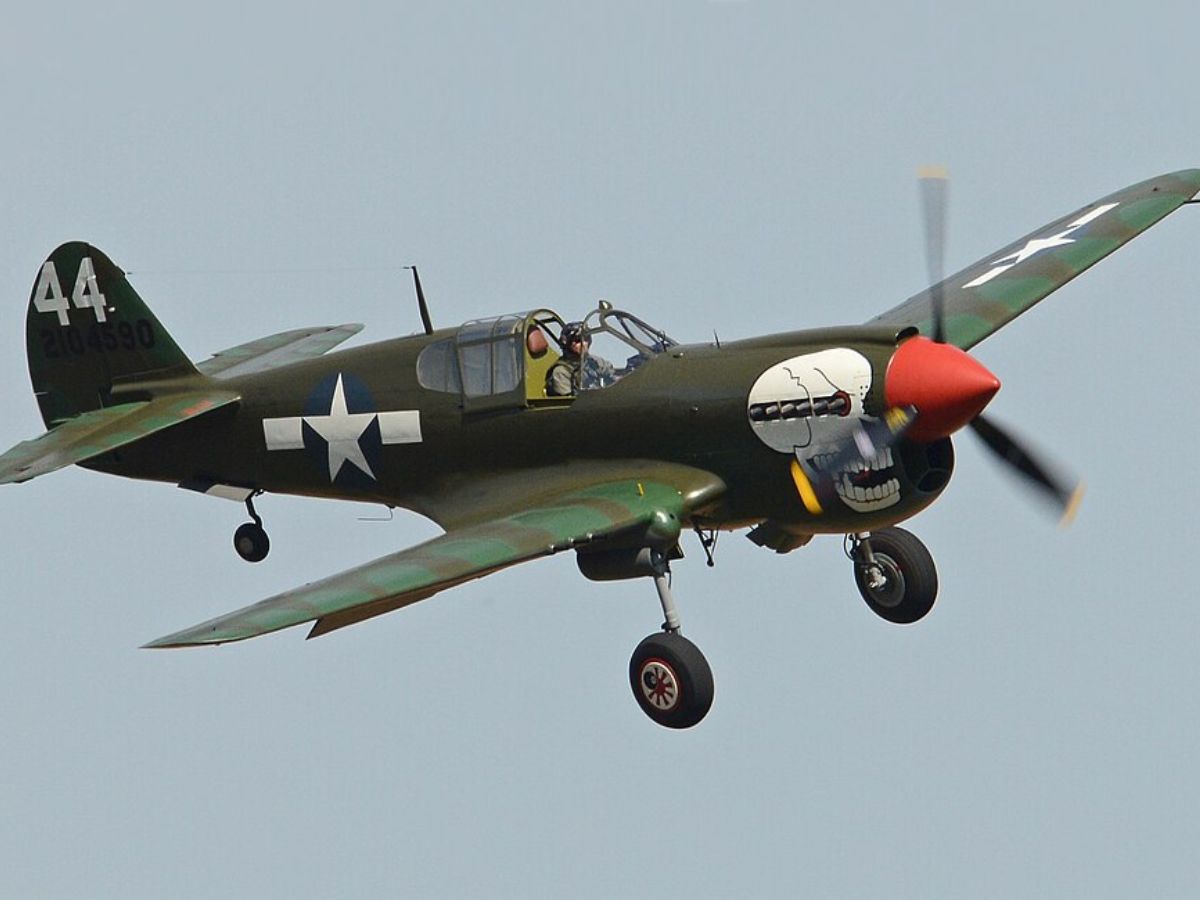
The P-40 Warhawk was the third most-produced American fighter of World War II (13,738 built) and the principal USAAF fighter throughout 1941-1943. It served in every major theater — the Pacific, China-Burma-India, North Africa, the Mediterranean, the Eastern Front, and the Aleutians. Though outperformed at altitude by the Bf 109 and Zero, the P-40 excelled at low and medium altitudes where its rugged construction, heavy six-gun armament, and superior diving speed gave skilled pilots a decisive edge. The American Volunteer Group "Flying Tigers" proved that with the right tactics, the P-40 could achieve extraordinary kill ratios even against superior opponents. Over 200 Allied pilots became aces flying the type.
P-40 Warhawk at a Glance
- Role
- Fighter
- Manufacturer
- Curtiss-Wright Corporation
- Nation
- United States
- Era
- World War II
By the Numbers
13,738
Built
13,738
Built
74:1
AVG Kill Ratio
1
Crew
200+
Aces on Type
28 nations
Operators
6 x .50 cal
Guns
Aircraft Description
The Curtiss P-40 Warhawk was the primary American fighter aircraft during the critical early years of World War II, serving as the backbone of Allied fighter strength from 1941 through 1943. Developed from the radial-engined P-36 Hawk by fitting a liquid-cooled Allison V-1710 inline engine, the P-40 was not the most advanced fighter of its era — but it was available in quantity when nothing else was. Its rugged construction, heavy armament, and superior diving speed made it effective in the hands of skilled pilots. The P-40 is forever associated with the Flying Tigers of the American Volunteer Group, whose shark-mouthed Warhawks became one of the most iconic images of the air war.
Origins: The Practical Fighter
The P-40 Warhawk began life as a pragmatic solution to an urgent problem. In the late 1930s, the U.S. Army Air Corps needed modern fighters — fast. The Curtiss P-36 Hawk, a radial-engined monoplane fighter, was already in production and proving reliable if unspectacular. Chief engineer Donovan R. Berlin's insight was simple: take the proven P-36 airframe and replace its Pratt & Whitney radial with a liquid-cooled Allison V-1710 inline engine, promising better streamlining and higher speed.
The conversion was straightforward. Berlin took the 10th production P-36A (serial 38-10) and grafted the Allison engine onto it, creating the XP-40. It first flew on October 14, 1938, at Buffalo, New York. The aircraft retained the P-36's wing, landing gear, and tail structure — keeping development time and risk minimal.
In April 1939, with war clouds gathering over Europe, the Army placed its largest fighter order since World War I: 524 P-40s. This was not because the P-40 was the best fighter available — even then, designers knew the turbosupercharged P-38 and the yet-to-fly P-47 would be superior. But those aircraft were years from production. The P-40 could be built now, on existing tooling, in the quantities the Army desperately needed. This became the P-40's defining characteristic throughout its career: it was the fighter that was there when needed.
The Flying Tigers: Tactics Over Technology
No P-40 story is complete without the American Volunteer Group — the "Flying Tigers." Organized in 1941 by Claire Lee Chennault, a retired Air Corps captain turned advisor to Chiang Kai-shek, the AVG recruited volunteer pilots from U.S. military services to fly P-40B and P-40C Tomahawks against the Japanese in China and Burma.
Chennault was a tactical genius who understood the P-40's limitations and strengths with crystalline clarity. The P-40 could not outmaneuver Japanese fighters — the Nakajima Ki-43 Oscar and Mitsubishi A6M Zero could turn circles around it. But the P-40 could outdive anything in the Japanese inventory. It had heavier firepower, better armor protection, and self-sealing fuel tanks that Japanese fighters lacked. Chennault built his entire tactical doctrine around these advantages:
- Always engage from altitude advantage
- Make high-speed diving passes through enemy formations
- Never turn to dogfight — dive away and climb back for another pass
- Use the two-ship element for mutual support
- Exploit the P-40's superior speed in a dive to break off unfavorable engagements
The AVG entered combat on December 20, 1941, and in just six and a half months destroyed 297 confirmed Japanese aircraft while losing only four P-40s in air-to-air combat — an extraordinary kill ratio of approximately 74:1. On July 4, 1942, the AVG was disbanded and absorbed into the USAAF as the 23rd Fighter Group, 14th Air Force.
The Shark Mouth: Origin of an Icon
The P-40's iconic shark mouth nose art is one of the most recognized military markings in history, but the AVG did not invent it. The lineage traces through three air forces. German Bf 110 fighters of the "Haifischgruppe" (Shark Group) painted shark mouths on their aircraft during Balkan campaigns. RAF No. 112 Squadron, operating Tomahawks in North Africa in the summer of 1941, saw the German markings and adopted the design — the P-40's large chin radiator intake was uniquely suited for it. AVG pilots then saw photographs of No. 112 Squadron's shark-mouthed Tomahawks in a magazine and adopted the design themselves. Commander Chennault ordered every aircraft in the group to carry the markings, making it a unit-wide standard.
The shark mouth has since become inseparable from the P-40's identity. Its appeal is practical as well as aesthetic: the P-40's deep chin intake provides a natural "mouth" that no other fighter could match.
Pearl Harbor: The P-40's First Day of War
P-40Bs were among the few American fighters to get airborne during the Japanese attack on Pearl Harbor on December 7, 1941. Most P-40s at Wheeler Field were destroyed on the ground, lined up wingtip to wingtip as anti-sabotage measures had clustered them together for easier guarding.
But Lieutenants George Welch and Kenneth Taylor of the 47th Pursuit Squadron raced to the satellite field at Haleiwa, which the Japanese had not attacked. They took off in P-40Bs and flew two separate sorties into the attacking formations, shooting down several Japanese aircraft between them. Both received Distinguished Service Crosses — they were recommended for the Medal of Honor but the recommendation was downgraded because they had taken off without orders.
North Africa: The Desert Warhawk
The P-40 was a mainstay of the Desert Air Force in North Africa from 1941 through 1943. RAF, Royal Australian Air Force, and South African Air Force squadrons operated Tomahawks and Kittyhawks extensively against the Luftwaffe and the Italian Regia Aeronautica. The type proved effective in the fighter-bomber role, attacking Axis ground forces with bombs and strafing, and in air superiority missions at low and medium altitudes.
The top-scoring P-40 ace of any air force was Clive "Killer" Caldwell of the RAAF, who achieved 22 victories while flying Tomahawks and Kittyhawks in the Western Desert. Other Australian double aces on the type included Nicky Barr, Bobby Gibbes, and John Waddy. The 324th Fighter Group, among the USAAF units that arrived for Operation Torch in November 1942, achieved better than a 2:1 kill ratio against Axis aircraft.
The Eastern Front
The Soviet Union received approximately 2,134 P-40s through Lend-Lease between 1941 and 1944. Britain initially transferred 195 Tomahawks to the USSR after Operation Barbarossa began on June 22, 1941. Additional P-40K, P-40M, and P-40N models were shipped directly from the United States.
Soviet P-40s saw most frontline use in 1942 and early 1943, particularly in the northern sectors defending Murmansk and Leningrad. They were gradually replaced by improved Soviet designs like the Lavochkin La-5 and Yakovlev Yak-9, as well as by Bell P-39 Airacobras, which Soviet pilots particularly favored for their cannon armament and low-altitude performance.
The Pacific and CBI Theaters
Beyond the Flying Tigers, P-40s served throughout the Pacific with USAAF, RAAF, and RNZAF units. The RAAF operated seven squadrons on the type, primarily in the New Guinea and Borneo campaigns. RNZAF Kittyhawk squadrons fought in the Solomon Islands. USAAF P-40 units served in the Aleutian Islands, where the type operated in brutally harsh Arctic conditions including fog, ice, and violent winds. The RCAF also deployed P-40s to Alaska.
In the China-Burma-India theater, the 23rd Fighter Group continued the AVG's legacy after July 1942, and the Chinese-American Composite Wing (CACW) also operated P-40s. At least 40 U.S. pilots became aces on the type in the CBI theater alone. Overall, the P-40's combat record against Japanese aircraft was strong: the type's combination of heavy armament, rugged construction, and superior diving speed — qualities shared with the F4F Wildcat — proved consistently effective when pilots used proper tactics.
Evolution: From Tomahawk to Warhawk
The P-40 evolved continuously through 11 major production variants. The most significant redesign came with the P-40D (Curtiss Model H-87), which featured a shorter nose, deeper radiator housing, and moved all armament to the wings — deleting the cowl-mounted guns of earlier models. The P-40E added a sixth .50 caliber gun and became the workhorse variant of 1942.
The P-40F introduced the Rolls-Royce/Packard Merlin engine for improved altitude performance, eliminating the chin carburetor scoop and reaching 373 mph. The lightweight P-40L variant, nicknamed "Gypsy Rose Lee" for all the parts stripped away, pushed weight reduction further.
The final and most-produced variant was the P-40N, with 5,219 built. The P-40N-1 was the fastest production Warhawk at 378 mph — faster than many realize for this often-underestimated fighter. Later N models featured a cut-down rear fuselage for improved rearward visibility. Production ended in November 1944 after 13,738 aircraft.
Assessment: The Fighter That Was There
The P-40 Warhawk was never the best fighter of World War II. Its single-stage supercharged Allison engine limited its high-altitude performance. It was outclimbed by the Bf 109 and out-turned by the Zero. It was eventually superseded by the P-51 Mustang, P-47 Thunderbolt, and P-38 Lightning.
But military history is not made only by the best weapons — it is made by weapons that are available when needed. The P-40 filled the gap between peacetime unpreparedness and wartime production of superior types. It was the fighter that held the line at Pearl Harbor, over the deserts of North Africa, through the jungles of New Guinea, and across the skies of China. Over 200 Allied pilots from at least 28 nations became aces flying the type. The Flying Tigers proved that with the right tactics, even a "second-tier" fighter could achieve first-tier results.
The P-40's legacy is not one of technical superiority but of practical effectiveness — the right aircraft, in the right place, at the right time, flown by pilots who understood exactly what it could and could not do.
Notable P-40 Aces
- Group Captain Clive "Killer" Caldwell, RAAF — 22 victories in P-40s (28.5 total). Highest-scoring P-40 ace of any air force. Scored kills against Bf 109s, Italian fighters, and Japanese aircraft in North Africa and the Pacific.
- Squadron Leader Nicky Barr, RAAF — 12 victories in P-40s. Shot down three times, escaped from POW camps three times. One of Australia's most celebrated fighter pilots.
- Colonel Bruce K. Holloway, USAAF — 13 victories. Top-scoring USAAF P-40 ace. Served with the 23rd Fighter Group in CBI. Later became a four-star general and Commander in Chief of SAC.
- Colonel David Lee "Tex" Hill, USAAF — 18.25 victories (12.25 in P-40s with AVG, 6 in P-51s). One of the most famous Flying Tigers. Squadron leader of the 2nd "Panda Bears" Squadron.
- Captain George Welch, USAAF — 16 victories (4 at Pearl Harbor in P-40B). One of the first Americans to score kills in WWII. Later became a test pilot; first to break Mach 1 in a dive.
- Group Captain Bobby Gibbes, RAAF — 10.25 victories in P-40s. Commanded No. 3 Squadron RAAF in North Africa. Known for leading aggressive ground-attack missions.
Paint Schemes and Markings
The P-40 wore a wider variety of camouflage schemes than almost any other WWII fighter, reflecting its service with 28 nations across every theater:
- USAAF Standard (1941-1944): Olive Drab (ANA 613) upper surfaces over Neutral Gray (ANA 603) undersides. The most common scheme for USAAF P-40s in all theaters.
- AVG/Flying Tigers: RAF export colors — Dark Earth and Dark Green uppers over Sky or Light Gray undersides. Chinese Nationalist twelve-pointed white sun roundels. The iconic shark mouth in white and red across the chin intake.
- RAF Desert Air Force: Dark Earth and Middle Stone uppers over Azure Blue undersides (Middle East Scheme). RAF roundels and fin flash. No. 112 Squadron's original shark mouths were the template for all subsequent P-40 shark designs.
- Soviet Lend-Lease: Often retained original Olive Drab/Neutral Gray factory paint with Soviet red stars applied over original insignia. Some received winter whitewash for northern sector operations.
- RAAF Pacific: Foliage Green over Sky Blue for tropical operations, later Dark Green and Dark Earth patterns for jungle environments.
- Natural Metal: Late-war P-40Ns sometimes delivered unpainted when the USAAF eliminated camouflage to save weight.
Design Features
Key engineering and design choices that defined the P-40 Warhawk's capabilities.
P-36 Hawk Lineage
The P-40 was created by grafting a liquid-cooled Allison V-1710 inline engine onto the proven P-36 Hawk airframe, retaining its wing, landing gear, and tail structure. This low-risk approach kept development time and cost minimal, allowing rapid production when the USAAC urgently needed modern fighters. The tradeoff was a design that could be improved incrementally but never fundamentally transformed.
Superior Diving Speed
The P-40's heaviest single advantage in combat was its exceptional diving speed. It could outdive the Japanese Zero, Ki-43 Oscar, and even the Bf 109 in certain configurations. This gave pilots a reliable escape route from unfavorable engagements and enabled devastating hit-and-run attacks from altitude — the foundation of Chennault's Flying Tigers tactics.
Rugged Construction and Pilot Protection
Like many American fighters, the P-40 featured self-sealing fuel tanks and pilot armor plate that Japanese and some Axis fighters lacked. Combined with a robust airframe that could absorb significant battle damage, these features gave American pilots a critical survivability advantage — the same philosophy that made the F4F Wildcat effective against the Zero.
Distinctive Chin Radiator
The large chin-mounted radiator air intake beneath the engine was the P-40's most recognizable feature and made it uniquely suited for the famous shark mouth nose art. The intake shape changed significantly between the early Tomahawk (H-81) and later Kittyhawk (H-87) variants, with the latter having a much deeper, more prominent intake.
Altitude Limitation
The single-stage, single-speed supercharged Allison engine gave the P-40 good low-to-medium altitude performance but poor high-altitude capability — a fundamental limitation that could not be fully overcome. The Merlin-engined P-40F improved altitude performance but was produced in limited numbers. This limitation defined the P-40's tactical employment throughout the war.
Engines & Armament
Powerplant and weapons configuration for the P-40 Warhawk's primary production variant.
Powerplant
Allison V-1710 liquid-cooled supercharged 60-degree V-12 engine (various models from 1,040 to 1,360 hp depending on variant); P-40F and P-40L variants used the Packard V-1650-1 (license-built Rolls-Royce Merlin), 1,300 hp, for improved altitude performance
Armament
P-40B/C: 2x .50 cal M2 Browning (nose) + 4x .30 cal M1919 (wings); P-40E onward: 6x .50 cal M2 Browning machine guns (wings), 235 rounds per gun; up to 500 lb bomb on centerline + 2x 250 lb bombs underwing (1,000 lb maximum external load)
Specifications
Key dimensions and performance figures for the P-40 Warhawk's primary production variant.
- Crew
- 1
- Length
- 9.66 m(31.7 ft)
- Wingspan
- 11.38 m(37.3 ft)
- Height
- 3.76 m(12.3 ft)
- Wing Area
- 21.9 m²(236 ft²)
- Max Speed
- 580 km/h(360 mph)
Variants & Models
Each P-40 Warhawk variant introduced changes to the airframe, engine, or armament. Visual ID features help modelers and spotters distinguish between versions.
XP-40
1
Built
- Powerplant
- Allison V-1710-19, 1,160 hp
- Max Speed
- 555 km/h(345 mph)
Visual ID
Converted from 10th production P-36A; inline engine replaces radial
First flight October 14, 1938, piloted by Edward Elliott at Buffalo, NY. Proved the concept of mating the Allison inline engine to the P-36 airframe.
P-40 (Tomahawk I)
199
Built
- Powerplant
- Allison V-1710-33, 1,040 hp
- Max Speed
- 555 km/h(345 mph)
Visual ID
No armor, no self-sealing tanks; two nose guns only
First production model. Lacked combat-essential features like armor and self-sealing tanks. 199 built; many exported to RAF as Tomahawk I. Not considered combat-ready by USAAC standards.
P-40B (Tomahawk IIA)
131
Built
- Powerplant
- Allison V-1710-33, 1,040 hp
- Max Speed
- 555 km/h(345 mph)
- Range
- 1,175 km(730 mi)
- Ceiling
- 9,754 m(32,001 ft)
Visual ID
Wing gun blisters; pilot armor plate added
Added pilot armor, partial self-sealing tanks, and four wing-mounted .30 cal guns. The primary mount of the American Volunteer Group "Flying Tigers." Aircraft at Pearl Harbor on December 7, 1941 were largely P-40Bs.
P-40C (Tomahawk IIB)
193
Built
- Powerplant
- Allison V-1710-33, 1,040 hp
- Max Speed
- 555 km/h(345 mph)
- Range
- 1,175 km(730 mi)
- Ceiling
- 8,840 m(29,003 ft)
Visual ID
Belly shackle for drop tank or bomb; externally similar to P-40B
Added fully self-sealing fuel tanks and underbelly shackle for 500 lb bomb or 52 US gallon drop tank. Also used by AVG Flying Tigers alongside P-40Bs. Slightly heavier than P-40B due to fuel tank protection.
P-40D (Kittyhawk I)
42
Built
- Powerplant
- Allison V-1710-39, 1,150 hp
- Max Speed
- 571 km/h(355 mph)
- Range
- 1,126 km(700 mi)
- Ceiling
- 9,174 m(30,098 ft)
Visual ID
Shorter nose (no cowl gun troughs); deeper radiator housing; wider-chord propeller
Major redesign (Curtiss Model H-87). Nose guns deleted, all armament moved to wings. Shorter, deeper nose profile. Only 42 built before the improved P-40E with six guns entered production.
P-40E (Kittyhawk IA)
2,320
Built
- Powerplant
- Allison V-1710-39, 1,150 hp
- Max Speed
- 580 km/h(360 mph)
- Range
- 1,046 km(650 mi)
- Ceiling
- 8,840 m(29,003 ft)
Visual ID
Six wing guns (three per wing); deeper chin intake vs Tomahawk; no nose gun troughs
The workhorse variant of 1942. Bore the brunt of early-war combat in the Pacific, North Africa, and CBI theaters. Added a third .50 caliber gun per wing over the P-40D. Approximately 2,320 built. The most commonly modeled P-40 variant alongside the Tomahawk.
P-40F (Kittyhawk II)
1,311
Built
- Powerplant
- Packard V-1650-1 Merlin, 1,300 hp
- Max Speed
- 600 km/h(373 mph)
- Range
- 1,400 km(870 mi)
- Ceiling
- 10,485 m(34,400 ft)
Visual ID
No chin carburetor scoop (Merlin uses updraft carburetor); otherwise similar to P-40E profile
Merlin engine eliminated the chin carburetor intake scoop, giving a cleaner nose profile. Improved altitude performance (max speed 373 mph). 1,311 built. Later aircraft received a lengthened rear fuselage for improved directional stability.
P-40K (Kittyhawk III)
1,300
Built
- Powerplant
- Allison V-1710-73, 1,325 hp
- Max Speed
- 580 km/h(360 mph)
- Range
- 1,046 km(650 mi)
- Ceiling
- 8,840 m(29,003 ft)
Visual ID
Chin scoop retained (Allison engine); later blocks had lengthened fuselage with dorsal fillet
More powerful Allison engine improved performance. 1,300 built. Later production blocks introduced a lengthened rear fuselage with a fillet ahead of the vertical stabilizer for better directional stability — a modification carried forward to all subsequent variants.
P-40L (Kittyhawk II)
700
Built
- Powerplant
- Packard V-1650-1 Merlin, 1,300 hp
- Max Speed
- 600 km/h(373 mph)
Visual ID
Lightened P-40F; some with only four guns; no chin scoop
Weight-reduced Merlin variant. Some aircraft had only four guns and reduced fuel to save weight. Nicknamed "Gypsy Rose Lee" by pilots for all the parts that were stripped off. 700 built.
P-40M (Kittyhawk III)
600
Built
- Powerplant
- Allison V-1710-81, 1,200 hp
- Max Speed
- 571 km/h(355 mph)
- Range
- 1,046 km(650 mi)
- Ceiling
- 9,144 m(30,000 ft)
Visual ID
Lengthened fuselage with dorsal fillet; chin scoop
Optimized for export. Stretched fuselage for improved stability. 600 built, primarily for Commonwealth air forces (RAAF, RNZAF, RAF).
P-40N (Kittyhawk IV)
5,219
Built
- Powerplant
- Allison V-1710-81/-99/-115, 1,200-1,360 hp
- Max Speed
- 608 km/h(378 mph)
- Range
- 386 km(240 mi)
- Ceiling
- 11,582 m(37,999 ft)
Visual ID
Cut-down rear fuselage for improved rearward visibility; lightweight construction
Most-produced variant (5,219 built). Incorporated weight-reduction measures throughout. P-40N-1 was the fastest production Warhawk at 378 mph. Early N models had four guns to save weight; later blocks restored six. Final production variant; last aircraft delivered November 1944.
Development & Operational Timeline
Key milestones in the P-40 Warhawk's journey from design through operational service.
XP-40 Prototype First Flight
Curtiss test pilot Edward Elliott flies the XP-40 prototype at Buffalo, New York. The aircraft is the 10th production P-36A airframe fitted with a liquid-cooled Allison V-1710-19 inline engine, proving the concept of mating an inline powerplant to the proven P-36 airframe.
Largest-Ever USAAC Fighter Order
The U.S. Army Air Corps, urgently seeking modern fighters after witnessing European air combat developments, places an order for 524 P-40s — the largest American fighter contract since World War I. The P-40 is chosen not as the most advanced design available, but as one that can be produced in quantity on existing tooling.
P-40 Enters USAAC Service
The first production P-40s enter operational service with the United States Army Air Corps, beginning to replace the P-36 Hawk in frontline pursuit squadrons.
RAF No. 112 Squadron Paints First Shark Mouths
RAF No. 112 Squadron, operating Tomahawks in North Africa, paints shark mouth markings on its aircraft — inspired by similar markings on Luftwaffe Bf 110 fighters. These photographs will later inspire the AVG Flying Tigers to adopt the same design.
Desert Air Force Operations in North Africa
RAF, RAAF, and SAAF squadrons operate Tomahawks and Kittyhawks extensively against the Luftwaffe and Regia Aeronautica across North Africa. The P-40 proves effective in the fighter-bomber role and in air superiority at low and medium altitudes over the Western Desert.
Soviet Lend-Lease Operations
The Soviet Union receives approximately 2,134 P-40s through Lend-Lease. Soviet P-40s serve primarily on the northern sectors defending Murmansk and Leningrad during 1942-1943 before being gradually replaced by improved Soviet designs and P-39 Airacobras.
P-40s in Combat at Pearl Harbor
P-40Bs are among the few U.S. fighters to get airborne during the Japanese attack on Pearl Harbor. Lieutenants George Welch and Kenneth Taylor take off from Haleiwa Field and shoot down several Japanese aircraft, earning Distinguished Service Crosses. Most P-40s on the ground at Wheeler Field are destroyed.
Flying Tigers Enter Combat
The American Volunteer Group "Flying Tigers," commanded by Claire Chennault, enters combat against Japanese forces over China and Burma flying P-40B and P-40C Tomahawks. In six and a half months of operations, the AVG destroys 297 confirmed Japanese aircraft while losing only four P-40s in air-to-air combat.
AVG Disbanded — Absorbed into USAAF
The American Volunteer Group is officially disbanded and absorbed into the USAAF as the 23rd Fighter Group, 14th Air Force. The Flying Tigers legacy — 297 confirmed kills for 4 air-to-air losses — becomes one of the most celebrated combat records of the war.
Operation Torch — North Africa
USAAF P-40 units arrive in North Africa as part of Operation Torch. The 33rd, 57th, 79th, 324th, and 325th Fighter Groups operate P-40s in the Mediterranean Theater through 1943.
Transition to Newer Types
P-40 units progressively transition to P-51 Mustangs, P-47 Thunderbolts, and P-38 Lightnings as these newer types become available in sufficient quantities. The P-40 continues in second-line service and with some Allied air forces through 1944.
Production Ends
P-40 production concludes after 13,738 aircraft. The P-40N is the final variant. By this time the Warhawk has been superseded by the P-51, P-47, and P-38 in frontline USAAF service, but continues serving with several Allied air forces.
Combat History
Major engagements and missions that defined the P-40 Warhawk's combat record.
Desert Air Force Operations — North Africa
1941-1943RAF, RAAF, and SAAF Tomahawk and Kittyhawk squadrons operated across the Western Desert against Luftwaffe Bf 109s and Italian Macchi C.202s. RAAF ace Clive "Killer" Caldwell scored 22 victories in P-40s — the highest-scoring P-40 pilot of any air force. The P-40 proved highly effective in the fighter-bomber role, attacking Axis ground forces.
Demonstrated the P-40's effectiveness as a fighter-bomber and its ability to compete against Axis fighters when employed at appropriate altitudes. Multiple Australian, South African, and British aces achieved double-ace status on the type in the desert.
Pearl Harbor — Defense of Oahu
December 7, 1941P-40Bs stationed at Wheeler Field and Haleiwa Field were caught largely on the ground during the Japanese attack. Lieutenants George Welch and Kenneth Taylor managed to take off from Haleiwa in P-40Bs and engaged Japanese aircraft, shooting down several attackers in two separate sorties.
One of the first American aerial engagements of the war. Welch and Taylor's actions demonstrated that the P-40B was capable against Japanese aircraft when able to engage on its own terms. Both received Distinguished Service Crosses.
American Volunteer Group Operations (Flying Tigers)
December 1941 - July 1942Claire Chennault's AVG operated P-40B and P-40C Tomahawks against Japanese forces over China and Burma for six and a half months. Chennault's tactics — diving attacks from altitude, avoidance of turning fights, mutual support in pairs — exploited the P-40's strengths against more maneuverable Japanese fighters.
4
Aircraft Lost
Proved that with disciplined tactics, the P-40 could achieve extraordinary kill ratios against ostensibly superior opponents. Became one of the most celebrated combat records of the war and established enduring principles of fighter tactics against maneuverable opponents.
New Guinea Air Campaign
1942-1943USAAF and RAAF P-40 units fought against Japanese forces in the critical New Guinea campaign. The P-40E and later P-40N variants operated from primitive airstrips in jungle conditions, providing air cover for ground forces and conducting ground attack missions against Japanese positions.
The P-40 was the primary Allied fighter in the Southwest Pacific during 1942-1943, filling the gap until P-38 Lightnings arrived in sufficient numbers. RAAF operated seven squadrons on the type.
Aleutian Islands Campaign
1942-1943USAAF and RCAF P-40 units defended Alaska and fought in the campaign to retake Attu and Kiska from Japanese occupation. P-40s operated in extremely harsh Arctic conditions including fog, ice, and violent winds.
Demonstrated the P-40's versatility and ruggedness in one of the war's most inhospitable operational environments. The harsh conditions made maintenance and operations extraordinarily challenging.
Unit Markings
The P-40 Warhawk served with units whose markings are documented in our markings reference guides.
12th Air Force Markings Lookup
Tail markings, cowling colors, and squadron identification for every tactical bomber and fighter group in the Mediterranean Theater.
5th Air Force Markings Lookup
Tail numbers, group insignia, and squadron markings for every bomber, attack, and fighter unit in the Southwest Pacific Theater.
Production & Service
From first flight to retirement — the P-40 Warhawk's operational lifespan at a glance.
- Number Built
- 13,738
- First Service
- 1940
- Last Built
- 1944
- Retired
- 1948
- Status
- Retired
Where to See One
Surviving P-40 Warhawk aircraft you can visit today. Airworthy aircraft may appear at air shows.
American Heritage Museum P-40B
Variant: P-40B
Only surviving airworthy P-40B Tomahawk. Pearl Harbor veteran aircraft. Flies at airshows and events.
Military Aviation Museum P-40E
Variant: P-40E
Airworthy P-40E that flies at museum events and airshows.
Planes of Fame P-40N
Variant: P-40N
Airworthy P-40N. Flies at annual Planes of Fame Airshow and other events.
Australian War Memorial Kittyhawk
Variant: P-40E
P-40E Kittyhawk recovered from a crash site in New Guinea. Displayed honoring RAAF Kittyhawk pilots who fought in the Southwest Pacific.
Canada Aviation Museum P-40
Variant: P-40
Part of the Canadian national aviation collection.
Museum of Flight P-40N
Variant: P-40N
P-40N Warhawk on display in the museum's Personal Courage Wing.
National Museum USAF P-40E
Variant: P-40E
Painted in Flying Tigers markings. Displayed in the WWII gallery.
National WWII Museum P-40
Variant: P-40
Fully restored example displayed in the museum's aviation galleries.
Palm Springs Air Museum P-40N
Variant: P-40N
On display in the museum's WWII collection.
Pearl Harbor Aviation Museum P-40
Variant: P-40
Displayed at the historic Ford Island hangars at the site of the December 7, 1941 attack.
Smithsonian P-40E
Variant: P-40E
Smithsonian National Air and Space Museum (Udvar-Hazy Center)
Chantilly, Virginia
Smithsonian Institution
Visit website →Painted as a 75th Fighter Squadron, 23rd Fighter Group, 14th Air Force aircraft. Former RCAF aircraft restored to USAAF markings.
Warhawk Air Museum Collection
Variant: P-40
Museum named for the P-40 Warhawk. Dedicated collection including multiple P-40 aircraft and artifacts.
Written by
Steve Carmichael
I am a ww2 model enthusiast getting back into building scaled models after many years away. This site allows me to work on my web development skills while sharing what I am learning.
More Fighter Aircraft
View all → Carrier-Based Fighter
Grumman Aircraft Engineering Corporation
F4F Wildcat
 Fighter
Chance Vought Corporation
F4U Corsair
 Fighter
Grumman Aircraft Engineering Corporation
F6F Hellcat
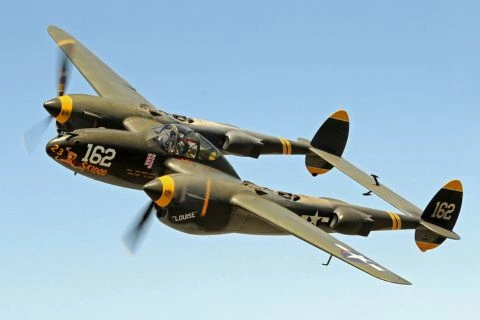 Twin-Engine Fighter
Lockheed Aircraft Corporation
P-38 Lightning
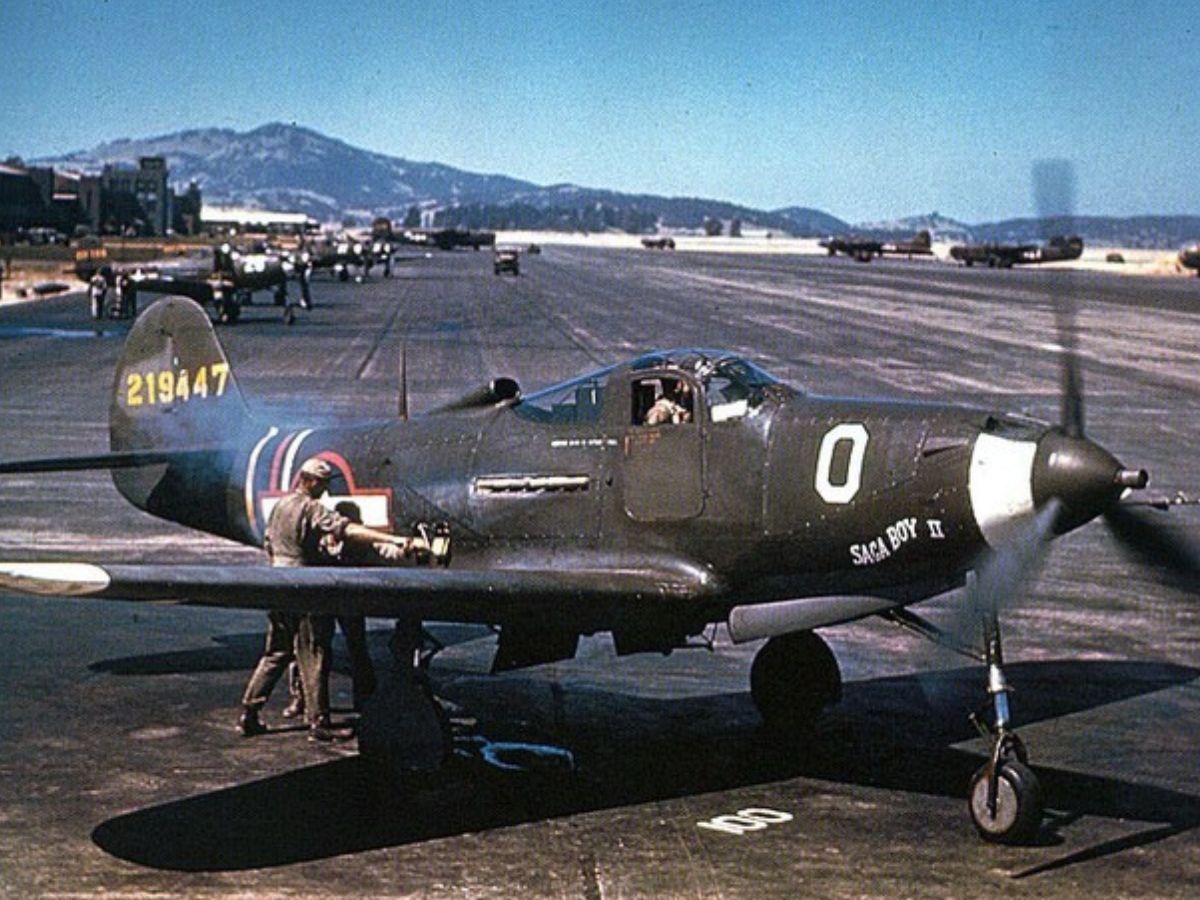 Fighter
Bell Aircraft Corporation
P-39 Airacobra
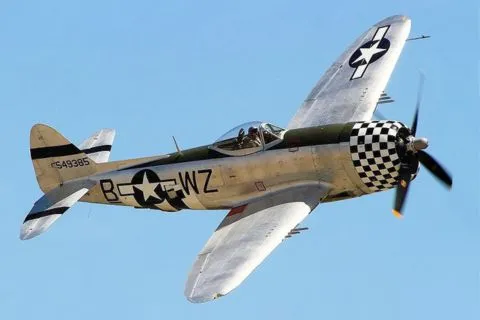 Fighter
Republic Aviation Corporation