Republic Aviation Corporation
P-47 Thunderbolt
 Steve CarmichaelLast updated April 3, 2026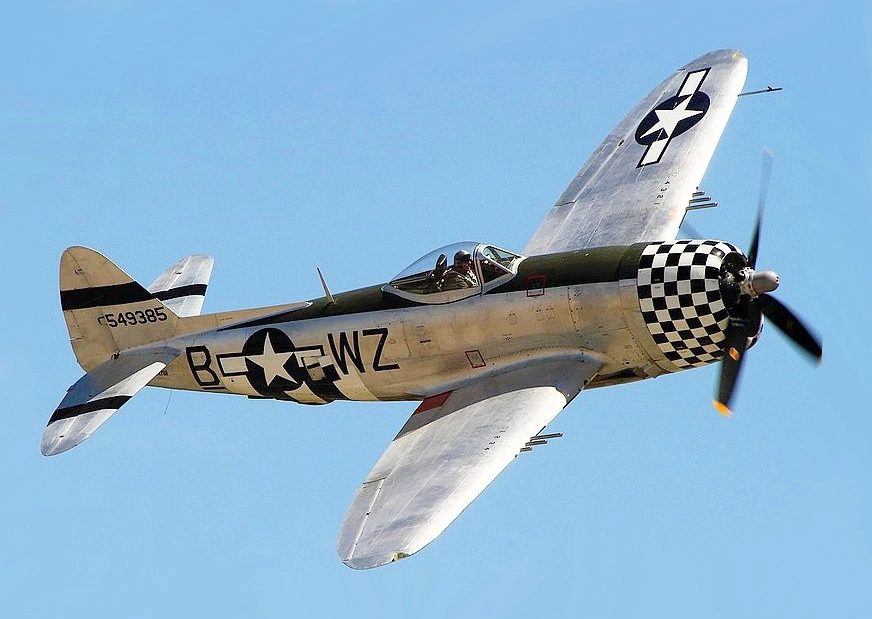
The Republic P-47 Thunderbolt was the largest, heaviest, and most expensive single-engine piston fighter ever built. Powered by the massive Pratt & Whitney R-2800 Double Wasp radial engine with an exhaust-driven turbo-supercharger, the P-47 excelled as both a high-altitude escort fighter and a devastating ground-attack platform. In the European Theater, Thunderbolts flew over 546,000 combat sorties — more than any other American fighter — destroying 3,752 enemy aircraft in aerial combat and delivering over 132,000 tons of bombs. The 56th Fighter Group, the war's top-scoring P-47 unit, was the only 8th Air Force fighter group to fly the Thunderbolt for the entire war, declining the transition to P-51 Mustangs.
P-47 Thunderbolt at a Glance
- Role
- Fighter
- Manufacturer
- Republic Aviation Corporation
- Nation
- United States
- Era
- World War II
By the Numbers
15,686
Built
3,499
Combat Losses
15,686
Built
546,000+
Combat Sorties (ETO)
3,752
Aerial Victories
132,000+ tons
Bombs Dropped (ETO)
4.6:1
Air-to-Air Kill Ratio
1
Crew
Aircraft Description
The Republic P-47 Thunderbolt was the largest, heaviest, and most expensive single-engine piston fighter ever built, and one of the most important American fighters of World War II. Serving as both a high-altitude escort fighter and a devastating low-level fighter-bomber, the P-47 flew more than 546,000 combat sorties in the European Theater alone, destroying 3,752 enemy aircraft in aerial combat while delivering over 132,000 tons of bombs. With 15,686 aircraft built, its rugged radial engine and massive airframe gave it extraordinary survivability that earned it the nickname "The Jug."
P-47 Thunderbolt History
Origins: The Biggest Single-Engine Fighter
The Republic P-47 Thunderbolt was the largest and heaviest single-engine fighter aircraft in history to be powered by a single piston engine. Designed by Alexander Kartveli around the massive Pratt & Whitney R-2800 Double Wasp radial engine and an exhaust-driven turbo-supercharger, the P-47 weighed nearly eight tons fully loaded — more than twice the weight of most contemporary fighters. Its size earned it the nickname "Jug," short for Juggernaut.
From Escort Fighter to Ground Attack Legend
The P-47 entered combat with the 56th Fighter Group in April 1943 over Western Europe, initially flying bomber escort missions from England. While it could not match the Fw 190 or Bf 109 in a turning fight, the Thunderbolt excelled in high-altitude combat and diving attacks, where its massive engine and turbo-supercharger gave it a decisive advantage above 25,000 feet. Pilots quickly learned to fight on their terms — using boom-and-zoom tactics that played to the P-47's strengths in speed, dive performance, and firepower.
As the P-51 Mustang took over the long-range escort role in early 1944, the P-47 found its true calling as a fighter-bomber. Its rugged radial engine could absorb battle damage that would destroy a liquid-cooled engine, and its eight .50-caliber machine guns — the heaviest armament of any single-engine American fighter — could devastate ground targets. With bombs, rockets, and napalm, P-47s became the most feared ground attack aircraft in the European and Mediterranean theaters.
D-Day and the Drive Across France
P-47 groups played a critical role in the Normandy invasion and the subsequent breakout across France. Fighter-bomber Thunderbolts flew constant armed reconnaissance and close air support missions, destroying German armor, vehicles, locomotives, and supply columns. During the Battle of the Falaise Pocket in August 1944, P-47s helped trap and destroy much of the German Seventh Army. The IX Tactical Air Command's Thunderbolts were so effective at interdiction that German troops came to fear the distinctive silhouette of the "Jabos" above all other Allied aircraft.
Pacific and China-Burma-India Theaters
Though less famous in the Pacific, P-47s served extensively with the Fifth Air Force in New Guinea and the Philippines, and with the Tenth and Fourteenth Air Forces in the China-Burma-India theater. In the CBI, P-47Ds operated in brutal heat and humidity, flying ground attack missions over jungle terrain against Japanese positions in Burma. The aircraft's ability to absorb punishment and deliver heavy ordnance made it ideal for the close support role in these demanding conditions.
Production and Legacy
Republic Aviation produced 15,636 Thunderbolts — more than any other American fighter of the war. The P-47 served with 40 percent of all USAAF fighter groups overseas and was credited with destroying 3,752 enemy aircraft in air-to-air combat. But its greatest contribution was in ground attack: P-47s claimed 86,000 railway cars, 9,000 locomotives, 6,000 armored fighting vehicles, and 68,000 trucks destroyed. Hub Zemke, Francis Gabreski, Robert S. Johnson, and Neel Kearby were among the top aces who made their names in the Thunderbolt.
Paint Schemes and Markings
The P-47 Thunderbolt's paint schemes evolved dramatically over the course of the war, reflecting both changing tactical doctrine and improvements in manufacturing. From dark camouflage to gleaming bare metal to invasion stripes, the Thunderbolt wore some of the most distinctive markings of any Allied fighter.
Olive Drab over Neutral Gray (1943–1944)
Early P-47C and P-47D models arrived in the European Theater wearing standard USAAF camouflage of Olive Drab (ANA 613) upper surfaces over Neutral Gray (ANA 603) undersides. National insignia featured the star-and-bar with red outline (pre-June 1943) or blue outline (post-June 1943). Group and squadron identification markings included colored cowling bands, rudder markings, and fuselage code letters. The 56th Fighter Group adopted distinctive white nose markings, while the 78th Fighter Group used black-and-white checkerboard cowlings.
Natural Metal Finish (1944–1945)
Beginning in mid-1944, Republic stopped applying factory camouflage paint, delivering P-47Ds in Natural Metal Finish (NMF). The unpainted aluminum saved approximately 11 pounds of weight and several man-hours per aircraft. Units added colorful nose art, group markings, and squadron colors that made late-war Thunderbolts among the most visually striking fighters of the conflict. The 56th Fighter Group's red-nosed NMF P-47s and the 353rd Fighter Group's yellow-nosed Thunderbolts became iconic images of the air war.
D-Day Invasion Stripes (June–September 1944)
For the Normandy invasion, all Allied tactical aircraft received hastily painted black and white alternating bands around wings and fuselage — five stripes total, each 18 inches wide. Applied the night before D-Day with whatever paint was available (often brushed on by hand), the stripes served as quick visual identification to prevent friendly fire from naval and ground forces. After September 1944, most units removed the upper surface stripes while retaining the lower surface bands for several more months.
Razorback Theater Markings
Early "razorback" P-47Ds in the ETO carried theater identification markings including white bands around the engine cowling and horizontal tail surfaces. The 56th Fighter Group's famous P-47s carried red cowl bands (later white) with individual pilot color markings. In the Mediterranean Theater (MTO), Twelfth Air Force P-47s wore distinctive yellow cowling bands and wingtips on olive drab airframes, helping distinguish them from Luftwaffe aircraft during the Italian campaign.
Pacific and CBI Schemes
P-47Ds in the Pacific Theater typically wore a two-tone scheme of Olive Drab or Dark Green upper surfaces over Neutral Gray or Sky Gray undersides, sometimes with white theater bands on wings and tail. In the CBI, P-47s of the Tenth Air Force carried distinctive shark mouth nose art inspired by the Flying Tigers tradition, painted over either olive drab or natural metal finishes. Fifth Air Force P-47s in New Guinea and the Philippines often featured elaborate nose art and squadron emblems.
Design Features
Key engineering and design choices that defined the P-47 Thunderbolt's capabilities.
Engines & Armament
Powerplant and weapons configuration for the P-47 Thunderbolt's primary production variant.
Powerplant
1x Pratt & Whitney R-2800-59 "Double Wasp" 18-cylinder twin-row radial, 2,000 hp (2,300 hp with water injection)
Armament
8x .50 caliber M2 Browning machine guns; up to 2,500 lbs bombs; 10x 5-inch HVAR rockets
Specifications
Key dimensions and performance figures for the P-47 Thunderbolt's primary production variant.
- Crew
- 1
- Length
- 11.02 m(36.2 ft)
- Wingspan
- 12.42 m(40.7 ft)
- Height
- 4.47 m(14.7 ft)
- Wing Area
- 27.87 m²(300 ft²)
- Max Speed
- 697 km/h(433 mph)
Variants & Models
Each P-47 Thunderbolt variant introduced changes to the airframe, engine, or armament. Visual ID features help modelers and spotters distinguish between versions.
P-47B
171
Built
- Powerplant
- 1x P&W R-2800-21, 2,000 hp
- Max Speed
- 660 km/h(410 mph)
Visual ID
Razorback fuselage with car-door canopy; forward-swept radio mast
Initial production variant. Used primarily for training and working up combat units. Known for tail flutter issues and limited range.
P-47C
602
Built
- Powerplant
- 1x P&W R-2800-21/R-2800-59, 2,000 hp
- Max Speed
- 697 km/h(433 mph)
Visual ID
Razorback fuselage; upright radio mast; belly shackle for drop tank or bomb
Introduced belly shackle for external stores (P-47C-1), improved engine controls (P-47C-2), and 8-inch fuselage extension for better center of gravity (P-47C-5). First variant to enter combat in Europe.
P-47D (Razorback)
- Powerplant
- 1x P&W R-2800-59, 2,000 hp (2,300 hp with water injection)
- Max Speed
- 697 km/h(433 mph)
- Ceiling
- 13,106 m(42,999 ft)
Visual ID
Razorback fuselage with high spine; framed canopy; D-1 through D-23 blocks
Early D-model blocks retained the razorback fuselage. Incremental improvements included water injection (D-10 onward) and paddle-blade propeller (D-22 onward). The most-produced variant overall, with 12,602 total D-models built across all blocks.
P-47D (Bubbletop)
- Powerplant
- 1x P&W R-2800-59, 2,000 hp (2,300 hp with water injection)
- Max Speed
- 697 km/h(433 mph)
- Ceiling
- 13,106 m(42,999 ft)
Visual ID
Cut-down rear fuselage with bubble canopy; dorsal fin added on later blocks; D-25 onward
Starting with D-25-RE (Farmingdale) and D-26-RA (Evansville), production switched to a cut-down rear fuselage with a bubble canopy, dramatically improving rearward visibility. This was the most significant visual and operational change in the Thunderbolt's evolution. Bubbletop aircraft reached combat units from approximately mid-1944.
P-47M
130
Built
- Powerplant
- 1x P&W R-2800-57(C), 2,800 hp with water injection
- Max Speed
- 761 km/h(473 mph)
Visual ID
Bubbletop canopy; based on D-30 airframe; dive brakes
High-speed interceptor variant developed to counter V-1 flying bombs and fast German jets. The fastest production Thunderbolt at 761 km/h (473 mph). Issued exclusively to the 56th Fighter Group at Boxted, England, in early 1945.
P-47N
1,816
Built
- Powerplant
- 1x P&W R-2800-57(C) or R-2800-77, 2,800 hp
- Max Speed
- 752 km/h(467 mph)
- Range
- 3,540 km(2,200 mi)
Visual ID
Longer-span squared-off wingtips; wing integral fuel tanks; zero-length rocket launchers
Long-range Pacific variant with redesigned, longer-span wing (12.98 m vs 12.42 m) containing integral fuel tanks adding 200 US gallons. Purpose-built to escort B-29s on long overwater missions against Japan from bases on Ie Shima and Saipan. Entered combat spring/summer 1945 from Ie Shima and Saipan.
Development & Operational Timeline
Key milestones in the P-47 Thunderbolt's journey from design through operational service.
XP-47B Contract Awarded
The U.S. Army Air Corps awards Republic Aviation a contract for the XP-47B prototype, initiating development of a new heavyweight fighter built around the Pratt & Whitney R-2800 Double Wasp engine and an exhaust-driven turbo-supercharger.
XP-47B Prototype First Flight
The XP-47B prototype makes its maiden flight at Farmingdale, Long Island, piloted by Lowry Brabham. Performance exceeds expectations, validating the turbo-supercharged R-2800 configuration.
56th and 78th Fighter Groups Deploy to England
The 56th Fighter Group and 78th Fighter Group deploy to England with the 8th Air Force, beginning operational work-up of the P-47 in the European Theater of Operations.
First P-47 Combat Mission
The 4th Fighter Group flies the first P-47 combat mission — a fighter sweep over France from RAF Debden, England. The Thunderbolt enters the air war over Europe.
First P-47 Aerial Victory
Major Don Blakeslee of the 4th Fighter Group scores the first aerial victory by a P-47 Thunderbolt during combat over Western Europe, confirming the type's ability to fight the Luftwaffe.
8th Air Force Transitions to P-51; 9th Air Force Expands P-47 Use
As 8th Air Force fighter groups transition to the longer-ranged P-51 Mustang for deep escort missions, the 9th Air Force tactical groups retain and expand their use of the P-47 as a fighter-bomber, defining the Thunderbolt's primary role for the remainder of the war.
D-Day: P-47s Provide Close Air Support over Normandy
P-47 groups of the 9th Air Force provide close air support and fighter cover for the Normandy invasion. Thunderbolts fly thousands of ground-attack sorties on D-Day and in the weeks following, devastating German positions and transportation networks.
Falaise Gap: P-47s Devastate Retreating German Forces
P-47 fighter-bombers devastate retreating German forces at the Falaise Gap in Normandy, destroying hundreds of vehicles and contributing to the destruction of two German armies caught in the pocket.
Battle of the Bulge
P-47s play a critical role in stemming the German advance during the Battle of the Bulge, flying close air support sorties in difficult winter weather once skies cleared, destroying German armor and supply columns.
P-47N Enters Combat in the Pacific
The long-range P-47N enters combat in the Pacific Theater, escorting B-29 Superfortresses on very long-range missions against Japan from bases on Ie Shima and Saipan.
Final P-47 Rolls Off Production Line
The last P-47 — a P-47N — rolls off the Farmingdale production line, ending production of the Thunderbolt after 15,686 aircraft built. An additional 5,934 were cancelled at war's end.
Combat History
Major engagements and missions that defined the P-47 Thunderbolt's combat record.
WWII Overall Statistical Record
1943-1945Across the full span of wartime operations, P-47 Thunderbolts flew over 546,000 combat sorties in the European Theater alone, destroying 3,752 enemy aircraft in aerial combat at a kill-to-loss ratio of 4.6:1. Total P-47 combat losses from all causes numbered 3,499 aircraft. Thunderbolts delivered over 132,000 tons of bombs and destroyed vast quantities of ground targets including 86,000 railway cars, 9,000 locomotives, 6,000 armored fighting vehicles, and 68,000 trucks.
The P-47 flew more combat sorties in the ETO than any other American fighter. Its combined record as both an air superiority fighter and ground-attack platform made it one of the most versatile and effective combat aircraft of World War II.
8th Air Force Fighter Operations (ETO)
1943-1945The P-47 was the initial primary fighter of VIII Fighter Command, entering combat in early 1943. Groups including the 56th, 78th, 353rd, and 356th Fighter Groups flew bomber escort missions deep into occupied Europe. The 56th Fighter Group ("Zemke's Wolfpack"), led by Colonel Hubert Zemke, was the top-scoring P-47 group of the war, credited with 664.5 aerial victories and 311 ground kills. Notable aces included Francis "Gabby" Gabreski (28 victories) and Robert S. Johnson (27 victories).
The 56th Fighter Group demonstrated that the P-47 could compete with the Luftwaffe's best fighters. Zemke pioneered the "Zemke Fan" tactic, allowing fighters to break from close escort and aggressively engage approaching enemy aircraft, influencing American fighter doctrine.
Mediterranean and China-Burma-India Theaters
1943-1945P-47s served with the 12th and 15th Air Forces in the Mediterranean Theater, flying fighter-bomber missions over Italy, southern France, and the Balkans. In the CBI, the P-47 replaced P-40s and P-38s in units including the 80th Fighter Group ("Burma Banshees"), which received P-47Ds in mid-1944 for ground attack in Burma and defense of the "Hump" air supply route to China.
Demonstrated the Thunderbolt's versatility across diverse operational environments, from the mountains of Italy to the jungles of Burma, excelling as a fighter-bomber in every theater where it served.
9th Air Force Tactical Operations (Fighter-Bomber)
1944-1945The 9th Air Force was the tactical air arm supporting ground operations in Western Europe. Its P-47 groups specialized in ground attack, close air support, and armed reconnaissance. From D-Day through VE-Day, 9th Air Force Thunderbolts claimed the destruction of over 86,000 railway cars, 9,000 locomotives, 6,000 armored fighting vehicles, and 68,000 trucks. The P-47's ability to carry 2,500 lbs of bombs plus rockets, combined with its eight .50 caliber machine guns and rugged airframe, made it the most effective tactical fighter-bomber of the war in Europe.
The P-47 defined the fighter-bomber role in the ETO. Its combination of heavy ordnance capacity, devastating firepower, and ability to survive ground fire made it the weapon of choice for tactical air commanders supporting the Allied advance across France and into Germany.
Unit Markings
The P-47 Thunderbolt served with units whose markings are documented in our markings reference guides.
8th Air Force Markings Lookup
Tail symbols, fuselage codes, and division color schemes for every strategic bomber and fighter group based in England.
9th Air Force Markings Lookup
Squadron codes, cowling colors, and tail markings for every tactical fighter and bomber group in the ETO.
12th Air Force Markings Lookup
Tail markings, cowling colors, and squadron identification for every tactical bomber and fighter group in the Mediterranean Theater.
5th Air Force Markings Lookup
Tail numbers, group insignia, and squadron markings for every bomber, attack, and fighter unit in the Southwest Pacific Theater.
Production & Service
From first flight to retirement — the P-47 Thunderbolt's operational lifespan at a glance.
- Number Built
- 15,686
- First Service
- 1942
- Last Built
- 1945
- Retired
- 1955
- Combat Losses
- 3,499
- Status
- Retired
Where to See One
Surviving P-47 Thunderbolt aircraft you can visit today. Airworthy aircraft may appear at air shows.
"Nellie B" (G-THUN)
S/N: 45-49192
Variant: P-47D-40-RA
Fighter Aviation Engineering
Duxford, United Kingdom
Duxford, Cambridgeshire, CB22 4QR
Fighter Aviation Engineering
Visit website →Airworthy P-47D-40-RA based at Duxford, UK. Regular airshow performer on the European circuit.
"Squirt VIII"
S/N: 45-49205
Variant: P-47D-40-RA
Palm Springs Air Museum
Palm Springs, USA
745 N Gene Autry Trail, Palm Springs, CA 92262
Palm Springs Air Museum
Visit website →Airworthy P-47D-40-RA at the Palm Springs Air Museum, California.
"Tallahassee Lassie"
S/N: 45-49406
Variant: P-47D-40-RA
Flying Heritage & Combat Armor Museum
Everett, USA
3407 109th Street SW, Everett, WA 98204
Flying Heritage & Combat Armor Museum
Visit website →Airworthy P-47D-40-RA maintained in flying condition at the Flying Heritage collection in Everett, Washington.
"Fiery Ginger IV"
S/N: 42-23278
Variant: P-47D
National Museum of the United States Air Force
Dayton, USA
1100 Spaatz Street, Wright-Patterson AFB, Dayton, OH 45433
United States Air Force
Visit website →P-47D razorback on static display at Wright-Patterson AFB. One of the earliest surviving D-models.
P-47D-30-RA (NASM)
S/N: 44-32691
Variant: P-47D-30-RA
National Air and Space Museum, Steven F. Udvar-Hazy Center
Chantilly, USA
14390 Air and Space Museum Parkway, Chantilly, VA 20151
Smithsonian Institution
Visit website →P-47D-30-RA bubbletop on static display at the Udvar-Hazy Center
Written by
Steve Carmichael
I am a ww2 model enthusiast getting back into building scaled models after many years away. This site allows me to work on my web development skills while sharing what I am learning.
More Fighter Aircraft
View all → Carrier-Based Fighter
Grumman Aircraft Engineering Corporation
F4F Wildcat
 Fighter
Chance Vought Corporation
F4U Corsair
 Fighter
Grumman Aircraft Engineering Corporation
F6F Hellcat
 Twin-Engine Fighter
Lockheed Aircraft Corporation
P-38 Lightning
 Fighter
Bell Aircraft Corporation
P-39 Airacobra
 Fighter
Curtiss-Wright Corporation