Chance Vought Corporation
F4U Corsair
 Steve CarmichaelLast updated April 3, 2026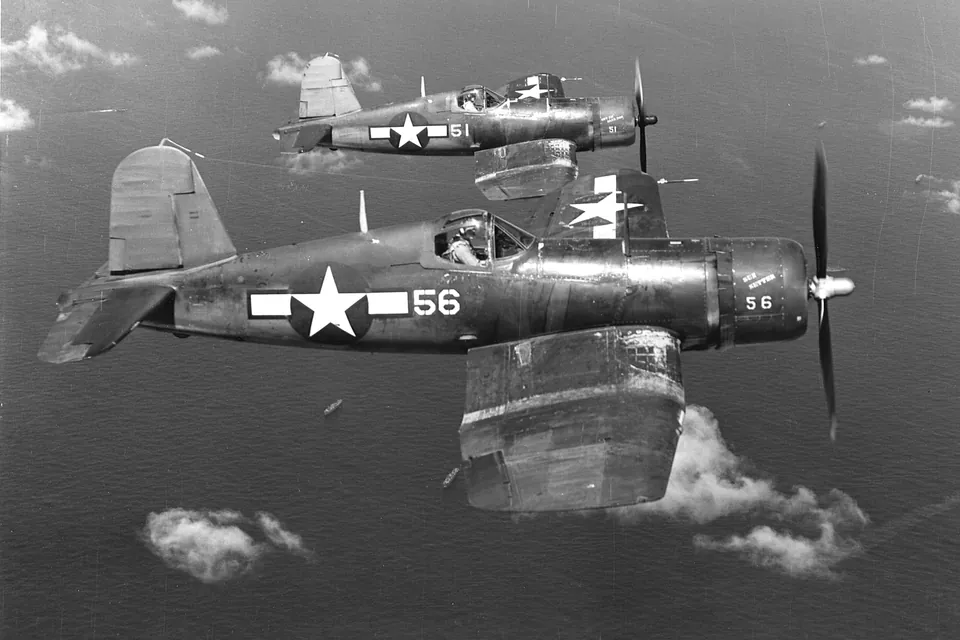
The Chance Vought F4U Corsair was a U.S.-designed, single-seat, carrier-capable fighter that combined the high power of the Pratt & Whitney R-2800 "Double Wasp" engine with a large propeller and an aerodynamically distinctive inverted-gull wing. Total Corsair-family production is most consistently documented as 12,571 aircraft (1942–1953), across Vought plus licensed production by Goodyear (FG series) and Brewster (F3A series). Navy/Marine statistical compilations attribute to Corsairs 64,051 action sorties, 2,140 air-to-air victory claims, and 189 air-combat losses — an approximately 11:1 claim ratio.
F4U Corsair at a Glance
- Role
- Fighter
- Manufacturer
- Chance Vought Corporation
- Nation
- United States
- Era
- World War II
By the Numbers
12,571
Built
189
Combat Losses
12,571
Built
64,051
Action Sorties
2,140
Air Victories
189
Air-Combat Losses
~11:1
Kill Ratio
1
Crew
Aircraft Description
The Vought F4U Corsair was one of the most capable carrier-based fighter-bombers of World War II. Its distinctive inverted gull wing accommodated the largest propeller ever fitted to a fighter and gave it exceptional speed. Initially deemed unsuitable for carrier operations, it became the dominant fighter in the Pacific Theater with the US Marine Corps.
Paint Schemes and Markings
The F4U Corsair transitioned through the standard US Navy color scheme evolution during the war, ending in the iconic overall Glossy Sea Blue that became synonymous with late-war Navy and Marine aviation.
- Blue-Gray over Light Gray (pre-1943): Early F4U-1 "birdcage" Corsairs were delivered in Blue-Gray upper surfaces over Light Gray undersides — the standard Navy two-tone scheme from the pre-war period. VF-17 "Jolly Rogers" still flew this scheme in early 1943.
- Tri-Color Scheme (1943-1944): Non-Specular Sea Blue (ANA 607) upper surfaces, Intermediate Blue (ANA 608) fuselage sides, Insignia White (ANA 601) undersides, with soft-edged demarcation between colors. This scheme appeared at frontline units from summer 1943.
- Overall Glossy Sea Blue (March 1944 onward): Glossy Sea Blue (ANA 623) on all surfaces. Applied to F4U-1D, F4U-4, and subsequent variants. This became the defining Corsair color scheme and the most popular modeling subject.
- Night Fighter Scheme: F4U-2 night fighters received overall Non-Specular Sea Blue (ANA 607) or flat black. Exhaust flame dampeners were fitted, and a radar pod mounted on the starboard wing. VF(N)-75 and VF(N)-101 operated these aircraft.
- Marine Corps Markings: White side numbers on the fuselage — typically the last three digits of the bureau number or tactical numbers. Marine squadrons used letter codes less frequently than Navy squadrons.
Design Features
Key engineering and design choices that defined the F4U Corsair's capabilities.
Inverted Gull Wing
The distinctive cranked wing was not for looks — it solved an engineering problem. The massive 13-foot propeller needed ground clearance, and a conventional straight wing would have required impractically long landing gear. The inverted gull kept the gear short while giving the prop the room it needed.
Largest Fighter Propeller
The 13-foot 4-inch Hamilton Standard propeller was the largest ever fitted to a single-engine fighter, driven by the powerful Pratt & Whitney R-2800 Double Wasp. This combination gave the F4U a top speed exceeding 400 mph — faster than any other US fighter when it first flew in 1940.
Progressive Carrier Improvements
The original F4U-1 was initially rejected for carrier use due to poor cockpit visibility and dangerous landing characteristics. Vought methodically fixed these issues: raising the cockpit, adding a longer tailwheel strut, and installing a stall strip on the right wing. By 1944, the Corsair was fully carrier-qualified.
Multi-Manufacturer Production
To meet wartime demand, the Corsair was built by three companies simultaneously: Vought (F4U designation), Goodyear (FG), and Brewster (F3A). Of the 12,571 total Corsairs, Goodyear alone built over 4,000. For modelers, the manufacturer matters — there were minor differences between variants.
Fighter-Bomber Flexibility
The Corsair evolved from a pure air-superiority fighter into one of the most effective fighter-bombers of the Pacific war. It could carry up to 4,000 lbs of bombs, eight 5-inch rockets, or napalm tanks — devastating against Japanese fortifications, troop concentrations, and shipping.
Engines & Armament
Powerplant and weapons configuration for the F4U Corsair's primary production variant.
Powerplant
1x Pratt & Whitney R-2800 "Double Wasp" 18-cylinder twin-row radial (variant-specific: R-2800-8 early, R-2800-8W/-18W/-32(E) later)
Armament
6x .50 caliber M2 Browning machine guns (standard); F4U-1C: 4x 20 mm cannon; later variants: bombs, rockets, and external stores for fighter-bomber role
Specifications
Key dimensions and performance figures for the F4U Corsair's primary production variant.
- Crew
- 1
- Length
- 10.26 m(33.7 ft)
- Wingspan
- 12.5 m(41.0 ft)
- Height
- 4.5 m(14.8 ft)
- Wing Area
- 29.17 m²(314 ft²)
- Max Speed
- 717 km/h(446 mph)
Variants & Models
Each F4U Corsair variant introduced changes to the airframe, engine, or armament. Visual ID features help modelers and spotters distinguish between versions.
F4U-1
2,814
Built
- Powerplant
- 1x P&W R-2800-8, ~2,000 hp
Visual ID
Early "birdcage" canopy vs later clearer canopy; three-blade propeller era
Aggregated early F4U-1 sub-variants (including -1A improved canopy). Vought-built. Core wartime fighter variant.
FG-1/FG-1D (Goodyear)
4,006
Built
- Powerplant
- 1x P&W R-2800-8W
Visual ID
"FG" is a paperwork designation; airframe broadly equivalent to F4U-1 family
Goodyear-built Corsairs. Largest single production block across all manufacturers.
F3A-1/F3A-1D (Brewster)
735
Built
- Powerplant
- 1x P&W R-2800-8
Visual ID
"F3A" paperwork identifier; airframe comparable to same-era Corsairs; smallest production population
Brewster-built Corsairs. Often treated as 136 + 599 across 1943–44.
F4U-1C
200
Built
- Powerplant
- 1x P&W R-2800-8
Visual ID
Four 20 mm cannon rather than six .50 cal; subtle wing armament differences
Cannon-armed sub-variant; limited production of 200 units.
F4U-1D
1,685
Built
- Powerplant
- 1x P&W R-2800-8W
- Max Speed
- 684 km/h(425 mph)
Visual ID
External stores emphasis: permanent racks/pylons for fighter-bomber configuration; late-war strike profile
Key fighter-bomber variant. Strongly reflected in Navy strike-heavy target categories.
F4U-4
2,045
Built
- Powerplant
- 1x P&W R-2800-18W, ~2,100 hp (with water injection)
- Max Speed
- 721 km/h(448 mph)
Visual ID
Four-blade propeller is the defining quick-ID cue for the -4 generation; late/postwar refinements
Vought-built. Grouped with F4U-4C. Additional sub-types: -4B (297), -4P (9), -4N (1).
F4U-5 series
568
Built
- Powerplant
- 1x P&W R-2800-32(E)
- Max Speed
- 756 km/h(470 mph)
Visual ID
"Postwar look": modernized systems; all-metal wing; four-blade propeller
Includes F4U-5 (223), F4U-5N night fighter (214), F4U-5NL winterized (101), F4U-5P recon (30). Substantial night-fighter subgroup.
AU-1 (F4U-6)
111
Built
- Powerplant
- 1x P&W R-2800 (attack-tuned)
Visual ID
Extra armor and attack-oriented fit; optimized for low-altitude strike profiles
Armored close-air-support "mudfighter" concept. Speed sacrificed for survivability and load capacity.
F4U-7
94
Built
- Powerplant
- 1x P&W R-2800
Visual ID
Final production Corsair; broadly AU-1-derived; French service markings are common identifiers
Built exclusively for French naval aviation. The last Corsair ever produced. Served in Indochina, Suez, and Algeria.
Development & Operational Timeline
Key milestones in the F4U Corsair's journey from design through operational service.
U.S. Navy Carrier-Fighter Requirement
The U.S. Navy issues a high-performance carrier-fighter requirement that drives the Corsair program—fit very high engine power and a large-diameter propeller into a carrier fighter without unacceptable penalties.
XF4U-1 Prototype First Flight
The XF4U-1 prototype makes its maiden flight, demonstrating the viability of the inverted-gull wing design paired with the powerful Pratt & Whitney R-2800 engine.
Production Deliveries Begin
Corsair production deliveries and early service acceptance commence. The aircraft enters Navy inventory.
First USMC Combat in Solomon Islands
United States Marine Corps squadrons introduce the Corsair to sustained combat in the Solomon Islands, operating from land bases rather than carrier decks—the beginning of the Corsair's distinctive land-based fighting emphasis.
Fleet Air Arm Carrier Operations Expand
The Royal Navy's Fleet Air Arm works through deck-handling challenges and expands Corsair carrier operations from British carriers, including HMS Illustrious in Indian Ocean and Pacific operations.
U.S. Carrier Re-Adoption Grows
U.S. Navy carrier-based Corsair operations grow as procedures and modifications mature, overcoming the early deck-handling and visibility issues that had initially restricted the type to land-based use.
Late-War Peak and F4U-4 Fleet Presence
Corsair operations reach late-war peak across the Pacific. The F4U-4 family, with its four-blade propeller and improved R-2800-18W engine, begins fleet presence.
Korean War: Hudner Medal of Honor Action
Lt. Thomas Hudner crash-lands his F4U-4 Corsair in a deliberate wheels-up landing near the Chosin Reservoir to attempt the rescue of Ensign Jesse L. Brown. Hudner received the Medal of Honor for this action.
Final Corsair Production: AU-1 and F4U-7
AU-1 armored attack variant and F4U-7 (built for France) production concludes. The F4U-7 is the final production Corsair, ending a production run spanning 1942–1953.
French Naval Corsair Combat Employment
French naval aviation employs AU-1 and F4U-7 Corsairs in Indochina, the Suez Crisis (Operation Musketeer), and Algeria. French Corsair service ends in September 1964.
Football War: Last Piston-Fighter Shootdowns
During the Honduras–El Salvador conflict ("Football War"), a Honduran F4U Corsair (FAH-609) scores air-to-air victories widely described as the last confirmed shootdowns by piston-engined fighters.
Combat History
Major engagements and missions that defined the F4U Corsair's combat record.
WWII Overall Statistical Record
1942-1945Navy/Marine statistical compilations attribute to Corsairs (F4U/FG) a wartime record spanning the full spectrum of naval air missions: fleet defense, fighter sweeps, strike escort, close air support, shipping attack, and night combat.
The highest claim ratio of any major U.S. Navy/Marine fighter type. Target categories were dominated by military targets, enemy airfields, and shipping/transportation, reflecting the Corsair's transformation into a leading fighter-bomber.
Solomon Islands Campaign (USMC Land-Based)
1943USMC squadrons introduced the Corsair to sustained combat in the Solomon Islands, operating from land bases. This was the beginning of the Corsair's distinctive combat story—emphasizing land-based fighting while carrier suitability matured through engineering changes and procedures.
Defined the Corsair's early operational identity: a carrier-designed fighter that initially proved itself from land strips, building the combat reputation that would carry through the war.
Korean War Close Air Support
1950-1953Corsairs served extensively in Korea for close-air-support and interdiction. Lt. Thomas Hudner's Medal of Honor action—crash-landing his F4U-4 to attempt rescue of Ensign Jesse L. Brown near the Chosin Reservoir—encapsulates the type's reputation for ruggedness and the human stakes of low-altitude combat support.
Proved the Corsair's continued relevance in the jet age for ground-attack roles. The Hudner-Brown episode became one of the most documented acts of valor associated with the type.
Honduras–El Salvador "Football War"
July 1969During the brief Honduras–El Salvador conflict, Honduran Air Force F4U Corsairs (notably FAH-609) engaged in air-to-air combat against Salvadoran aircraft, scoring victories widely described as the last confirmed piston-engined fighter-vs-fighter shootdowns in history.
A remarkable late chapter in Corsair history—the type remained militarily active into the late 1970s in Central America, decades after its WWII origins.
Production & Service
From first flight to retirement — the F4U Corsair's operational lifespan at a glance.
- Number Built
- 12,571
- First Service
- 1942
- Last Built
- 1953
- Retired
- 1979
- Combat Losses
- 189
- Status
- Retired
Where to See One
Surviving F4U Corsair aircraft you can visit today. Airworthy aircraft may appear at air shows.
F-AZVJ
S/N: 97264
Variant: F4U-4
France
France-based airworthy Corsair; earlier registration N5218V
G-FGID (The Fighter Collection)
S/N: 88297
Variant: FG-1D
Imperial War Museum Duxford
Duxford, United Kingdom
Duxford, Cambridgeshire, CB22 4QR
The Fighter Collection
Visit website →Based with The Fighter Collection; documented history chain
N240CA
S/N: 97359
Variant: F4U-4B
USA
Notable for film/warbird history and long restoration chain
N62290 (Ex-El Salvador)
S/N: 92629
Variant: FG-1D
USA
Ex-El Salvador chain-of-custody; warbird circuit history
Sky Boss (N83JC)
S/N: 67089
Variant: FG-1D
USA
Long U.S. civil registration history; warbird name "Sky Boss"
ZK-COR (RNZAF Heritage)
S/N: 88391
Variant: FG-1D
New Zealand
Documented RNZAF service identity; earlier registrations include N55JP and G-BXUL
BuNo 92050 (Warbird Heritage)
S/N: 92050
Variant: FG-1D
USA
Warbird Heritage Foundation
Restoration to airworthy noted in registry
BuNo 97382
S/N: 97382
Variant: F4U-4
USA
Long-running airworthy restoration efforts after Central American service
FAH-609
S/N: 124715
Variant: F4U-5N
Central artifact of the 1969 "Football War" piston-fighter combat narrative; the aircraft credited with the last piston-fighter air-to-air victories
KD431 (Fleet Air Arm Corsair)
S/N: 14862
Variant: Corsair Mk IV (FG-1D)
Fleet Air Arm Museum
Yeovilton, United Kingdom
RNAS Yeovilton, Ilchester, Somerset, BA22 8HT
Fleet Air Arm Museum
Visit website →One of the best-documented Fleet Air Arm Corsairs; long chain-of-custody documentation
Model Kits Available
Scale model kits of the F4U Corsair from leading manufacturers.
Tamiya 1/48 F4U-1D Corsair
Tamiya · 1/48
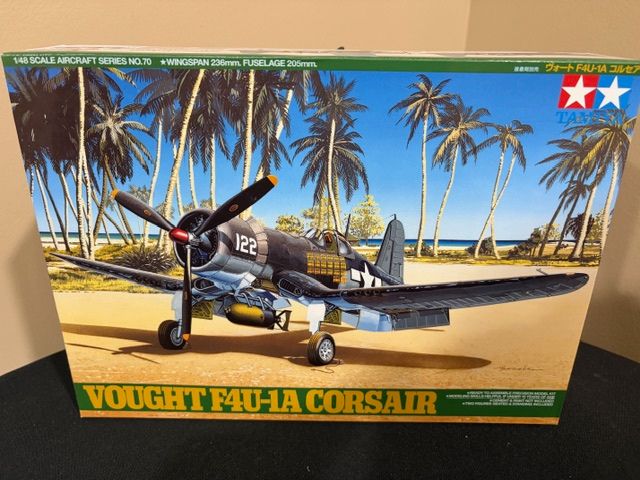
Tamiya 1/48 F4U-1A Corsair
Tamiya · 1/48
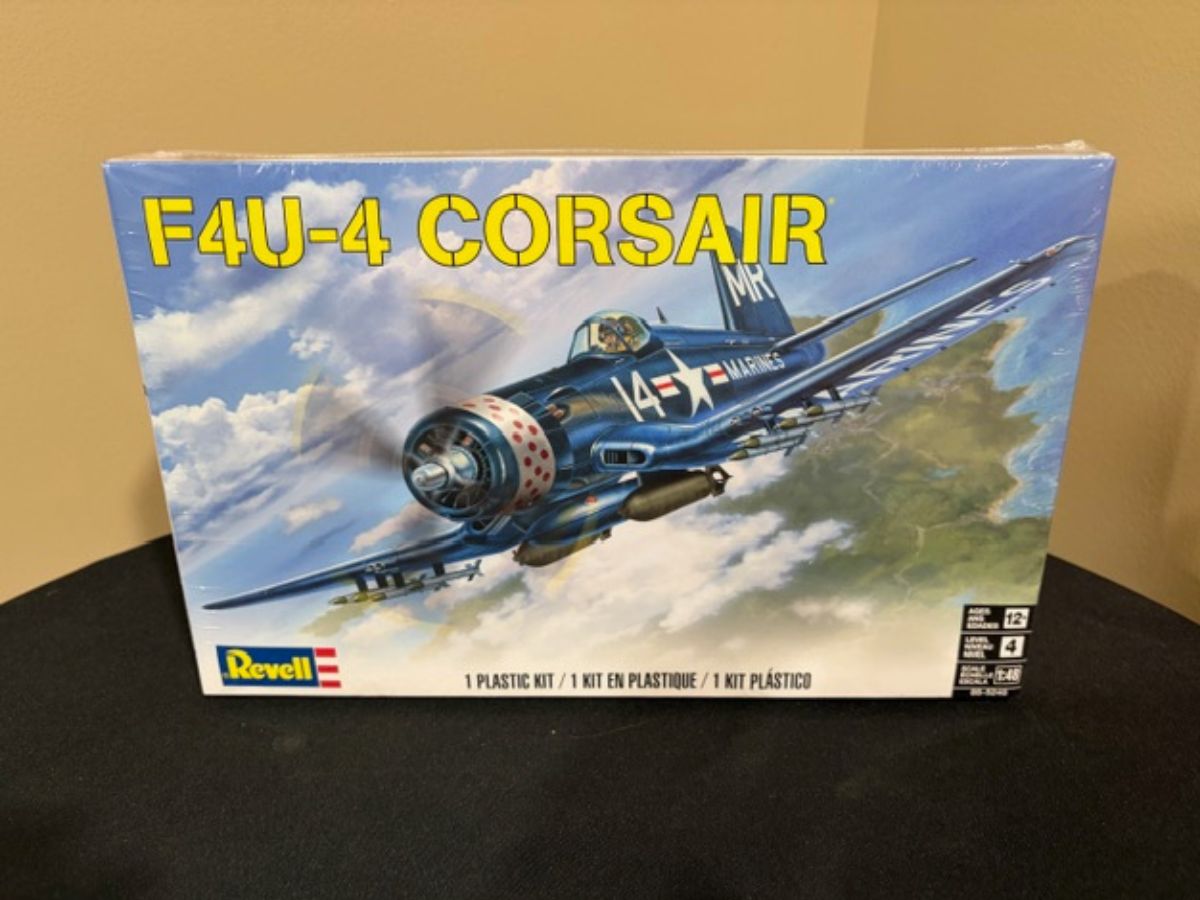
Revell 1/48 F4U-4 Corsair
Revell · 1/48
Tamiya 1/72 F4U-1D Corsair
Tamiya · 1/72
Additional Information
No additional information is found
Written by
Steve Carmichael
I am a ww2 model enthusiast getting back into building scaled models after many years away. This site allows me to work on my web development skills while sharing what I am learning.
More Fighter Aircraft
View all →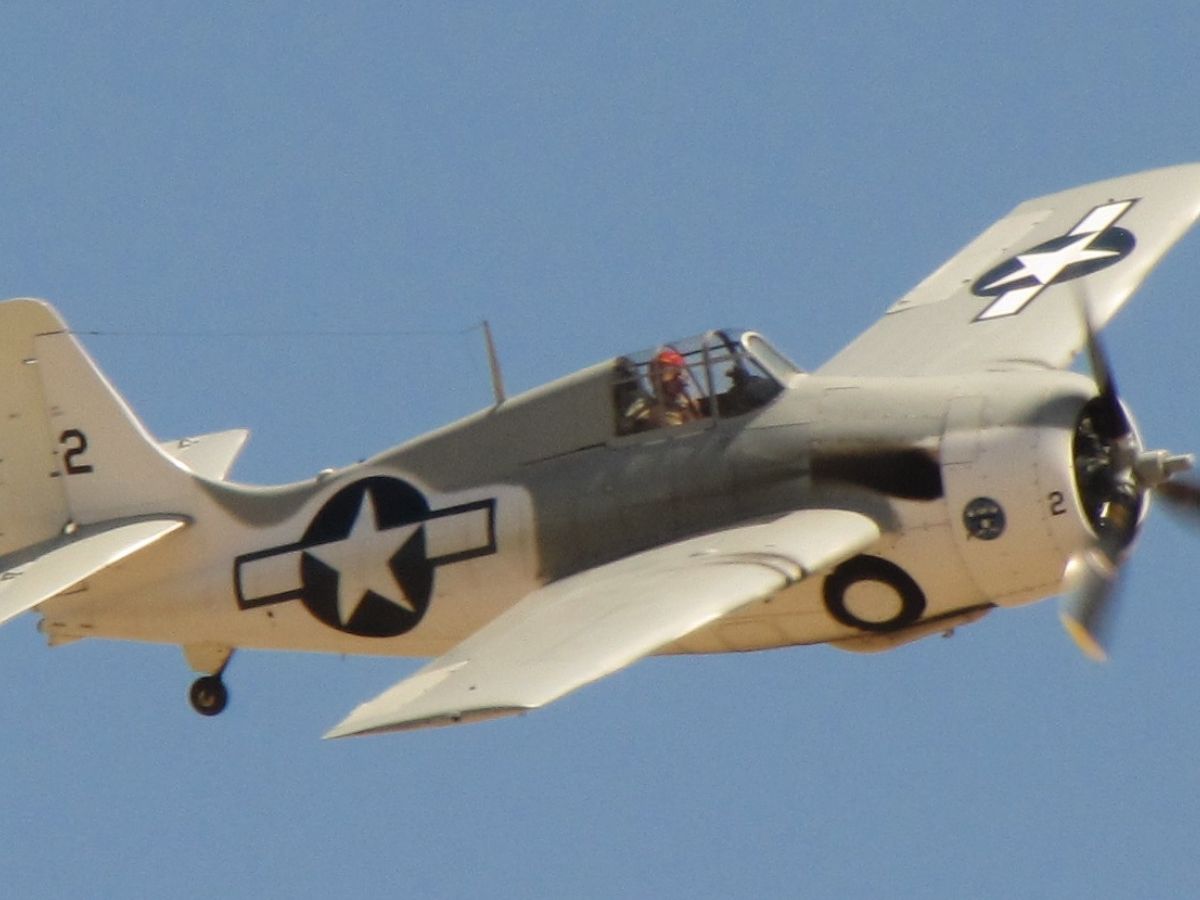 Carrier-Based Fighter
Grumman Aircraft Engineering Corporation
F4F Wildcat
 Fighter
Grumman Aircraft Engineering Corporation
F6F Hellcat
 Twin-Engine Fighter
Lockheed Aircraft Corporation
P-38 Lightning
 Fighter
Bell Aircraft Corporation
P-39 Airacobra
 Fighter
Curtiss-Wright Corporation
P-40 Warhawk
 Fighter
Republic Aviation Corporation