Lockheed Aircraft Corporation
P-38 Lightning
 Steve CarmichaelLast updated April 3, 2026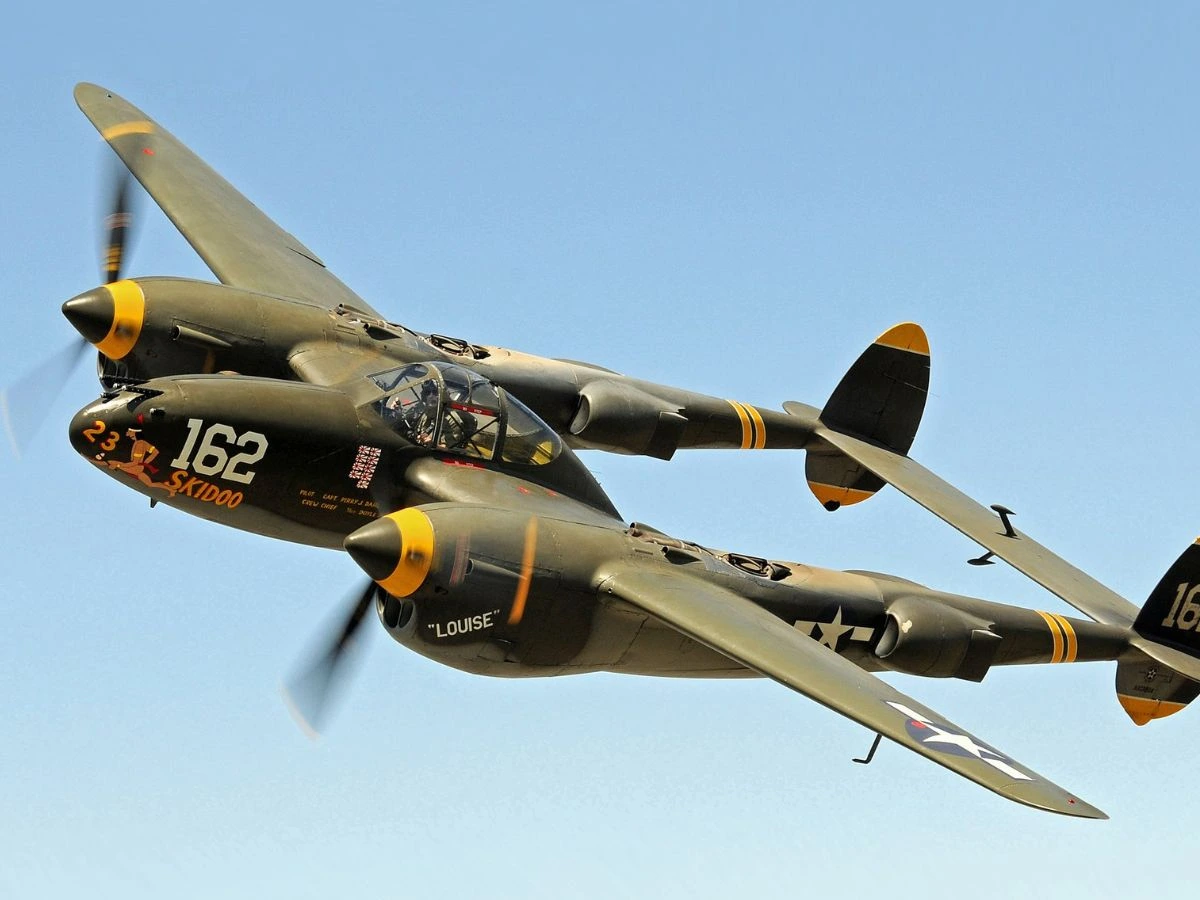
The P-38 Lightning was Lockheed's twin-engine, twin-boom fighter that served in every theater of World War II. It was the mount of America's two highest-scoring aces — Richard Bong (40 victories) and Thomas McGuire (38 victories) — and the aircraft that flew the longest-range fighter interception of the war: the mission that killed Admiral Isoroku Yamamoto. With nose-mounted armament that eliminated convergence problems, turbo-supercharged engines for high-altitude performance, and range that no single-engine fighter could match, the P-38 was the defining American fighter of the Pacific air war.
P-38 Lightning at a Glance
- Role
- Twin-Engine Fighter
- Manufacturer
- Lockheed Aircraft Corporation
- Nation
- United States
- Era
- World War II
By the Numbers
10,037
Built
10,037
Built
Bong (40) & McGuire (38)
Top Aces
1
Crew
414 mph / 667 km/h
Max Speed (P-38L)
2
Engines
All (ETO, MTO, PTO, CBI)
Theaters Served
Aircraft Description
The Lockheed P-38 Lightning was the only American fighter aircraft in production throughout the entire United States involvement in World War II — from Pearl Harbor to V-J Day. Its radical twin-boom, twin-engine design gave it distinctive performance: concentrated nose-mounted firepower, exceptional range, and high speed at altitude. The P-38 was the primary long-range fighter in the Pacific Theater and served in every major combat zone of the war, from the Aleutians to North Africa to the skies over Germany.
Paint Schemes and Markings
The P-38 Lightning's distinctive twin-boom silhouette made it one of the most recognizable aircraft of the war. Its paint schemes evolved from standard camouflage to gleaming natural metal as production increased and Allied air superiority was established.
- Olive Drab over Neutral Gray (1941-1944): Standard USAAF scheme — Dark Olive Drab (ANA 613) upper surfaces over Neutral Gray (ANA 603) undersides. Applied to P-38E through P-38H models. Some aircraft in the Pacific received field-applied Medium Green blotching.
- Photo-Reconnaissance "Haze Paint" (1942): F-4 and F-5 photo-recon variants received a distinctive scheme: black base coat with a synthetic blue-gray "Haze Paint" sprayed over upper surfaces, graduating from light blue to near-white on undersurfaces. Approximately 130 aircraft received this unusual finish.
- Mediterranean Theater Schemes: Operation Torch aircraft (November 1942) carried yellow recognition rings around fuselage stars. Some North African P-38s received Sand (ANA 615) and Medium Green (ANA 612) upper surfaces over Azure Blue (ANA 609) undersides for desert operations.
- Natural Metal Finish (1944 onward): P-38J and P-38L models delivered unpainted from mid-1944. NMF aircraft were common in both the ETO and Pacific by late 1944.
- D-Day Invasion Stripes (June 1944): Standard black and white invasion stripes applied to wings and both twin booms. The P-38 was the only twin-engine U.S. fighter in the European theater, making the stripes particularly important for friendly-fire prevention.
- Pacific Markings: 5th and 13th Air Force P-38s commonly carried white identification markings on spinners and tail tips. Unit-specific markings varied by fighter group.
Design Features
Key engineering and design choices that defined the P-38 Lightning's capabilities.
Twin-Boom Configuration
The P-38's most distinctive feature: twin fuselage booms extending aft from the engine nacelles, each carrying a turbo-supercharger, radiator, and tail surface. The pilot sat in a central nacelle between the booms. This layout provided structural rigidity, excellent engine cooling, and a compact, aerodynamically clean arrangement that no single-engine design could replicate.
Concentrated Nose Armament
Unlike wing-mounted guns on conventional fighters, the P-38's four .50 caliber machine guns and one 20mm cannon were clustered in the nose pod. This eliminated the convergence problem — the guns fired parallel, delivering a dense, devastating cone of fire at any range without needing to set convergence distance. Pilots reported being able to saw wings off enemy aircraft.
Counter-Rotating Propellers
The P-38's engines turned in opposite directions (the left engine clockwise, the right counterclockwise viewed from the rear), canceling out propeller torque. This gave the Lightning perfectly symmetrical handling — critical for single-engine emergencies and for precision gunnery. No other mass-produced WWII fighter had this feature.
Turbo-Supercharged Engines
Each Allison V-1710 was paired with a General Electric turbo-supercharger mounted in the tail boom, giving the P-38 exceptional high-altitude performance. While naturally-aspirated Allisons lost power above 15,000 feet, the turbocharged P-38 maintained full power to 25,000+ feet — essential for bomber escort and high-altitude interception.
Fowler Flaps
The P-38 was among the first fighters to use large-area Fowler flaps that extended rearward and downward from the wing trailing edge. These dramatically increased wing area and lift at low speeds, giving the heavy twin-engine fighter surprisingly good low-speed handling and short-field performance for its size and weight.
Engines & Armament
Powerplant and weapons configuration for the P-38 Lightning's primary production variant.
Powerplant
2x Allison V-1710 series liquid-cooled V-12 engines with General Electric turbo-superchargers; counter-rotating propellers eliminated torque effects. Early models: V-1710-27/29 (1,150 hp); late P-38L: V-1710-111/113 (1,475 hp with War Emergency Power)
Armament
1x Hispano AN/M2(C) 20mm cannon with 150 rounds + 4x Browning AN/M2 .50 caliber machine guns with 500 rpg, all nose-mounted in the central nacelle. External: up to 4,000 lbs of bombs (2x 2,000 lb) or 10x 5-inch HVAR rockets on underwing pylons
Specifications
Key dimensions and performance figures for the P-38 Lightning's primary production variant.
- Crew
- 1
- Length
- 11.53 m(37.8 ft)
- Wingspan
- 15.85 m(52.0 ft)
- Height
- 3 m(9.8 ft)
- Wing Area
- 30.43 m²(328 ft²)
- Max Speed
- 667 km/h(414 mph)
Variants & Models
Each P-38 Lightning variant introduced changes to the airframe, engine, or armament. Visual ID features help modelers and spotters distinguish between versions.
XP-38
1
Built
- Powerplant
- 2x Allison V-1710-11/15, 1,150 hp
- Max Speed
- 628 km/h(390 mph)
Visual ID
Flush-riveted skin; early canopy design; no armament fitted
First flight January 27, 1939 at March Field, CA. Set a transcontinental speed record during delivery flight to Mitchell Field but crashed on landing due to carburetor icing. The airframe was destroyed but the design was validated.
P-38D
36
Built
- Powerplant
- 2x Allison V-1710-27/29, 1,150 hp
- Max Speed
- 628 km/h(390 mph)
- Range
- 1,287 km(800 mi)
- Ceiling
- 11,887 m(38,999 ft)
Visual ID
First variant with self-sealing fuel tanks and armor plate; low-set tailplane
First combat-capable variant. Redesignated from P-38 (original 30 airframes) after adding self-sealing tanks and armor. Served in the Aleutians.
P-38E
210
Built
- Powerplant
- 2x Allison V-1710-27/29, 1,150 hp
- Max Speed
- 628 km/h(390 mph)
- Range
- 1,287 km(800 mi)
- Ceiling
- 11,887 m(38,999 ft)
Visual ID
Revised instrument panel; SCR-274 radio
First variant with the definitive 20mm cannon replacing the 37mm. The 20mm had a much higher rate of fire and more ammunition capacity. Some converted to F-4 photo-reconnaissance configuration.
P-38F
527
Built
- Powerplant
- 2x Allison V-1710-49/53, 1,325 hp (WEP)
- Max Speed
- 626 km/h(389 mph)
- Range
- 1,287 km(800 mi)
- Ceiling
- 11,887 m(38,999 ft)
Visual ID
Underwing hardpoints for bombs or tanks; combat flap system
First variant with underwing pylons for bombs or drop tanks, dramatically increasing versatility. Saw first major combat in North Africa (Operation Torch, November 1942). Introduced combat maneuvering flaps.
P-38G
1,082
Built
- Powerplant
- 2x Allison V-1710-51/55, 1,325 hp (WEP)
- Max Speed
- 640 km/h(398 mph)
- Range
- 1,287 km(800 mi)
- Ceiling
- 11,887 m(38,999 ft)
Visual ID
Improved radio equipment; otherwise externally similar to F
Widely used in the Mediterranean and Pacific from mid-1943. Some converted to F-5A photo-reconnaissance variants.
P-38H
601
Built
- Powerplant
- 2x Allison V-1710-89/91, 1,425 hp (WEP)
- Max Speed
- 646 km/h(401 mph)
- Range
- 1,287 km(800 mi)
- Ceiling
- 12,200 m(40,026 ft)
Visual ID
Slightly revised cowlings for new engine variant
Incremental engine improvement; saw extensive service in the Mediterranean and Southwest Pacific. Higher power output improved climb rate and high-altitude performance.
P-38J
2,970
Built
- Powerplant
- 2x Allison V-1710-89/91, 1,425 hp (WEP)
- Max Speed
- 666 km/h(414 mph)
- Range
- 3,637 km(2,260 mi)
- Ceiling
- 13,400 m(43,963 ft)
Visual ID
Chin-mounted intercoolers (relocated from wing leading edges); flat windscreen; boom-mounted fuel tanks increased internal capacity
The most significant upgrade in the Lightning lineage. Moving the intercoolers from the wing leading edges to chin scoops under the engines freed up wing space for 55-gallon fuel tanks in each leading edge, increasing range by nearly 40%. The P-38J-25 block introduced hydraulically boosted ailerons and electrically actuated dive flaps to address compressibility issues in high-speed dives.
P-38L
3,923
Built
- Powerplant
- 2x Allison V-1710-111/113, 1,475 hp (WEP)
- Max Speed
- 667 km/h(414 mph)
- Range
- 3,637 km(2,260 mi)
- Ceiling
- 13,400 m(43,963 ft)
Visual ID
Rocket pylons under outer wing panels (late blocks); otherwise similar to late-J
The definitive and most-produced Lightning variant. Higher-output engines, rocket capability, and all late-J improvements as standard. Served extensively in the Pacific through V-J Day. The P-38L was the mount of both Bong and McGuire during their highest-scoring periods.
F-4 / F-5 (Photo Recon)
1,400
Built
- Powerplant
- 2x Allison V-1710 (various)
Visual ID
Camera ports in nose replacing gun muzzles; often unpainted (natural metal) for speed
Photo-reconnaissance conversions across multiple P-38 variants. The F-4 was based on the P-38E/F; the F-5 on the G/H/J/L. Antoine de Saint-Exupery, author of The Little Prince, disappeared flying an F-5B on a reconnaissance mission over southern France on July 31, 1944.
P-38M Night Lightning
75
Built
- Powerplant
- 2x Allison V-1710-111/113, 1,475 hp (WEP)
- Max Speed
- 657 km/h(408 mph)
Visual ID
Radar pod under nose; raised rear cockpit with separate canopy for radar operator
Two-seat night fighter conversion of the P-38L. A radar operator sat in a raised position behind the pilot under a separate canopy. Arrived in the Pacific in the final months of the war; saw limited combat but proved the concept of a twin-engine night interceptor.
Development & Operational Timeline
Key milestones in the P-38 Lightning's journey from design through operational service.
Lockheed Wins Design Competition
Lockheed submits its Model 22 proposal to the U.S. Army Air Corps Circular Proposal X-608, beating competing designs from Curtiss, Vultee, and other manufacturers. The twin-engine, twin-boom concept is radical but promises the range and firepower the Army requires.
XP-38 Prototype First Flight
The XP-38 makes its maiden flight from March Field, California, piloted by Lt. Benjamin Kelsey. The aircraft demonstrates exceptional performance, later setting an unofficial transcontinental speed record during its delivery flight — though the prototype is destroyed in a landing accident at Mitchell Field, New York.
First P-38s Enter Service
The first production P-38s are delivered to the USAAF. Initially used for training and coastal defense patrols along the American West Coast following Pearl Harbor.
First Aerial Victory
Lt. Elza Shahan of the 27th Fighter Squadron and 2nd Lt. Joseph Shaffer of the 33rd Fighter Squadron, flying P-38Fs on an Iceland-based patrol, shoot down a Focke-Wulf Fw 200 Condor over the Atlantic — the first Luftwaffe aircraft destroyed by the USAAF.
Operation Torch — Combat Debut in Force
P-38F and P-38G Lightnings deploy to North Africa as part of Operation Torch, the Allied invasion of French North Africa. The Lightning quickly establishes air superiority and proves itself against Luftwaffe Bf 109s and Fw 190s in the Mediterranean Theater.
Operation Vengeance — Yamamoto Interception
Sixteen P-38G Lightnings of the 339th Fighter Squadron fly a 1,000-mile round-trip mission over open ocean to intercept and shoot down the transport aircraft carrying Japanese Admiral Isoroku Yamamoto over Bougainville. It remains the longest-range fighter interception in aviation history.
Southwest Pacific Dominance
Under General George Kenney's 5th Air Force, P-38s become the dominant American fighter in the Southwest Pacific. The Lightning's twin-engine reliability over vast ocean distances and concentrated firepower make it the preferred mount of top aces including Richard Bong and Thomas McGuire.
P-38J Enters Service
The P-38J variant introduces relocated intercoolers and leading-edge fuel tanks, dramatically increasing range. Combined with dive flaps and boosted ailerons on later blocks, the J-model addresses earlier high-altitude maneuverability concerns.
P-38s Over Normandy
P-38 groups of the 8th and 9th Air Forces provide fighter cover, ground attack, and tactical reconnaissance during the D-Day invasion and subsequent Normandy campaign. The Lightning's distinctive twin-boom silhouette makes it the easiest Allied fighter for ground troops to identify, reducing friendly-fire incidents.
Major Richard Bong — 40 Victories
Major Richard Bong scores his 40th and final aerial victory flying a P-38L in the Pacific, making him the highest-scoring American ace of all time. He is recalled from combat and awarded the Medal of Honor.
V-J Day — End of Production
P-38 production ends with the conclusion of hostilities. The Lightning is the only American fighter that was in production from before Pearl Harbor through V-J Day. Remaining contracts for over 1,900 additional P-38Ls are canceled.
Final USAF Retirement
The last P-38s and F-5 photo-reconnaissance variants are retired from active USAF service. Some continue flying with foreign air forces and civilian operators for several more years.
Combat History
Major engagements and missions that defined the P-38 Lightning's combat record.
North Africa & Mediterranean Air Campaign
1942-1943P-38 groups deployed to North Africa beginning with Operation Torch and fought through Tunisia, Sicily, and Italy. In the Mediterranean, Lightnings provided bomber escort, conducted ground attack missions, and engaged in air superiority sweeps against Luftwaffe and Regia Aeronautica fighters.
The North Africa campaign was the P-38's first large-scale combat test. The aircraft proved its worth against experienced Luftwaffe opposition, though early models revealed shortcomings — notably compressibility problems in high-speed dives — that would be addressed in the J and L variants.
Southwest Pacific Fighter Operations
1942-1945P-38s became the primary long-range fighter of the 5th Air Force under General George Kenney, conducting escort, air superiority, and ground attack missions across New Guinea, the Philippines, and the Dutch East Indies. The Lightning's twin-engine reliability was critical over the vast oceanic distances of the Pacific Theater, where a single-engine failure in a conventional fighter meant ditching in the ocean.
The P-38 was responsible for more Japanese aircraft destroyed than any other USAAF fighter in the Pacific. America's top two aces — Richard Bong (40 kills) and Thomas McGuire (38 kills) — both flew P-38s exclusively. The aircraft's range advantage over the P-47 and P-51 made it indispensable in the Pacific until the final months of the war.
Operation Vengeance
April 18, 1943Sixteen P-38G Lightnings launched from Guadalcanal on a precisely timed 1,000-mile round-trip interception over the Solomon Sea. The flight navigated at wave-top level on a circuitous route to avoid detection, arriving within one minute of the predicted intercept time. The cover flight engaged escorting Zeros while the killer flight attacked the two Betty bombers carrying Admiral Yamamoto and his staff.
16
Dispatched
1
Aircraft Lost
1
Personnel Lost
The longest-range fighter interception mission of World War II. The death of Japan's most capable naval strategist was a profound blow to Japanese morale and strategic leadership. The mission demonstrated the P-38's unmatched combination of range, speed, and firepower.
European Theater Operations (8th & 9th Air Forces)
1943-1945P-38 groups served with both the 8th Air Force (strategic bomber escort) and 9th Air Force (tactical operations) in the European Theater. Lightnings provided bomber escort before sufficient P-51 Mustangs arrived, and later transitioned to ground attack and tactical reconnaissance roles. The 9th Air Force's P-38 groups provided close air support during the Normandy invasion and subsequent breakout.
The P-38's European record was mixed: excellent at ground attack and low-level work, but its high-altitude performance over Europe was hampered by extreme cold at 25,000+ feet affecting the Allison engines and turbocharger intercoolers — a problem less severe in the warmer Pacific. The distinctive twin-boom silhouette proved a significant advantage during D-Day, as ground troops could instantly identify the P-38 as friendly, reducing fratricide incidents.
Unit Markings
The P-38 Lightning served with units whose markings are documented in our markings reference guides.
8th Air Force Markings Lookup
Tail symbols, fuselage codes, and division color schemes for every strategic bomber and fighter group based in England.
9th Air Force Markings Lookup
Squadron codes, cowling colors, and tail markings for every tactical fighter and bomber group in the ETO.
15th Air Force Markings Lookup
Wing symbols, tail color schemes, and squadron markings for every strategic bomber and fighter group based in Italy.
5th Air Force Markings Lookup
Tail numbers, group insignia, and squadron markings for every bomber, attack, and fighter unit in the Southwest Pacific Theater.
Production & Service
From first flight to retirement — the P-38 Lightning's operational lifespan at a glance.
- Number Built
- 10,037
- First Service
- 1941
- Last Built
- 1945
- Retired
- 1949
- Status
- Retired
Where to See One
Surviving P-38 Lightning aircraft you can visit today. Airworthy aircraft may appear at air shows.
23 Skidoo
S/N: 42-67762
Variant: P-38J-10-LO
Flying Heritage & Combat Armor Museum
Everett, Washington
3407 109th Street SW, Everett, WA 98204
Strato-Art Inc.
Visit website →Restored to flying condition. One of the few airworthy P-38J models in existence.
Glacier Girl
S/N: 41-7630
Variant: P-38F-1-LO
Recovered in 1992 from beneath 268 feet of ice on the Greenland ice cap, where it had made an emergency landing in 1942. One of the most remarkable aircraft recoveries in history. Restored to flying condition and completed its first post-recovery flight in 2002.
Thoughts of Midnite
S/N: 44-53095
Variant: P-38L-5-LO
Planes of Fame Air Museum
Chino, California
7000 Merrill Avenue, Chino, CA 91710
Planes of Fame
Visit website →One of the few flyable P-38Ls. Regular airshow performer.
Joltin' Josie
S/N: 44-53097
Variant: P-38L-5-LO
March Field Air Museum
Riverside, California
22550 Van Buren Boulevard, March ARB, Riverside, CA 92518
March Field Air Museum
Visit website →Static display at the museum located on the former March Army Air Field — the same base where the original XP-38 made its first flight in 1939.
Marge
S/N: 44-53236
Variant: P-38L-5-LO
National Air and Space Museum (Udvar-Hazy Center)
Chantilly, Virginia
14390 Air and Space Museum Parkway, Chantilly, VA 20151
Smithsonian Institution
Visit website →Painted as Richard Bong's personal aircraft "Marge," named for his fiancee Marge Vattendahl. Displayed in the Steven F. Udvar-Hazy Center alongside other iconic WWII aircraft.
Putt Putt Maru
S/N: 44-23314
Variant: P-38J-20-LO
National Museum of the United States Air Force
Dayton, Ohio
1100 Spaatz Street, Wright-Patterson AFB, Dayton, OH 45433
United States Air Force
Visit website →Painted in the markings of the 475th Fighter Group. On permanent display in the WWII Gallery.
Written by
Steve Carmichael
I am a ww2 model enthusiast getting back into building scaled models after many years away. This site allows me to work on my web development skills while sharing what I am learning.
More Fighter Aircraft
View all → Carrier-Based Fighter
Grumman Aircraft Engineering Corporation
F4F Wildcat
 Fighter
Chance Vought Corporation
F4U Corsair
 Fighter
Grumman Aircraft Engineering Corporation
F6F Hellcat
 Fighter
Bell Aircraft Corporation
P-39 Airacobra
 Fighter
Curtiss-Wright Corporation
P-40 Warhawk
 Fighter
Republic Aviation Corporation