Glenn L. Martin Company
B-26 Marauder
 Steve CarmichaelLast updated March 16, 2026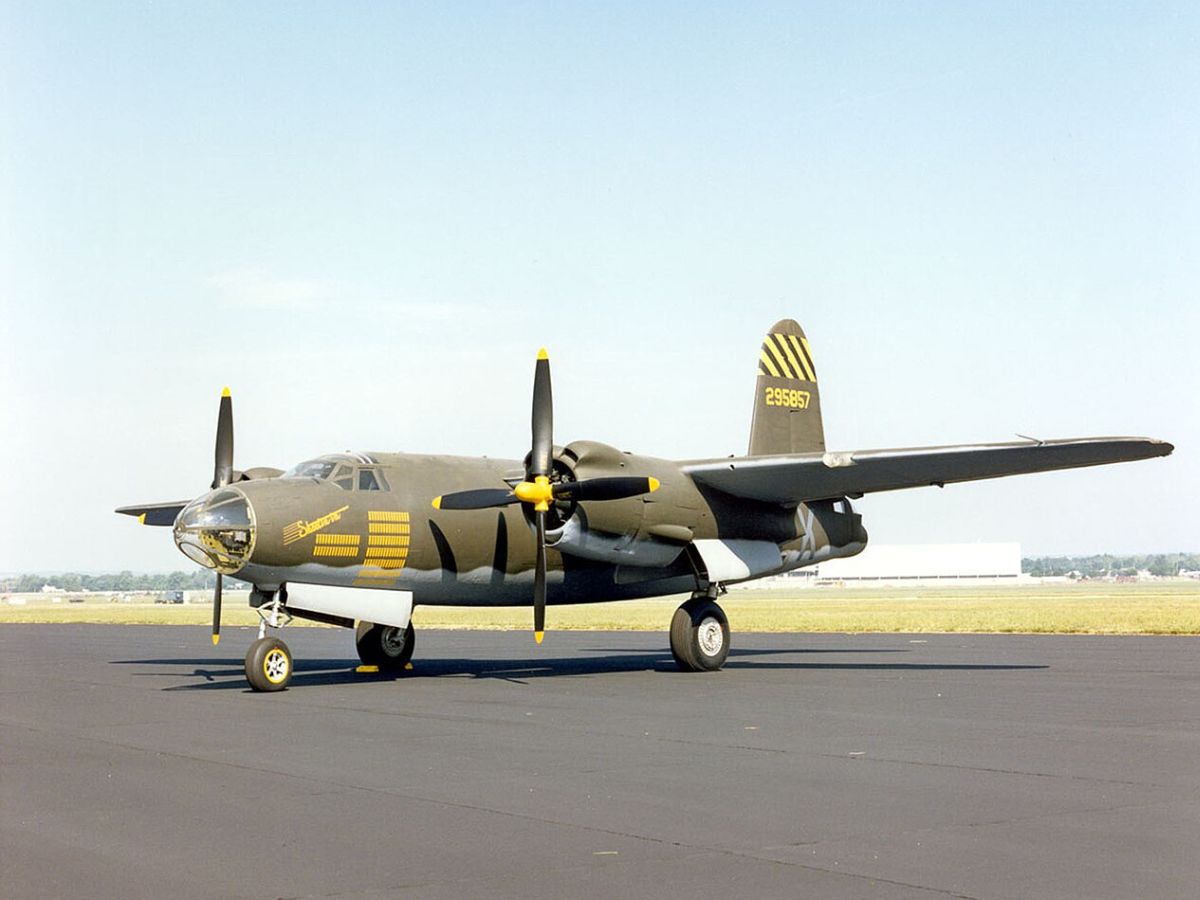
The Martin B-26 Marauder earned the grim nickname "Widowmaker" during training due to its high wing loading and hot landing speed, but it ultimately achieved the lowest combat loss rate of any USAAF bomber in the European theater — just 0.5% per sortie by war's end. With 5,288 built, the B-26 served as the principal medium bomber of the 9th Air Force in northern Europe and the 12th Air Force in the Mediterranean, flying over 129,000 combat sorties.
B-26 Marauder at a Glance
- Role
- Medium Bomber
- Manufacturer
- Glenn L. Martin Company
- Nation
- United States
- Era
- World War II
By the Numbers
5,288
Built
911
Combat Losses
5,288
Built
7
Crew
129,000+
Combat Sorties
0.5% (lowest)
Loss Rate
169,000+ tons
Bombs Dropped
Aircraft Description
The Martin B-26 Marauder overcame a notorious early reputation as the "Widowmaker" to achieve the lowest combat loss rate of any USAAF bomber in the European theater by war's end. With 5,288 built, it served as the principal medium bomber of the 9th Air Force in the ETO and the 12th Air Force in the Mediterranean, flying over 129,000 sorties and dropping more than 169,000 tons of bombs.
Design Origins
The B-26 Marauder was born from a 1939 USAAC competition for a new medium bomber, Proposal No. 39-640. Engineer Peyton M. Magruder of the Glenn L. Martin Company designed the Model 179 to maximize speed and range, prioritizing aerodynamic efficiency over docile handling. The design featured a circular-section fuselage, short high-aspect-ratio wings with a wing loading higher than any contemporary bomber, and two of the most powerful engines then available — the Pratt & Whitney R-2800 Double Wasp. Martin won the contract "off the drawing board" on July 5, 1939, with an initial order for 201 aircraft — the first time a USAAC combat aircraft had been ordered straight from the design without a prototype competition. The first B-26 flew on November 25, 1940, and deliveries began in February 1941.
The "Widowmaker" Controversy
The B-26 quickly earned a fearsome reputation during training. Its high wing loading produced a landing speed of over 130 mph — far higher than any bomber pilots had previously encountered — and its stall characteristics were abrupt and unforgiving. Training bases, particularly MacDill Field in Tampa, Florida, experienced a distressing rate of landing accidents, and the aircraft acquired a grim collection of nicknames: "Widowmaker," "Flying Coffin," "B-Dash-Crash," and "One-a-Day-in-Tampa-Bay." The accident rate prompted a Congressional investigation in 1943, with some members advocating for the aircraft's withdrawal from service.
The solution came from multiple directions. Martin extended the wingspan from 65 to 71 feet on the B-26B-10 sub-variant, reducing wing loading and improving low-speed handling. The USAAF overhauled its training program, adding dedicated transition training and requiring pilots to master single-engine procedures. Legendary test pilot and instructor Jimmy Doolittle personally demonstrated the B-26's capabilities, flying it on one engine to show skeptical pilots it could be done safely. By mid-1943, the training accident rate had dropped dramatically, and the controversy subsided as combat results began to vindicate the aircraft.
Pacific Operations
The B-26's first combat occurred in the Pacific, where the 22nd Bombardment Group flew the first USAAF bombing mission of the war from Australia in April 1942. B-26s also participated in the Battle of Midway in June 1942, where four torpedo-armed Marauders of the 69th Bombardment Squadron attacked the Japanese carrier fleet — one of the few instances of USAAF aircraft conducting torpedo attacks. The Pacific B-26 groups operated the early short-wing models, which proved difficult to maintain in tropical conditions. By early 1943, most Pacific B-26 units had transitioned to B-25 Mitchells or B-24 Liberators, and the Marauder's story became a European one.
Mediterranean Theater
The 12th Air Force operated three B-26 bombardment groups — the 17th, 319th, and 320th — under the 42nd Bombardment Wing in the Mediterranean theater. These groups flew from bases in North Africa, Sardinia, Corsica, and Italy, conducting tactical bombing missions during the campaigns in Tunisia, Sicily, Italy, and southern France. The 12th Air Force B-26 groups developed and refined the medium-altitude box formation tactics that would later be adopted by the 9th Air Force in England. Operating at 10,000–14,000 feet in tight formations, the Marauder groups achieved remarkable bombing accuracy against bridges, rail yards, and coastal defenses.
The 9th Air Force and the ETO
The B-26 became the principal medium bomber of the 9th Air Force in the European theater, with eight bombardment groups eventually operating the type: the 322nd, 323rd, 344th, 386th, 387th, 391st, 394th, and 397th. After the disastrous low-level Ijmuiden raids in May 1943, the 9th Air Force B-26 groups adopted medium-altitude formation tactics and never looked back. For the remainder of the war, the Marauder force concentrated on precision tactical targets: V-1 launch sites, bridges, marshaling yards, fuel depots, and communication centers.
On D-Day, June 6, 1944, nine B-26 groups flew multiple missions against German coastal defenses, with Marauders among the first aircraft over the Normandy beaches. In the weeks that followed, B-26 groups conducted an intensive bridge-busting campaign, severing German lines of communication across the Seine and Loire rivers with bombing accuracy that rivaled dive bombers. By late 1944, the B-26 Marauder had achieved the lowest combat loss rate of any USAAF bomber in the European theater — approximately 0.5% per sortie — a stunning vindication for an aircraft that had nearly been cancelled.
The Remarkable Turnaround
The B-26's transformation from "Widowmaker" to the safest bomber in the ETO is one of the most remarkable stories of the air war. The keys to this turnaround were the wing extension on the B-26B-10, improved pilot training, the adoption of medium-altitude formation tactics, and the sheer professionalism of the crews and ground personnel who operated the aircraft. By war's end, B-26 groups had flown over 129,000 combat sorties and dropped more than 169,000 tons of bombs — a record of sustained, precise tactical bombing unmatched by any other medium bomber force. The A-20 Havoc served alongside the B-26 in both the 9th and 12th Air Forces, sharing many of the same targets.
Transition and Retirement
Despite its combat record, the B-26 was retired almost immediately after the war. Its demanding handling characteristics made it unsuitable for the peacetime Air Force, and the Douglas A-26 Invader — which could perform the same mission with a smaller crew — was already replacing Marauder groups by late 1944. Production ended in March 1945 after 5,288 aircraft, and by 1947 the type had been completely withdrawn from USAF service. Unlike the B-25 Mitchell, which found postwar roles as trainers and executive transports, virtually all B-26s were scrapped, making surviving examples extremely rare today.
Paint Schemes and Camouflage
The B-26 Marauder wore the standard USAAF paint schemes of its era, with some theater-specific variations.
- Olive Drab over Neutral Gray (1941–1944): The standard USAAF camouflage of Olive Drab (ANA 613) upper surfaces over Neutral Gray (ANA 603) undersurfaces. Applied to all early and mid-production B-26s. The OD/NG scheme was worn during the type's most intense combat period in 1943–1944. Markings included national insignia (star-and-bar from June 1943), serial numbers on the vertical tail, and group/squadron identification markings.
- Natural Metal Finish (Mid-1944 onward): From mid-1944, the USAAF abandoned camouflage paint on new production aircraft to save weight and production time. 9th Air Force B-26 groups transitioned to natural metal finish aircraft, though the transition was less complete than in fighter units. Some groups operated a mix of OD and NMF aircraft simultaneously, creating interesting modeling subjects.
- Mediterranean Schemes: 12th Air Force B-26s in North Africa occasionally received local desert tan and sand modifications over the standard OD/NG, particularly on upper surfaces. Some aircraft received medium sea grey or azure blue undersurfaces adapted from RAF practice in the theater.
- Invasion Stripes (June 1944): All 9th Air Force tactical aircraft received alternating black and white identification bands on wings and rear fuselage for the Normandy invasion. B-26s wore the full five-stripe pattern. Fuselage stripes were removed within weeks; wing stripes persisted longer on some aircraft into the fall of 1944.
- Group Markings: 9th Air Force B-26 groups used distinctive tail markings for formation identification: colored geometric shapes, diagonal stripes, and solid-color rudders. The 322nd BG used a yellow triangle, the 386th a yellow diagonal stripe, the 387th a white "K" in a circle, and each group developed its own distinctive scheme. These colorful markings are one of the main appeals of the B-26 for scale modelers.
Design Features
Key engineering and design choices that defined the B-26 Marauder's capabilities.
Torpedo-Shaped Fuselage
The B-26's most distinctive identification feature was its perfectly circular, torpedo-shaped fuselage cross-section — smooth, streamlined, and devoid of the flat-sided construction found on most contemporary bombers. This aerodynamically clean design contributed to the aircraft's high speed but also made it visually unique and immediately recognizable.
High Wing Loading
The original B-26 had the highest wing loading of any USAAF aircraft at the time of its introduction, with short, stubby wings designed for speed rather than docile handling. This gave the Marauder its high landing speed (130+ mph) and unforgiving stall characteristics that earned it the 'Widowmaker' reputation. The B-26B-10 and later variants extended the wingspan from 65 to 71 feet, partially addressing this issue.
Martin Dorsal Turret
A powered Martin-designed dorsal turret with twin .50-caliber machine guns sat atop the fuselage aft of the cockpit. The turret provided 360-degree traverse and was operated by the radio operator/gunner. It was one of the most visible profile features of the B-26 and a key recognition point for modelers.
Bell Tail Turret
A Bell-designed powered tail turret with twin .50-caliber machine guns gave the B-26 strong rearward defense — critical for medium-altitude bombing formations. The tail turret was a distinctive feature from the B-26B onward and differentiated it from the earlier hand-held tail gun arrangement.
Tricycle Landing Gear
Like the A-20 Havoc, the B-26 featured tricycle landing gear with a nosewheel, which provided excellent ground handling and forward visibility. The main gear retracted rearward into the engine nacelles. The relatively short gear legs, combined with the high wing loading, contributed to the challenging landing characteristics that required precise airspeed control.
Twin Vertical Stabilizers (Late Models)
The B-26F and B-26G introduced a taller single vertical stabilizer and rudder, providing improved directional stability. Earlier models had a distinctive, somewhat undersized vertical tail that contributed to directional control challenges at low speeds — a detail important for modelers building specific variants.
Shoulder-Mounted Wing
The wing was mounted in a shoulder position, giving the aircraft a distinctive silhouette. The wing leading edge met the fuselage high on the circular cross-section, with the bomb bay occupying the lower fuselage beneath the wing center section.
Engines & Armament
Powerplant and weapons configuration for the B-26 Marauder's primary production variant.
Powerplant
2x Pratt & Whitney R-2800-43 Double Wasp, 18-cylinder twin-row air-cooled radial engines, each producing 1,920 hp at takeoff. The R-2800 was one of the most powerful and reliable piston engines of the war, with a displacement of 46 liters (2,804 cu in). Each engine drove a four-blade Curtiss Electric constant-speed propeller. The R-2800 featured a two-speed supercharger and ran on 100-octane fuel. Early B-26 and B-26A models used the R-2800-5 rated at 1,850 hp; the B-26B introduced the R-2800-43 at 1,920 hp. The same basic R-2800 engine family also powered the P-47 Thunderbolt, F4U Corsair, and F6F Hellcat, making it arguably the most important American aero engine of the war.
Armament
The B-26B carried twelve .50-caliber (12.7 mm) Browning M2 machine guns: one fixed forward-firing in the nose, four in flexible waist positions (two per side in staggered mounts), two in the Martin dorsal turret, two in the Bell tail turret, and one in the nose compartment and one ventral tunnel gun. The internal bomb bay accommodated up to 1,361 kg (3,000 lb) of bombs for normal missions, with a maximum overload capacity of 2,359 kg (5,200 lb) over short ranges. Typical bomb loads included six 500 lb GP bombs, twelve 250 lb bombs, or combinations of incendiary and fragmentation clusters. External bomb racks were not standard. Later B-26F and B-26G models carried eleven .50-caliber guns.
Specifications
Key dimensions and performance figures for the B-26 Marauder's primary production variant.
- Crew
- 7
- Length
- 17.75 m(58.2 ft)
- Wingspan
- 21.64 m(71.0 ft)
- Height
- 6.55 m(21.5 ft)
- Wing Area
- 61.13 m²(658 ft²)
- Max Speed
- 454 km/h(282 mph)
Variants & Models
Each B-26 Marauder variant introduced changes to the airframe, engine, or armament. Visual ID features help modelers and spotters distinguish between versions.
B-26Marauder I (RAF)
201
Built
- Powerplant
- 2x Pratt & Whitney R-2800-5 Double Wasp, 1,850 hp each
- Max Speed
- 507 km/h(315 mph)
- Range
- 1,610 km(1,000 mi)
- Ceiling
- 7,620 m(25,000 ft)
Visual ID
Short 65-ft wingspan, original short engine nacelles, early armament with .30 cal guns, single hand-held tail gun
Initial production variant with short 65-foot wingspan. Fastest B-26 variant due to lower drag from smaller wings, but the high wing loading (55 lb/sq ft) created dangerously high landing speeds. Most served in the Pacific with the 22nd and 38th Bomb Groups before being withdrawn from combat.
B-26AMarauder IA (RAF)
139
Built
- Powerplant
- 2x Pratt & Whitney R-2800-9 Double Wasp, 1,850 hp each
- Max Speed
- 507 km/h(315 mph)
- Range
- 1,610 km(1,000 mi)
- Ceiling
- 7,620 m(25,000 ft)
Visual ID
Short 65-ft wingspan, torpedo shackles under fuselage, otherwise similar to B-26
Added torpedo-carrying capability with external shackle for a single Mark 13 aerial torpedo. Some B-26As saw action in the Pacific, including torpedo attacks against Japanese shipping. 139 built, with 52 diverted to the RAF as Marauder IA.
B-26BMarauder II (RAF)
1,883
Built
- Powerplant
- 2x Pratt & Whitney R-2800-43 Double Wasp, 1,920 hp each
- Max Speed
- 454 km/h(282 mph)
- Range
- 1,850 km(1,150 mi)
- Ceiling
- 6,400 m(20,997 ft)
Visual ID
From B-26B-10 onward: extended 71-ft wingspan, taller vertical stabilizer, increased armament to twelve .50 cal guns, staggered waist gun positions
The major production variant and backbone of ETO/MTO operations. The critical B-26B-10 sub-variant introduced the extended 71-foot wingspan (up from 65 ft), which reduced wing loading and significantly improved handling. Earlier B-26B models retained the short wing. 1,883 built at Martin's Baltimore, Maryland plant.
B-26CMarauder II (RAF)
1,235
Built
- Powerplant
- 2x Pratt & Whitney R-2800-43 Double Wasp, 1,920 hp each
- Max Speed
- 454 km/h(282 mph)
- Range
- 1,850 km(1,150 mi)
- Ceiling
- 6,400 m(20,997 ft)
Visual ID
Identical to late-production B-26B; distinguished only by Omaha manufacturing origin
Identical to the B-26B but built at Martin's Omaha, Nebraska plant. The B/C designation distinction matters for serial number research but has no visual difference. 1,235 built. Many B-26Cs served with the 12th Air Force in the Mediterranean theater.
B-26FMarauder III (RAF)
300
Built
- Powerplant
- 2x Pratt & Whitney R-2800-43 Double Wasp, 1,920 hp each
- Max Speed
- 454 km/h(282 mph)
- Range
- 1,850 km(1,150 mi)
- Ceiling
- 6,400 m(20,997 ft)
Visual ID
Wing incidence increased 3.5 degrees for better takeoff performance, slightly revised tail assembly, reduced to eleven .50 cal guns
Introduced increased wing incidence angle of 3.5 degrees, improving takeoff and landing performance — a direct response to the Widowmaker criticism. Armament reduced to eleven .50-caliber guns. 300 built at Baltimore. Served with both 9th and 12th Air Forces in the final year of the war.
B-26GMarauder III (RAF)
893
Built
- Powerplant
- 2x Pratt & Whitney R-2800-43 Double Wasp, 1,920 hp each
- Max Speed
- 454 km/h(282 mph)
- Range
- 1,850 km(1,150 mi)
- Ceiling
- 6,400 m(20,997 ft)
Visual ID
Identical to B-26F in design; minor equipment standardization changes
Final production variant. Essentially identical to the B-26F with minor equipment standardization. 893 built at Baltimore. The last B-26G was delivered in March 1945, ending Marauder production. The aircraft at the National Museum of the USAF is a B-26G.
AT-23B / TB-26B
208
Built
- Powerplant
- 2x Pratt & Whitney R-2800-43 Double Wasp, 1,920 hp each
- Max Speed
- 454 km/h(282 mph)
Visual ID
Armament removed, target-towing equipment fitted, bright trainer markings
Trainer and target-tow conversion of B-26B airframes. Used for gunnery training, with a sleeve target streamed from a winch in the rear fuselage. 208 converted. The Navy also operated JM-1 and JM-2 variants for target towing, converted from AT-23B and TB-26C airframes respectively.
Development & Operational Timeline
Key milestones in the B-26 Marauder's journey from design through operational service.
Martin Wins Medium Bomber Competition
The Glenn L. Martin Company's Model 179 design, by engineer Peyton M. Magruder, wins the USAAC Proposal No. 39-640 competition for a new medium bomber. The design is accepted "off the drawing board" without a prototype flyoff — the first time this has been done for a combat aircraft — with an initial order for 201 aircraft.
XB-26 First Flight
The first B-26 (there was no XB-26 prototype — the first production aircraft served as the test vehicle) makes its maiden flight from Martin's Middle River, Maryland plant. Test pilots note the aircraft's high speed but also its demanding handling characteristics at low speed.
First Production Deliveries
The 22nd Bombardment Group at Langley Field, Virginia, receives the first production B-26 Marauders. Crews immediately note the aircraft's high landing speed and unforgiving stall characteristics, leading to a string of training accidents.
First Combat Mission (Pacific)
B-26 Marauders of the 22nd Bombardment Group fly the first USAAF bombing mission of the Pacific war, attacking Japanese targets from bases in Australia. The 22nd BG would continue operating B-26s in the Southwest Pacific before transitioning to B-24s.
B-26s Attack Japanese Fleet at Midway
Four B-26 Marauders of the 69th Bombardment Squadron, armed with torpedoes, attack the Japanese carrier fleet during the Battle of Midway. Two are shot down and the other two badly damaged. One B-26, piloted by Lt. James Muri, flew so low over the carrier Akagi that its gunners strafed the flight deck.
Disastrous Ijmuiden Raid
The 322nd Bombardment Group flies its first ETO mission — a low-level attack on a power station at Ijmuiden, Netherlands. The mission is a catastrophe: intense flak destroys or damages every aircraft, with one B-26 shot down. A follow-up mission three days later loses 10 of 11 aircraft. The disasters force an immediate switch to medium-altitude tactics.
Medium-Altitude Tactics Adopted
After the Ijmuiden disasters, 9th Air Force B-26 groups adopt medium-altitude box formation bombing between 10,000–14,000 feet, transforming the Marauder from a failed low-level attacker into a devastatingly accurate formation bomber. Loss rates drop dramatically and accuracy improves.
Congressional Investigation
Amid growing concern over the B-26's training accident rate, a Congressional committee investigates whether the Marauder should be withdrawn from service. Improved training procedures, the extended-wing B-26B-10, and growing combat success in Europe ultimately save the program.
B-26s Support D-Day
Nine 9th Air Force B-26 groups fly multiple missions against German coastal defenses, bridges, and transportation targets on D-Day. The Marauder groups are among the first aircraft over the Normandy beaches, bombing German positions at Utah and Omaha Beach. All aircraft wear black-and-white invasion stripes.
Lowest Loss Rate Achieved
By late 1944, the B-26 Marauder has achieved the lowest combat loss rate of any USAAF bomber in the European theater — approximately 0.5% per sortie — a remarkable turnaround from its early "Widowmaker" reputation. The achievement validates the medium-altitude formation tactics developed after Ijmuiden.
Last B-26 Delivered
The final B-26G Marauder rolls off the Martin production line at Baltimore, Maryland, ending production after 5,288 aircraft. By this time, B-26 groups are being progressively converted to the Douglas A-26 Invader.
Last Combat Missions in ETO
B-26 Marauder groups fly their final combat missions in the European theater in the closing days of the war. The type is rapidly retired after V-E Day, with most aircraft scrapped or sent to storage. Unlike many WWII types, the B-26 saw almost no postwar service due to its demanding handling.
Combat History
Major engagements and missions that defined the B-26 Marauder's combat record.
Battle of Midway — Torpedo Attack
June 4, 1942Four B-26 Marauders of the 69th Bombardment Squadron, each carrying a Mark 13 aerial torpedo, attacked the Japanese carrier strike force during the Battle of Midway. Two aircraft were shot down and the other two were badly damaged. Lt. James Muri's B-26 flew so close to the carrier Akagi that his gunners strafed the flight deck, and the aircraft narrowly avoided crashing into the carrier's bridge.
4
Dispatched
2
Aircraft Lost
One of the few instances of USAAF bombers conducting torpedo attacks. The near-miss on Akagi's bridge may have influenced Admiral Nagumo's fateful decision to re-arm his aircraft, contributing to the delay that allowed US dive bombers to catch the Japanese carriers with loaded aircraft on deck.
Ijmuiden Raids — First ETO Missions
May 14–17, 1943The 322nd Bombardment Group conducted two disastrous low-level missions against targets in the Netherlands. On May 14, all 11 B-26s attacking the Ijmuiden power station were hit by flak, with one shot down. On May 17, a follow-up low-level mission lost 10 of 11 aircraft to withering flak and fighter attacks. The surviving aircraft was heavily damaged.
22
Dispatched
11
Aircraft Lost
The most important turning point in B-26 history. The Ijmuiden disasters proved that low-level tactics were suicidal against European flak defenses and forced an immediate switch to medium-altitude formation bombing. This tactical change, combined with improved training, ultimately transformed the B-26 from a death trap into the safest bomber in the ETO.
Operation Husky — Invasion of Sicily
July–August 194312th Air Force B-26 groups (17th, 319th, and 320th Bombardment Groups) conducted extensive tactical bombing missions during the Allied invasion of Sicily. Targets included airfields, bridges, rail junctions, and coastal defenses. The B-26s operated from North African bases, flying across the Mediterranean to strike targets on Sicily.
Proved the B-26 as an effective medium-altitude tactical bomber in the Mediterranean theater. The 12th Air Force B-26 groups refined the formation bombing tactics that would be adopted by 9th Air Force units in England, establishing patterns used through the rest of the war.
Operation Overlord — D-Day
June 6, 1944Nine 9th Air Force B-26 bombardment groups flew multiple missions on D-Day, attacking German coastal batteries, strongpoints, bridges, and transportation choke points. B-26s were among the first aircraft over the beaches, bombing German positions at Utah and Omaha Beach in the predawn hours. All aircraft wore black-and-white invasion stripes for identification.
9
Aircraft Lost
D-Day represented the B-26's finest hour as a tactical bomber. The 9th Air Force's Marauder groups flew with exceptional precision to avoid hitting Allied troops on the beaches below. The low loss rate on this high-intensity day demonstrated how far the B-26 program had come since Ijmuiden just thirteen months earlier.
Bridge Interdiction Campaign — France
June–August 19449th Air Force B-26 groups conducted an intensive campaign to destroy bridges over the Seine and Loire rivers, cutting German lines of communication and preventing reinforcements from reaching the Normandy front. The Marauder proved exceptionally accurate in bridge-busting missions, with some groups achieving direct hits on spans as narrow as 30 feet.
The bridge interdiction campaign showcased the B-26's precision bombing capability. Flying in tight box formations at medium altitude, Marauder groups achieved bombing accuracy that rivaled that of dive bombers while carrying a much heavier bomb load. This campaign is often cited as the B-26's greatest operational achievement.
Operation Dragoon — Southern France
August 15, 194412th Air Force B-26 groups supported the Allied invasion of southern France (Operation Dragoon), attacking German coastal defenses, bridges, and transportation targets in the Rhone Valley. B-26 groups operated from bases in Sardinia and Corsica, providing tactical air support for the invasion forces.
One of the 12th Air Force B-26 force's major operations. The Marauder groups supported the rapid Allied advance up the Rhone Valley, contributing to the liberation of southern France and the linkup with forces from Normandy.
Battle of the Bulge — Ardennes Support
December 1944 – January 1945When weather cleared during the German Ardennes offensive, 9th Air Force B-26 groups flew maximum-effort missions against German supply lines, rail junctions, bridges, and troop concentrations. Marauder groups operated in challenging winter conditions, with icing, low ceilings, and poor visibility limiting operations on many days.
Demonstrated the B-26's all-weather capability and the resilience of its crews and ground support. The Marauder groups' ability to mount large-scale operations on short notice when weather permitted was critical to disrupting German logistics during the Bulge.
Unit Markings
The B-26 Marauder served with units whose markings are documented in our markings reference guides.
9th Air Force Markings Lookup
Squadron codes, cowling colors, and tail markings for every tactical fighter and bomber group in the ETO.
12th Air Force Markings Lookup
Tail markings, cowling colors, and squadron identification for every tactical bomber and fighter group in the Mediterranean Theater.
Production & Service
From first flight to retirement — the B-26 Marauder's operational lifespan at a glance.
- Number Built
- 5,288
- First Service
- 1941
- Last Built
- 1945
- Retired
- 1948
- Combat Losses
- 911
- Status
- Retired
Where to See One
Surviving B-26 Marauder aircraft you can visit today. Airworthy aircraft may appear at air shows.
B-26 Marauder
S/N: 40-1464
Variant: B-26
Fantasy of Flight / Kermit Weeks Collection
Polk City, Florida
Kermit Weeks
Extremely rare early short-wing B-26 (one of the original 201 built). Under long-term restoration by collector Kermit Weeks. If completed, it would be the only airworthy Marauder in the world.
B-26C-45-MO "Peg o' My Heart"
S/N: 42-107640
Variant: B-26C
B-26C on outdoor static display. One of the few surviving Omaha-built Marauders. Displayed in 9th Air Force markings.
B-26G Marauder
S/N: 44-68221
Variant: B-26G
B-26G on display at the French national aviation museum. France operated B-26s with the Armee de l'Air after the war, receiving them under Lend-Lease for use in French Indochina.
B-26G-10-MA "Dinah Might"
S/N: 43-34581
Variant: B-26G
Legendary D-Day veteran. "Dinah Might" of the 391st Bombardment Group, 9th Air Force, landed on the emergency airstrip at Utah Beach on June 7, 1944, with battle damage — the first Allied bomber to land in Normandy. Recovered from a French farm in the 1980s and restored.
B-26G-25-MA "Shootin' In"
S/N: 44-68219
Variant: B-26G
B-26G on static display in the WWII Gallery. One of only a handful of surviving Marauders worldwide. Restored in markings of the 387th Bombardment Group, 9th Air Force.
Written by
Steve Carmichael
I am a ww2 model enthusiast getting back into building scaled models after many years away. This site allows me to work on my web development skills while sharing what I am learning.