Bell Aircraft Corporation
P-39 Airacobra
 Steve CarmichaelLast updated March 16, 2026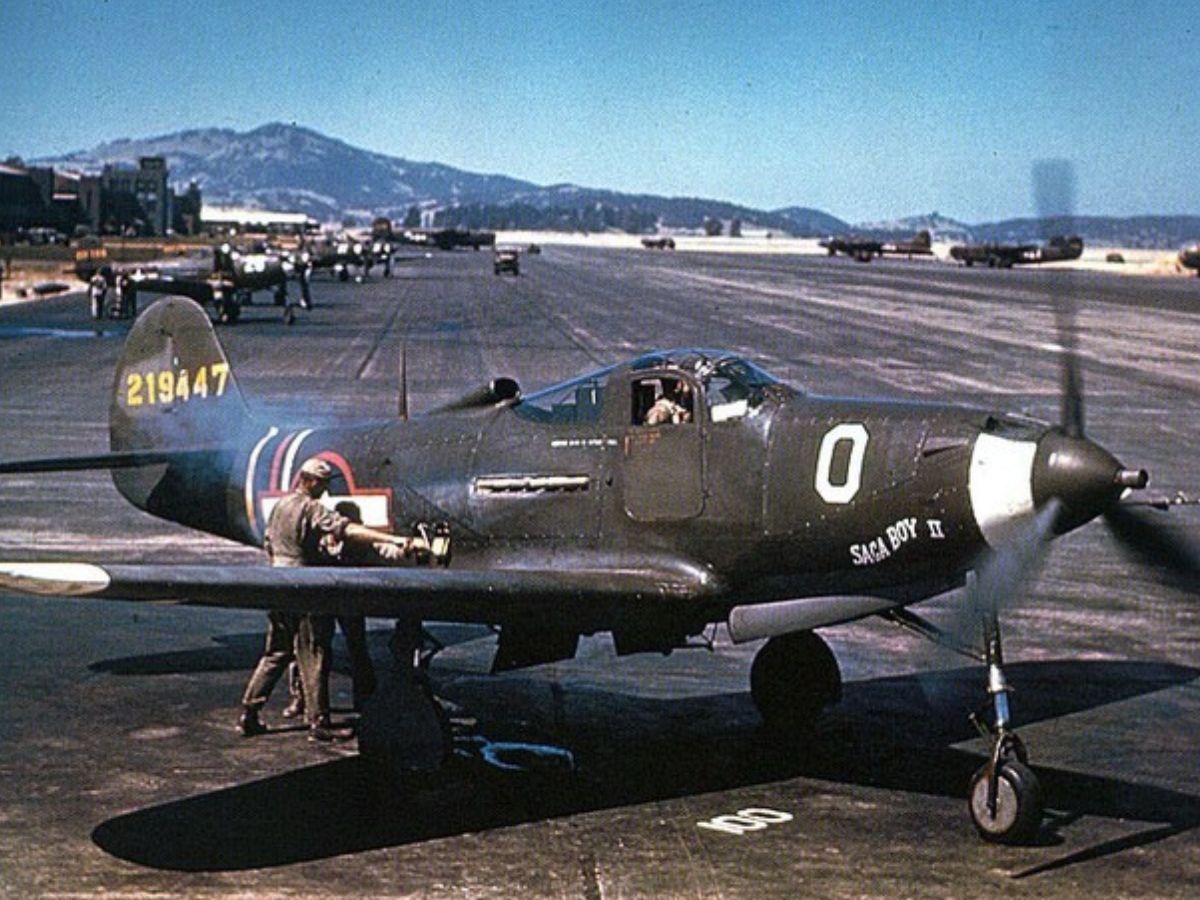
The Bell P-39 Airacobra was the most unconventional American fighter of World War II — and one of the most misunderstood. Its radical mid-engine layout, with the Allison V-1710 mounted behind the pilot and driving the propeller via a long extension shaft, allowed a devastating 37mm cannon to fire through the propeller hub. But the Army's fateful decision to remove the prototype's turbocharger crippled the P-39's high-altitude performance, rendering it obsolete for the air superiority role in Western theaters. The Soviet Union, however, recognized the Airacobra's strengths: at the low altitudes where Eastern Front combat occurred, the P-39 was fast, well-armed, and rugged. Nearly 5,000 P-39s were sent to the USSR under Lend-Lease, and Soviet aces — including Aleksandr Pokryshkin, the second-highest-scoring Allied ace of the war with 59 victories — made it one of the deadliest fighters on the Eastern Front.
P-39 Airacobra at a Glance
- Role
- Fighter
- Manufacturer
- Bell Aircraft Corporation
- Nation
- United States
- Era
- World War II
By the Numbers
9,588
Built
107
Combat Losses
9,588
Built
~4,773
Soviet Lend-Lease
37mm M4
Cannon
376 mph
Top Speed
Pokryshkin (59 victories)
Top Soviet Ace
Aircraft Description
The Bell P-39 Airacobra was one of the most unconventional American fighters of World War II, featuring a mid-mounted engine behind the pilot, a 37mm cannon firing through the propeller hub, tricycle landing gear, and automobile-style entry doors. While its lack of a turbocharger limited its effectiveness at high altitude for the USAAF, the P-39 found its true calling on the Eastern Front, where nearly 5,000 were sent to the Soviet Union under Lend-Lease. Soviet pilots, fighting at low altitude where the Airacobra excelled, made the P-39 one of the top-scoring Allied fighter types of the war.
Origins: A Radical Concept
The P-39 Airacobra was born from one of the most daring design concepts in fighter aviation history. In 1937, Bell Aircraft Corporation designers Robert Woods and Harland Poyer conceived an aircraft with the engine mounted behind the pilot, driving the propeller through an extension shaft beneath the cockpit floor. This radical layout freed the nose for a heavy weapon — a 37mm cannon firing through the hollow propeller shaft — and allowed tricycle landing gear for superior ground handling. No other major fighter manufacturer attempted anything similar.
The XP-39 prototype first flew on April 6, 1938, and with its turbocharged Allison V-1710-17, it was genuinely impressive — reaching 390 mph at altitude, faster than virtually any fighter in the world. Bell and the Army were elated. But then came the decision that would define the Airacobra's entire career.
The Turbocharger Decision
In early 1939, NACA engineers at Langley conducted extensive wind tunnel tests on the XP-39 and recommended removing the turbocharger and its associated ducting to reduce drag. The Army Air Corps agreed, reasoning that the simplified aircraft would be easier to produce in quantity and that improved streamlining would compensate for the lost high-altitude capability. Bell redesigned the aircraft as the XP-39B without the turbocharger.
The consequences were profound. Without the turbocharger, the P-39's single-stage, single-speed supercharger could not maintain engine power above approximately 15,000 feet. Performance degraded sharply at the altitudes where European and Pacific air combat increasingly took place. The RAF, which had ordered the type as the Airacobra I, tested it in 1941 and promptly rejected it — the aircraft could not compete with the Bf 109F or Fw 190 at altitude. After a single operational sortie by No. 601 Squadron on October 9, 1941, the RAF withdrew the type. Most of the British order was diverted to the USAAF as P-400s.
Pacific Baptism of Fire
The P-39's first major combat came in the desperate early months of the Pacific war. P-39D Airacobras and diverted P-400s equipped the 8th and 35th Fighter Groups of the 5th Air Force, defending the vital Allied base at Port Moresby, New Guinea, against relentless Japanese air attacks throughout 1942. The 35th Fighter Group's "Black Panthers" flew P-39s during some of the most critical defensive actions of the New Guinea campaign.
At Guadalcanal, P-400s of the 67th Fighter Squadron operated from the beleaguered Henderson Field alongside Marine F4F Wildcats. Unable to intercept Japanese bombers at altitude, the P-400 pilots adapted, using their 20mm cannon for devastating ground attack missions against Japanese positions. The Airacobra was not the fighter the Pacific needed, but it was the fighter that was available — and its pilots made the best of it until P-38 Lightnings and P-40 Warhawks arrived in sufficient numbers.
The Aleutians
P-39s also served in one of the war's most inhospitable theaters — the Aleutian Islands of Alaska. The 54th Fighter Group operated P-39Ds and P-400s from primitive bases in some of the worst flying weather on earth: perpetual fog, violent williwaw winds, icing at all altitudes, and visibility measured in yards. Pilots flew patrol and ground attack missions against Japanese forces occupying Attu and Kiska. The P-39's rugged construction served it well in the Arctic, though many aircraft were lost to weather and operational accidents rather than enemy action.
Mediterranean Service
The 12th Air Force operated P-39 Airacobras in the Mediterranean theater with the 81st and 350th Fighter Groups, primarily on coastal defense, convoy patrol, and ground support missions. The 350th FG was one of the few USAAF groups to fly the P-39 operationally in the MTO, before transitioning to P-47 Thunderbolts.
Most significantly, the 332nd Fighter Group — the legendary Tuskegee Airmen and the first African-American fighter group in USAAF history — flew P-39 Airacobras during their initial combat deployment to the Mediterranean in early 1944. The 332nd operated under the 12th Air Force before transferring to the 15th Air Force, where they rapidly transitioned to P-47 Thunderbolts and then P-51 Mustangs, with which they built their extraordinary escort record.
The Eastern Front: The P-39's True Theater
If the P-39 was a disappointment in USAAF service, it was a revelation on the Eastern Front. Beginning in late 1942, thousands of P-39N and P-39Q Airacobras were delivered to the Soviet Union under Lend-Lease, primarily via the Alaska-Siberia (ALSIB) ferry route from Fairbanks, Alaska, across Siberia to the front lines. By war's end, approximately 4,773 P-39s had been shipped to the USSR — making the Soviet Union the largest single operator, receiving roughly half of all production.
Soviet pilots discovered what American and British pilots had missed: at the low altitudes where Eastern Front combat occurred — typically below 15,000 feet — the P-39 was fast, maneuverable, well-armed, and rugged. The 37mm cannon was devastating in the close-range engagements favored by Soviet fighter doctrine. The aircraft's armor protection — including the engine behind the pilot acting as a shield — was valued in the ground-strafing role. And the P-39's smooth handling at low altitude, combined with its good visibility from the mid-mounted cockpit, made it a natural fit for Eastern Front tactics.
The results were extraordinary. Aleksandr Ivanovich Pokryshkin, flying P-39N and P-39Q Airacobras with the 16th Guards Fighter Aviation Regiment, scored 59 confirmed victories — making him the second-highest-scoring Allied ace of the war, behind only fellow Soviet pilot Ivan Kozhedub. Pokryshkin developed innovative vertical maneuvering tactics, the "Kuban Staircase," that perfectly exploited the P-39's characteristics. Grigory Rechkalov, Pokryshkin's wingman in the same regiment, scored 56 victories — 44 of them in the P-39. At least 30 Soviet pilots achieved ace status flying the Airacobra.
The P-39's Soviet record stands as one of the most striking examples in aviation history of an aircraft finding its true calling in an unexpected theater. The same fighter that the RAF rejected after one mission became one of the deadliest weapons on the Eastern Front — not because the aircraft changed, but because the conditions of combat changed.
Legacy: The Right Plane in the Wrong Place
The P-39 Airacobra's story is ultimately one of context. With the turbocharger, it might have been a world-class fighter. Without it, the P-39 was miscast in the roles the USAAF needed it to fill — high-altitude interception and air superiority in the Pacific and Mediterranean. It was replaced in USAAF service by the P-38 Lightning, P-47 Thunderbolt, and P-51 Mustang, all of which could operate effectively at altitude.
But the Soviet experience proved that the P-39 was far from a bad aircraft. Deployed in the right conditions — low altitude, close range, with pilots trained to exploit its unique strengths — the Airacobra was a devastating fighter. Its 37mm cannon, mid-engine agility, and rugged construction made it one of the most effective fighters on the Eastern Front. Bell Aircraft went on to develop the improved P-63 Kingcobra, which was produced almost exclusively for Soviet Lend-Lease, but that aircraft never achieved the combat record of its predecessor.
The Airacobra remains one of the most fascinating and debated fighters of World War II — a radical design that challenged every convention of fighter aircraft layout, failed in the theaters where it was first deployed, and then succeeded brilliantly in a theater its designers never anticipated.
Paint Schemes and Camouflage
The P-39 Airacobra wore a range of paint schemes reflecting its service across multiple theaters and nations.
- Olive Drab over Neutral Gray (1941–1943): The standard USAAF camouflage of Olive Drab (ANA 613) upper surfaces over Neutral Gray (ANA 603) undersurfaces. This was the most common scheme on USAAF P-39Ds and early P-39 variants in the Pacific, Aleutians, and early MTO deployments. National insignia evolved from the star-with-red-center to the star-and-bar during 1942–1943.
- Dark Green / Dark Earth (P-400 Export): P-400s originally built for the RAF wore British-specification Dark Green and Dark Earth upper surface camouflage over Sky (light blue-gray) undersurfaces. Many P-400s retained their RAF camouflage when diverted to USAAF service in the Pacific, with American insignia overpainted on the British roundels. This creates distinctive modeling subjects.
- Natural Metal Finish (1943–1944): Late-production P-39N and P-39Q models were delivered unpainted in natural metal finish, consistent with the USAAF's 1944 directive eliminating camouflage. Most NMF P-39s went directly to the Soviet Union under Lend-Lease.
- Soviet Schemes: Soviet P-39s wore a wide variety of schemes depending on the front and time period. Common configurations included Soviet-applied green or gray camouflage over light blue or gray undersurfaces, with red stars on fuselage and wings. Many Soviet P-39s carried individual aircraft numbers, victory stars, Guards regiment badges, and patriotic slogans. Soviet Airacobras are some of the most colorful and distinctive WWII fighter subjects for modelers.
- Aleutian Schemes: P-39s in Alaska often received field-applied modifications to the standard OD/NG camouflage, including darker or mottled upper surface applications to suit the perpetually overcast conditions. Aircraft at forward bases suffered rapid paint deterioration from the extreme weather.
- 12th Air Force / MTO Schemes: P-39s with the 350th FG in the Mediterranean generally wore standard OD/NG or received local modifications. The 332nd FG's P-39s carried standard USAAF camouflage during their brief operational period with the type.
Design Features
Key engineering and design choices that defined the P-39 Airacobra's capabilities.
Mid-Engine Configuration
The P-39's defining feature was its Allison V-1710 engine mounted behind the pilot, driving the propeller through a long extension shaft that ran beneath the cockpit floor. This radical layout — unique among single-engine production fighters of the era — freed the nose for the 37mm cannon installation and placed the engine weight near the aircraft's center of gravity for improved maneuverability. However, it created dangerous spin characteristics and made the aircraft tail-heavy when ammunition was expended.
37mm Nose Cannon
The M4 37mm autocannon fired through the hollow propeller reduction gearbox — a configuration only possible because the engine was behind the pilot. This gave the P-39 the heaviest nose armament of any American single-engine fighter. The 37mm shell was devastating against aircraft and ground targets, though the limited ammunition supply (30 rounds) and slow rate of fire demanded marksmanship. Soviet pilots, trained in close-range combat, exploited this weapon brilliantly.
Tricycle Landing Gear
The P-39 was one of the first single-engine fighters to feature tricycle landing gear with a steerable nosewheel, providing excellent forward visibility during taxi and ground operations. This was made possible by the mid-engine layout, which moved the center of gravity aft. The nosewheel configuration eliminated the ground-looping tendency common to tailwheel fighters and impressed pilots accustomed to the P-40's conventional gear.
Car-Style Entry Doors
Instead of a sliding or hinged canopy, the P-39 featured automobile-style doors on each side of the cockpit — the only major Allied fighter with this arrangement. The doors provided easy ground access but complicated emergency bailout procedures, as pilots had to jettison the door, roll the aircraft inverted, and drop out. This was a significant concern in combat and contributed to pilot reluctance toward the type.
Allison V-1710 (Without Turbocharger)
The XP-39 prototype featured a turbocharged V-1710 that delivered outstanding high-altitude performance, reaching 390 mph. However, NACA wind tunnel testing at Langley recommended removing the turbocharger to reduce drag, and the Army concurred. This single decision defined the P-39's entire career: without the turbocharger, performance above 15,000 feet degraded sharply, making the P-39 unsuitable for the high-altitude air combat that characterized the Western European theater.
Aerodynamic Refinement
Despite its unconventional layout, the P-39 was aerodynamically clean. The mid-engine position allowed a slim nose profile, and the flush-riveted, stressed-skin construction produced low drag. At low and medium altitudes where the single-stage supercharger was still effective, the P-39Q reached 376 mph — competitive with contemporary fighters. The aircraft's smooth handling at these altitudes made it popular with Soviet pilots.
Armor Protection
The P-39 featured substantial pilot protection: armor plate behind the pilot's seat and head, a bullet-resistant windshield, and the engine itself acting as a rear shield. This arrangement — with the engine behind the pilot absorbing hits that would otherwise strike the cockpit — was an incidental benefit of the mid-engine design that Soviet pilots particularly appreciated in the close-range, low-altitude dogfights of the Eastern Front.
Engines & Armament
Powerplant and weapons configuration for the P-39 Airacobra's primary production variant.
Powerplant
1x Allison V-1710-85 (P-39Q), liquid-cooled 60-degree V-12 engine producing 1,200 hp at takeoff, mounted behind the pilot in a mid-fuselage position. The engine drove the propeller through a 10-foot (3 m) extension shaft that passed beneath the cockpit floor — a unique arrangement that concentrated the aircraft's mass near the center of gravity for improved maneuverability but created dangerous spin recovery characteristics if the center of gravity shifted. The V-1710 was a single-stage, single-speed supercharged engine; critically, the turbocharger fitted to the XP-39 prototype was removed at the Army's insistence to reduce weight and complexity, permanently limiting the P-39 to low- and medium-altitude performance. Earlier variants used the V-1710-35 (P-39D, 1,150 hp) and V-1710-63 (P-39N, 1,200 hp).
Armament
The P-39's armament was centered on its unique nose-mounted 37mm M4 autocannon, which fired through the hollow propeller shaft — a configuration made possible by the mid-engine layout. The M4 cannon fired a 1.34 lb (608 g) explosive or armor-piercing shell effective against both aircraft and ground targets, though its low rate of fire (150 rounds/min) and limited ammunition (30 rounds) required accurate shooting. Two synchronized .50-caliber (12.7 mm) Browning M2 machine guns were mounted in the upper cowling (200 rounds each), with four .30-caliber (7.62 mm) wing-mounted machine guns (300 rounds each) on most variants. The P-39Q replaced the four .30-cal wing guns with two .50-cal guns in underwing pods. A belly shackle could carry one 500 lb bomb for ground attack missions.
Specifications
Key dimensions and performance figures for the P-39 Airacobra's primary production variant.
- Crew
- 1
- Length
- 9.19 m(30.2 ft)
- Wingspan
- 10.36 m(34.0 ft)
- Height
- 3.78 m(12.4 ft)
- Wing Area
- 19.79 m²(213 ft²)
- Max Speed
- 605 km/h(376 mph)
Variants & Models
Each P-39 Airacobra variant introduced changes to the airframe, engine, or armament. Visual ID features help modelers and spotters distinguish between versions.
XP-39 / XP-39BPrototype
2
Built
- Powerplant
- 1x Allison V-1710-17, 1,150 hp (with turbocharger on XP-39)
- Max Speed
- 628 km/h(390 mph)
- Ceiling
- 10,211 m(33,501 ft)
Visual ID
Turbocharger intake and exhaust ducting on XP-39; removed on XP-39B. Smooth cowling, early canopy shape.
The XP-39 first flew on April 6, 1938, with a turbocharged V-1710-17 achieving 390 mph — exceptional for 1938. After NACA wind tunnel tests, the Army ordered the turbocharger removed (creating the XP-39B), which reduced top speed to 375 mph but simplified production. This fateful decision permanently limited the type's altitude capability.
P-39DAiracobra
923
Built
- Powerplant
- 1x Allison V-1710-35, 1,150 hp
- Max Speed
- 592 km/h(368 mph)
- Range
- 845 km(525 mi)
- Ceiling
- 9,601 m(31,499 ft)
Visual ID
First major production variant, self-sealing fuel tanks, increased armor, four wing-mounted .30 cal guns
First variant built in large numbers and the primary USAAF combat model in early 1942. Added self-sealing fuel tanks, increased armor protection, and leak-proof fuel cells — all lessons from early combat reports. The P-39D equipped units defending Australia and New Guinea with the 5th Air Force. 923 built at Bell's Buffalo, New York plant.
P-400Airacobra I (Export)
675
Built
- Powerplant
- 1x Allison V-1710-35, 1,150 hp
- Max Speed
- 587 km/h(365 mph)
- Range
- 845 km(525 mi)
- Ceiling
- 9,052 m(29,698 ft)
Visual ID
20mm cannon (not 37mm) in nose, British-specification instruments, different radio equipment
Originally ordered by the RAF as the Airacobra I, the P-400 was found unsuitable for European high-altitude combat and most were diverted to the USAAF. P-400s served with distinction at Guadalcanal with the 67th Fighter Squadron and in New Guinea, where their 20mm cannon was effective against Japanese ground targets. The P-400 designation was an informal USAAF code for these diverted export aircraft.
P-39NAiracobra
2,095
Built
- Powerplant
- 1x Allison V-1710-85, 1,200 hp
- Max Speed
- 604 km/h(375 mph)
- Range
- 845 km(525 mi)
- Ceiling
- 10,668 m(35,000 ft)
Visual ID
Aeroproducts propeller, V-1710-85 engine, lighter weight structure. Some N models had reduced fuel for weight savings.
Major production variant with the uprated V-1710-85 engine and Aeroproducts propeller. Many P-39Ns were shipped directly to the Soviet Union under Lend-Lease, where they became one of the primary Soviet fighter types of 1943–1944. 2,095 built.
P-39QAiracobra
4,905
Built
- Powerplant
- 1x Allison V-1710-85, 1,200 hp
- Max Speed
- 605 km/h(376 mph)
- Range
- 845 km(525 mi)
- Ceiling
- 10,668 m(35,000 ft)
Visual ID
Underwing .50 cal gun pods (replacing wing .30 cals), otherwise similar to P-39N. Most-produced variant.
The definitive and most-produced Airacobra variant. The P-39Q replaced the four wing-mounted .30-caliber machine guns with two .50-caliber guns in streamlined underwing pods, giving a standardized all-.50-caliber armament. The vast majority of P-39Qs went directly to the Soviet Union under Lend-Lease. 4,905 built — more than half of all Airacobra production.
TP-39F/QTwo-Seat Trainer
- Powerplant
- 1x Allison V-1710-85, 1,200 hp
Visual ID
Second cockpit canopy behind pilot position, dual controls, training markings
Field and depot-level conversions of P-39F and P-39Q airframes to two-seat trainers with a second cockpit installed behind the pilot. Used for transition training to familiarize pilots with the P-39's unusual mid-engine handling characteristics, particularly its spin behavior. The number converted is not precisely documented.
Development & Operational Timeline
Key milestones in the P-39 Airacobra's journey from design through operational service.
XP-39 First Flight
The Bell XP-39 prototype makes its maiden flight at Wright Field, Ohio. The aircraft features a turbocharged Allison V-1710-17 engine mounted behind the pilot, driving the propeller through an extension shaft — a radical configuration designed by Bell engineers Robert Woods and Harland Poyer. With the turbocharger, the XP-39 reaches 390 mph, making it one of the fastest fighters in the world.
NACA Recommends Turbocharger Removal
After extensive wind tunnel testing at NACA Langley, engineers recommend removing the turbocharger and carburetor air scoop to reduce drag and simplify the design. The Army Air Corps concurs, and Bell redesigns the aircraft as the XP-39B. This decision — driven by concerns about production complexity and airframe drag — permanently limits the P-39 to low- and medium-altitude performance, defining its entire combat career.
Army Orders P-39 Into Production
The U.S. Army Air Corps places an initial order for 80 P-39C fighters with Bell Aircraft Corporation in Buffalo, New York. It is one of the Army's first orders for a tricycle-gear fighter. The order is soon expanded as the international situation deteriorates, eventually reaching thousands of aircraft.
First USAAF Deliveries
The first production P-39D Airacobras are delivered to USAAF pursuit squadrons. The aircraft generates intense curiosity due to its unconventional layout — the mid-mounted engine, nose cannon, tricycle gear, and car-style doors are unlike anything pilots have previously encountered.
RAF Rejects the Airacobra
The Royal Air Force receives the first Airacobra I (P-400) fighters and quickly discovers the type's critical weakness: without a turbocharger, performance above 15,000 feet is inadequate for European combat against the Bf 109F and Fw 190 at altitude. After a single operational sortie on October 9, 1941, by No. 601 Squadron, the RAF withdraws the type. Most P-400s are diverted to the USAAF.
P-400s Deploy to the Pacific
RAF-rejected P-400 Airacobras are rushed to the Southwest Pacific, where they enter combat with the 8th and 35th Fighter Groups defending Australia and New Guinea against Japanese air attacks. Despite their limitations, P-400s and P-39Ds provide critical air defense during the desperate early months of the Pacific war, when modern fighters are scarce.
P-400s at Guadalcanal
P-400 Airacobras of the 67th Fighter Squadron deploy to Henderson Field on Guadalcanal, becoming one of the first USAAF fighter units in the Solomon Islands campaign. Unable to effectively intercept Japanese bombers at altitude, the P-400s are repurposed for ground attack missions, where their 20mm cannon proves effective against Japanese positions.
Soviet Lend-Lease Deliveries Begin in Earnest
Large-scale deliveries of P-39 Airacobras to the Soviet Union begin via the Alaska-Siberia (ALSIB) ferry route from Fairbanks, Alaska, across Siberia. Soviet pilots quickly discover that the P-39's low-altitude performance — speed, maneuverability, and the devastating 37mm cannon — is ideally suited to the close-range, low-level air combat that characterizes the Eastern Front.
Pokryshkin Begins Scoring in P-39
Soviet ace Aleksandr Ivanovich Pokryshkin, flying P-39N and P-39Q Airacobras with the 16th Guards Fighter Aviation Regiment, begins his extraordinary scoring run that will ultimately total 59 confirmed victories — making him the second-highest-scoring Allied ace of the war. Pokryshkin develops innovative vertical maneuvering tactics (the "Kuban Staircase") perfectly suited to the P-39's characteristics.
12th Air Force P-39 Operations in the MTO
The 350th Fighter Group of the 12th Air Force operates P-39 Airacobras on coastal defense and convoy patrol missions in the Mediterranean theater. The 350th is one of the few USAAF groups to fly the P-39 operationally in the MTO, before transitioning to P-47 Thunderbolts.
332nd Fighter Group (Tuskegee Airmen) Flies P-39s
The 332nd Fighter Group — the famed Tuskegee Airmen and the first African-American fighter group in USAAF history — flies P-39 Airacobras during their initial combat deployment to the Mediterranean theater. The 332nd quickly transitions to P-47 Thunderbolts and then to P-51 Mustangs, with which they build their legendary escort record.
P-39 Production Ends
Bell Aircraft Corporation delivers the last P-39Q Airacobra from its Buffalo, New York plant, ending production after 9,588 aircraft. Of these, approximately 4,773 are delivered to the Soviet Union — making the USSR the largest single operator. The USAAF has already withdrawn the type from frontline service, replacing it with the P-38, P-47, and P-51.
Withdrawn from USAAF Frontline Service
The P-39 Airacobra is withdrawn from all USAAF frontline combat units, replaced by the P-38 Lightning, P-47 Thunderbolt, and P-51 Mustang. Remaining P-39s are relegated to training duties or scrapped. In Soviet service, however, the P-39 continues fighting on the Eastern Front through the final Allied offensive to Berlin in April–May 1945.
Combat History
Major engagements and missions that defined the P-39 Airacobra's combat record.
Defense of Port Moresby — 5th Air Force
April – December 1942P-39D Airacobras and P-400s of the 8th and 35th Fighter Groups, <a href="/research/markings/5th-air-force" class="text-olive-600 hover:underline">5th Air Force</a>, defended the vital Allied base at Port Moresby, New Guinea, against repeated Japanese air attacks. The P-39's limited ceiling prevented it from effectively intercepting high-altitude Japanese bombers, but pilots used the aircraft for low-level interception and strafing of Japanese airfields at Lae and Salamaua.
Port Moresby was the most important USAAF P-39 deployment. The 35th FG's "Black Panthers" flew P-39s during the desperate defense of New Guinea before transitioning to P-47 Thunderbolts. Though the P-39 was not ideal for the role, its presence helped hold the line until superior types arrived.
Aleutian Islands Campaign
1942–1943P-39D and P-400 Airacobras of the 54th Fighter Group operated from bases in Alaska during the Aleutian Islands campaign, flying missions against Japanese forces occupying Attu and Kiska. The brutal Arctic conditions — fog, ice, violent winds, and near-zero visibility — were as dangerous as the enemy. P-39s flew patrol, interception, and ground support missions in some of the worst flying weather of the war.
The Aleutian campaign was one of the most challenging P-39 deployments. The harsh Arctic environment tested both aircraft and crews to the limit, and many P-39s were lost to weather and operational accidents rather than enemy action. The campaign demonstrated the aircraft's structural ruggedness in extreme conditions.
Guadalcanal — 67th Fighter Squadron
August – December 1942P-400 Airacobras of the 67th Fighter Squadron deployed to Henderson Field on Guadalcanal alongside Marine and Navy fighters. Unable to match Japanese fighters at altitude, the P-400s were primarily used for ground attack, strafing Japanese troop concentrations, supply dumps, and positions. The 20mm cannon of the P-400 was effective against ground targets.
Guadalcanal illustrated both the P-39's weakness (high-altitude interception) and its unexpected strength (ground attack). The 67th FS pilots adapted creatively, using the P-400 as a close-support aircraft when it could not compete with Zeros above 15,000 feet. This foreshadowed the type's later ground-attack role.
12th Air Force Mediterranean Operations
1943–1944The 81st and 350th Fighter Groups of the <a href="/research/markings/12th-air-force" class="text-olive-600 hover:underline">12th Air Force</a> operated P-39 Airacobras in the Mediterranean theater, primarily on coastal defense, convoy patrol, and ground support missions. The 350th FG was one of the few USAAF groups to fly the P-39 operationally in the MTO before transitioning to <a href="/aircraft/wwii/fighters/p-47-thunderbolt" class="text-olive-600 hover:underline">P-47 Thunderbolts</a>.
The MTO P-39 deployment demonstrated the aircraft's niche utility in coastal defense and ground attack — roles where its low-altitude performance was adequate and its heavy armament was an asset, though it was clearly outclassed by contemporary fighters in air-to-air combat.
Soviet Eastern Front — Kuban Air Battles
April – June 1943Soviet Air Force P-39 regiments participated in the massive air battles over the Kuban bridgehead in southern Russia — some of the largest and most intense aerial engagements of the Eastern Front. Soviet ace Aleksandr Pokryshkin, flying a P-39N with the 16th Guards Fighter Aviation Regiment, developed his revolutionary vertical maneuvering tactics during the Kuban battles and scored heavily against Luftwaffe fighters.
The Kuban air battles were the P-39's finest hour. In the low-altitude, close-range dogfights characteristic of the Eastern Front, the Airacobra's 37mm cannon, good maneuverability, and robust construction made it a formidable opponent. Pokryshkin's success — and his innovative tactics — demonstrated that the P-39 was far from obsolete when employed in the right conditions.
332nd Fighter Group (Tuskegee Airmen) — Initial Deployment
February – June 1944The 332nd Fighter Group — the first African-American fighter group in USAAF history — flew P-39 Airacobras during their initial combat deployment to the Mediterranean. Operating under the <a href="/research/markings/12th-air-force" class="text-olive-600 hover:underline">12th Air Force</a> and later the <a href="/research/markings/15th-air-force" class="text-olive-600 hover:underline">15th Air Force</a>, the Tuskegee Airmen flew coastal patrol and harbor defense missions before quickly transitioning to <a href="/aircraft/wwii/fighters/p-47-thunderbolt" class="text-olive-600 hover:underline">P-47 Thunderbolts</a> and then <a href="/aircraft/wwii/fighters/p-51-mustang" class="text-olive-600 hover:underline">P-51 Mustangs</a>.
The 332nd FG's brief P-39 period is historically significant as the combat debut of the Tuskegee Airmen. Though the P-39 was not their primary combat aircraft, it was the type in which many Tuskegee Airmen first flew in combat, proving their skill and courage before transitioning to the Thunderbolts and Mustangs with which they built their legendary record.
Soviet Advance to Berlin — Final Eastern Front Campaigns
1944–1945P-39N and P-39Q Airacobras continued in frontline Soviet service through the final great offensives of 1944–1945, including Operations Bagration, Lvov-Sandomierz, the Vistula-Oder Offensive, and the Battle of Berlin. Soviet Guards regiments flying P-39s provided air superiority over the advancing Red Army. By war's end, approximately 4,773 P-39s had been delivered to the Soviet Union, and Soviet aces had scored thousands of aerial victories in the type.
The P-39's Eastern Front service is its greatest legacy. Soviet pilots achieved a kill ratio in the P-39 that far exceeded anything USAAF pilots accomplished with the same aircraft — proof that the Airacobra was not a poor aircraft, but rather an aircraft deployed in the wrong theater by the Americans. At low altitude on the Eastern Front, it was one of the finest fighters of the war.
Unit Markings
The P-39 Airacobra served with units whose markings are documented in our markings reference guides.
15th Air Force Markings Lookup
Wing symbols, tail color schemes, and squadron markings for every strategic bomber and fighter group based in Italy.
12th Air Force Markings Lookup
Tail markings, cowling colors, and squadron identification for every tactical bomber and fighter group in the Mediterranean Theater.
5th Air Force Markings Lookup
Tail numbers, group insignia, and squadron markings for every bomber, attack, and fighter unit in the Southwest Pacific Theater.
Production & Service
From first flight to retirement — the P-39 Airacobra's operational lifespan at a glance.
- Number Built
- 9,588
- First Service
- 1941
- Last Built
- 1944
- Retired
- 1944
- Combat Losses
- 107
- Status
- Retired
Where to See One
Surviving P-39 Airacobra aircraft you can visit today. Airworthy aircraft may appear at air shows.
P-39Q Airacobra
S/N: 44-3887
Variant: P-39Q
One of the very few airworthy P-39 Airacobras in the world. Regularly demonstrated at air shows, giving visitors a rare chance to see Bell's unconventional mid-engine fighter in flight and hear the distinctive sound of the Allison V-1710 driving through the extension shaft.
P-39Q Airacobra (recovered)
S/N: 42-20781
Variant: P-39Q
P-39Q recovered from an Aleutian Islands crash site. Alaska saw extensive P-39 operations during the Aleutian campaign, and several crash sites have yielded recoverable airframes from the harsh but preserving Arctic environment.
P-39N Airacobra
S/N: 42-9032
Variant: P-39N
Niagara Aerospace Museum
Niagara Falls, New York
Niagara Aerospace Museum
P-39N on display near Bell Aircraft's original factory in Buffalo/Niagara Falls, where all 9,588 Airacobras were built. A fitting tribute to the aircraft in its hometown.
P-39Q Airacobra
S/N: 42-19993
Variant: P-39Q
National Air and Space Museum (Steven F. Udvar-Hazy Center)
Chantilly, Virginia
Smithsonian Institution
Visit website →P-39Q in the collection of the Smithsonian's National Air and Space Museum, housed at the Udvar-Hazy Center near Dulles Airport.
P-39Q-15-BE Airacobra
S/N: 44-2911
Variant: P-39Q
P-39Q on static display in the WWII Gallery. Displayed in natural metal finish with USAAF training unit markings. One of the best-preserved examples of the most-produced Airacobra variant.
Written by
Steve Carmichael
I am a ww2 model enthusiast getting back into building scaled models after many years away. This site allows me to work on my web development skills while sharing what I am learning.
More Fighter Aircraft
View all → Carrier-Based Fighter
Grumman Aircraft Engineering Corporation
F4F Wildcat
 Fighter
Chance Vought Corporation
F4U Corsair
 Fighter
Grumman Aircraft Engineering Corporation
F6F Hellcat
 Twin-Engine Fighter
Lockheed Aircraft Corporation
P-38 Lightning
 Fighter
Curtiss-Wright Corporation
P-40 Warhawk
 Fighter
Republic Aviation Corporation